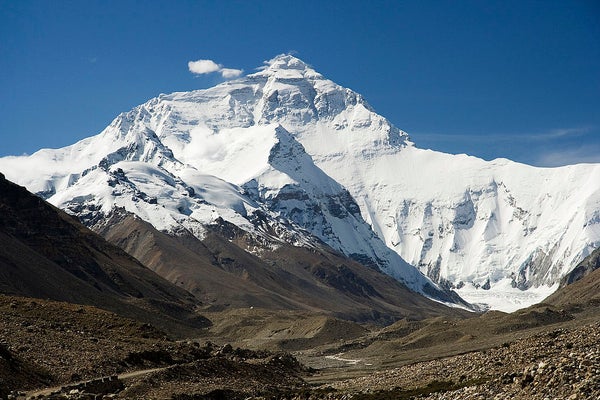
Cover Image: April 2008 Scientific American Magazine See Inside

Into Thin Air: Mountain Climbing Kills Brain Cells

The neural cost of high-altitude mountaineering


Share on Tumblr

All eight Aconcagua climbers showed cortical atrophy on MRI scans. Seven showed enlarged VR spaces, and four showed numerous subcortical lesions. Some needed no scan to tell them their brains had been injured. One climber suffered aphasia (problems with speech), from which he recovered six months later. Two complained of transient memory loss after returning, and three others struggled with bradypsychia (slowed mental function).

The body is remarkably resilient: Does the brain recover from these mountaineering wounds? To answer this question, the researchers reexamined the same climbers three years after the expedition, with no other high-altitude climbing intervening. In all cases, the damage was still apparent on the second set of scans.

Still, Aconcagua is one of the world’s highest mountains. Mont Blanc in the western Alps is less extreme. Its 4,810-meter summit is climbed every year by thousands of mountaineers who probably do not expect injury to their “second favorite organ,” to use Woody Allen’s nomenclature for the brain. Yet the researchers found that of seven climbers who reached Mont Blanc’s summit, two returned with enlarged VR spaces.

Because Why?
The study suggests that chronic exposure to high altitudes is not required to experience irreversible brain damage. In fact, amateurs seem to be at greater risk, because they are more likely to suffer acute mountain sickness or high-altitude cerebral edema. At the same time, the experience required to become well acclimated seems to take an ever increasing cumulative toll; compared with the amateurs, professional climbers in this study had ­greater cortical atrophy overall. They felt stronger but showed more brain damage.

Mountain climbing is growing in popularity—and with good reason. It can provide experiences of a lifetime; a communion with nature and with friends that feeds the soul; intense and enduring rewards surpassing those found within the bounds of routine; and adventure and challenge that build courage, stamina and fortitude. It also gets you into incomparable mountain wilderness—although that is vanishing. Many sense that the singular “it” residing in George Mallory’s pithy raison d’ascent—“Because it’s there!”—may soon be gone.

Some 5,000 climbers ascend Himalayan peaks every year. Thousands more climb peaks in the Alps and Andes. Many of these people spend liberally to mount expeditions or to be guided to the summit. But it is increasingly clear that these climbers are paying for the privilege with something more than hard-earned cash. They’re paying with brain tissue.


Buy This Issue
If your institution has site license access, enter here.

ABOUT THE AUTHOR(S)

R. DOUGLAS FIELDS is a developmental neurobiologist who writes frequently for Scientific American and Scientific American Mind and serves on Minds advisory board.


15 Comments

Add Comment
View
  1. 1. harriev 12:02 PM 4/3/08

    Most interesting when you consider a pressurized aircraft cabin is standardized at 8000 ft/2440 meters. You are taken there rather quickly.

    Reply | Report Abuse | Link to this
  2. 2. ibihse 02:29 PM 4/3/08

    What about lower oxygen levels due to say poorly ventilated work spaces do they also cause brain damage? Something like apoxia can be experienced sometimes in a big mall or large buildings with lot of people

    Reply | Report Abuse | Link to this
  3. 3. hwcorley 12:27 AM 4/8/08

    I recently talked with a flight attendant who worked for one of the large airlines. She said that she was retiring because the airline broke the 8000 foot requirement and now pressurized to an altitude of 15,000 feet to save money. She was afraid of having a stroke, something that she said that was becoming more and more frequent after flying.

    Reply | Report Abuse | Link to this
  4. 4. fdenbl 07:30 PM 4/8/08

    What about people who pactice breath-holding exercises like yoga-practioners and free-divers?

    Reply | Report Abuse | Link to this
  5. 5. R. Douglas Fields 10:43 PM 4/11/08

    The dangers of hypoxia in aviation are well known, and in many situations, they are not subtle. "In the event of a loss of normal cabin pressure, oxygen masks will appear from the overhead compartments… if you are traveling with small children, please apply your own mask first and then tend to those who may need help." In other words, you have about 25 seconds to don the mask before there is a good chance you will lose consciousness.
    People with respiratory or cardiac problems are at risk of suffering a dangerous drop in oxygen concentration in their blood (hypoxemia) in a commercial air plane. This is why doctors advise people with certain medical conditions not to fly, or to do so only while breathing supplemental oxygen. Still, a study in 2007 by Kelly, Hlavac, and Beckert, in Aviation Space Environ. Med, found that such passengers can still suffer significant hypoxic events, during light physical activity, such as going to the lavatory, resulting in shortness of breath and dizziness.
    Healthy individuals on a normal commercial flight will experience a significant decrease in blood oxygen (Kelly, P.T. et al., Aviat. Space Environ Med., 2007). The amount of oxygen in blood of a healthy individual inside a commercial aircraft cabin decreases in proportion to a person's age (Muhm, J.M. Aviat. Space. Environ. Med 2005). However, children also experience effects of hypoxia during airline travel. The oxygen content in their blood declines and their heart rate increases to 105 beats per min in a 3 hr flight. (No wonder they kick the back of your seat.) Further decreases in oxygen and further increases in heart rate to 108 beats per min develop after 7 hrs in flight (Lee, Yamamoto and Relles, Pediatr. Emerg. Care 2002). The same study found no "acclimatization" on long flights--as any climber could have told you, acclimatization takes longer than 7 hrs—rather, the decline in oxygen concentration in the children's blood worsens on longer flights. Another study found that airline passengers can take a lesson from climbers who will acclimatize by "climbing high on the mountain, then descending low to sleep". By taking shorter flights with substantial layovers (Fatemian, et al., Pflugers. Arch, 2001), report that the body does acclimatize to hypoxia of airline travel. An 8 hour lay-over is required, but fortunately the airlines are becoming very accommodating in providing this situation to their customers (often without request).
    Climbers suffer blood clots and strokes due to thickened blood. I guess everyone already knows about "deep vein thrombosis" on air flights, which can be fatal.
    HACE, the dangerous high altitude illness of mountain climbers can be suffered in the "friendly skys", too. Zrinzo et al report two interesting cases in J. Neurosurgery 2006. A 22-year old man returned from a flight with a headache, which quickly developed into severe neurological problems, a Glasgow Coma Score of 13 and he was placed on an artificial respirator. "A CT scan revealed almost complete obliteration of the ventricular system [in his brain]…" The fellow had been just fine before the flight. The second case concerned a 55 yr old woman who was well before hand, but she suffered such severe brain injury from the commercial airline flight that, unfortunately, she died 24 hours later. These two people had pre-existing conditions that were triggered by the high-altitude. The authors conclude "Air crews may wish to consider the use of supplemental oxygen if passengers exhibit excessive drowsiness or abnormal behavior, including conduct resembling alcohol intoxication, well-described presentation of acute altitude sickness." (Humm…I think I may have witnessed that.)
    The thing is, just like climbing, the standards for airline safety are focused on preventing sudden illness. No one gets a brain scan if they don't feel sick. Yet only 1 of 13 Everest climbers returned from the summit with a normal brain MRI. One difference, though: you can't change the air pressure on a mountain top, but inside an airplane, why are we flying around hypoxic at 8000 ft?
    Finally, a sad personal note. I wonderful colleague of mine died suddenly during a flight across the country. She was exuberantly healthy when I last saw her the day before she departed. I do hope people are keeping statistics on these things. -R. Douglas Fields

    Reply | Report Abuse | Link to this
  6. 6. fthomas08 06:12 PM 4/14/08

    Interesting article. I was an air rescue pilot flying mountain rescue in the Pacific Northwest for a number of years. It was not uncommon to go from sea level to 13,000 feet numerous times in one day. Our base was at sea level and missions often required extended time above 10,000 - 8 to 10 hours.

    I now have brain lesions and have asked the doctors if this experience may have either contributed or caused the damage. This article may in fact point to a contributing factor for me.

    Reply | Report Abuse | Link to this
  7. 7. Jano_M 09:20 PM 4/21/08

    I wonder if skiing can do a damage to your brain in the same way. I live in Houston, elevation 100 feet (30 meters) and whithin a day I may be on slopes in Taos, New Mexico, rapidly ascending and descending between 9,000 and 12,000 feet (3,000 to 4,000 meters). I remember that once I had to leave on the very first day of skiing because I got an intense headache (I seldom if ever get headaches), and the headache did not stop until I was back to 3,000 feet elevation (1,000 meters).
    Jano Mladonicky

    Reply | Report Abuse | Link to this
  8. 8. Four Corners 08:34 PM 7/11/08

    I have lived for years in Colorado between 7 and 8K feet, so commercial flights are not a big change for me. You would think, perhaps, that the answer is to live high! The high life, alas, has its problems too. Living at higher altitudes, it seems, tends to damage the lungs and then the heart. Strokes are more likely due to thicker blood. Maybe I'll move to Death Valley. Or maybe I'll stay here and die happy.

    Reply | Report Abuse | Link to this
  9. 9. lingenieuse in reply to ibihse 11:26 PM 9/16/08

    Is this type of hypoxia similar to post op patients who may have respiratory depression caused by opiods

    Reply | Report Abuse | Link to this
  10. 10. winterparkjack 10:35 AM 8/23/09

    I am an extremely fortumate climber. In 06 at 23,000' on Everest i has a stroke. I lost the use of my left hand and some cognative thinking. With the assistance of two Sherpas I was able to down climb teh Lhotse face back to C2. After 24 hours i still could not get dressed with out the help of a Sherpa. Today i am 57 and my memory is challanged. Is it from being high or age? This event was a surpise sine in 02 my high point was 28,000. i did have visual problems at that elevation and question if that was from optic nerve swelling. My vision did return to normal. The Poisk system did not fit my face and i climbed with out 100% use of o2. i am considering going high again an meeting with docs in Denver with high altitude expertise. jack@winterparkjack.com

    Reply | Report Abuse | Link to this
  11. 11. dmarski 04:10 PM 9/21/09

    Hi Dr. ! First of all, sorry my bad english... I read your article and I would to give my congratulations ! It's very clean and objective. In fact, I'm writing a text book (in portuguese) about High Altitude Climbing / Trekking, and I would to use your article (about brain damage) in my book. It's possible ? obviously I'll give all correct credits.

    Thanks in advance and best regards,

    Davi Marski - Brazil
    davi@marski.org

    PS: I had some brain damages a couple of years ago.. I was climbing near 20000 feet and I've pneumonia... after a lot of time in hypoxia, with no oxygen, when I returned to Brazil I felt in myself all of symptons described in your text ;-)

    Reply | Report Abuse | Link to this
  12. 12. girsa56 04:08 AM 5/28/12

    With the major portion of the western population making commercial flights very frequently, a lot of people out there must have some form of brain damage.

    The first time I made an international flight I felt like a significantly different person; I felt that my brain had organically changed. On the ground, for the remainder of the time after the flight kinetic movement appeared different, things seemed to move at an artificial pace. I felt physically ill, and became depressed. I couldn't concentrate as well as before. Overall I felt compromised, skewed. Now, after multiple international flights I feel like a zombie. Initially my IQ was 190, now it's in the low hundred something. I feel devastated, and no one had forewarned me about this; I had no idea that this might happen. After you do it (international flying) once you're drawn to do it again and again. Sometimes you have to for business reasons, but often suffering comes from the pursuit of happiness - seeing new places, experiencing new cultures. The greatest minds in the world today are reclusive. They sequester themselves in oxygen rich environs and think and analyze and calculate and contrive and maintain a superb noggin. Frequent flyers become kooky - digress into dinosaurs, e.i. - bird brains.

    It takes time to evaluate the repercussions of a given new technology and many more eons for our species to adjust to it, to evolve to handle it. Airplanes are detrimental to the ecosystem as well as the physiological intersystem. Most people don't climb mountains to get to the other side, but flight is a form of transportation that has become standard for traveling long distances and getting to the other side of oceans.

    Reply | Report Abuse | Link to this
  13. 13. saddlesablazin 06:32 PM 10/25/12

    Dr. Fields - I know this is an old article but I had some questions for you. Would treatment with supplementary oxygen and dex earlier than normal help mitigate these effects? So instead of say using oxygen in the death zone, one would start earlier say at 6k meters? Or perhaps a gammow bag? Thanks.

    Reply | Report Abuse | Link to this
  14. 14. Escience 06:18 PM 3/31/13

    ok, Mountain Climbers, It is the physical world that you live in, if you climb above 10,000 feet without oxygen you will get brain damage. It is science, no amount of conditioning that you do will prevent this. It is a fact. You cannot walk in space without a space suit. The human body does not posses the ability to go to these heights without oxygen and not get damaged. If you think otherwise you obviously didn't get science in school. You cannot overcome the physics of the situation and this should not be a shock to you that you will damage your brain.

    Reply | Report Abuse | Link to this
  15. 15. Four Corners in reply to winterparkjack 10:47 AM 4/1/13

    WinterPark Jack is not an extremely fortunate climber. Fortunate climbers do not suffer strokes. I'd guess his loss of cognitive ability may not be as temporary as he thinks, given his intent to head back up into the aethereal realms. But maybe the experience of extreme terrestrial elevations is worth the high risk. I, personally, understand that, but I really like being able to think, too. That may be further down Jack's list, especially now.

    Reply | Report Abuse | Link to this
Leave this field empty

Add a Comment

You must sign in or register as a ScientificAmerican.com member to submit a comment.
Click one of the buttons below to register using an existing Social Account.

More from Scientific American

Follow Us:

See what we're tweeting about

Scientific American MIND

More »

Free Newsletters


Get the best from Scientific American in your inbox

Solve Innovation Challenges

Powered By: Innocentive

  SA Digital

Latest from SA Blog Network

  SA Digital

Science Jobs of the Week

Email this Article

Into Thin Air: Mountain Climbing Kills Brain Cells: Scientific American Mind

X
Scientific American Mind

Subscribe Today

Save 66% off the cover price and get a free gift!

Learn More >>

X

Please Log In

Forgot: Password

X

Account Linking

Welcome, . Do you have an existing ScientificAmerican.com account?

Yes, please link my existing account with for quick, secure access.


Forgot Password?

No, I would like to create a new account with my profile information.

Create Account
X

Report Abuse

Are you sure?

X

Institutional Access

It has been identified that the institution you are trying to access this article from has institutional site license access to Scientific American on nature.com. To access this article in its entirety through site license access, click below.

Site license access
X

Error

X

Share this Article

X