
This answer comes from Douglas A. Johnson, a senior health physicist and laser safety officer for Texas A&M University. He is also adjunct lecturer in the nuclear engineering department. Doug is a member of the American National Standards Institute (ANSI) for laser safety standards. (The ANSI Z136 series is recognized by OSHA, and is the authoritative laser safety document in the United States.)
|
Image: CNN Interactive
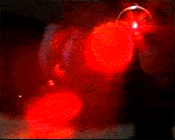
LASER POINTER shines into the camera lens. |
Eye damage from a pocket laser is unlikely, but could be possible under certain conditions. Red laser pointers that are "properly labeled" in the 3-5 mW range have not caused eye damage -- no retinal damage has been reported -- but there are very real concerns. One is pointers not manufactured to federal specifications. There are reports that green lasers, improperly imported to the U.S., far exceed safety limits.
On supporting science journalism
If you're enjoying this article, consider supporting our award-winning journalism by subscribing. By purchasing a subscription you are helping to ensure the future of impactful stories about the discoveries and ideas shaping our world today.
The Food and Drug Administration's Center for Devices and Radiological Health (FDA) is responsible for light products, including lasers. The FDA regulates the devices and how they are classified and labeled. A class 2 is "safer" than a class 3. Many laser pointers are in the range of 1 to 5 milliwatts (mW), a subclass of 3 called 3A. A close reading of exposure limits indicate that a 5 mW laser could cause eye damage.
Why even worry about 5 mW (5 thousandths of a watt), which is less than one percent of one percent of the power of a 60 Watt incandescent bulb? First, the numbers are used differently. Light bulb wattage measures the power it uses. It only converts about 10 percent of that electrical power into light. In a laser, the power is a measure of the light output.
Second, the light bulb gives light in all directions so you only see a small part of the whole. As you move away from the bulb, you see a quarter of the light every time the distance is doubled. A laser gives light in one small beam. If it gets into the eye, you receive all the laser's energy, not just a fraction.
Third, a light bulb gives off light at many different wavelengths (different photon energies). A laser is a pure tone, only one wavelength. The coherent light will be more damaging.
The common red laser pointer is a diode laser, really just a special type of transistor, or diode. Because of the unique features of laser light, it is magnified by 100,000 times as it passes through the eye. The light passes to the back part of the eye, the retina, which is where we perceive vision. The eye actually sees a small part of the electromagnetic spectrum that runs from short cosmic ray energies to long radiowaves. We see only from violet to red. Infrared (IR) and ultraviolet (UV) are just outside our ability to see. The eye is most sensitive to yellow-green light (550 nm). At the same power, 670 nm red light is only 3 percent as bright.
|
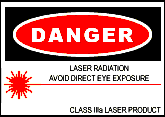
So for a pointer to be useful, the power must be high enough that the
government classifies it as a 3A and requires a DANGER label. |
When determining safety limits for the laser pointer or in other areas, a value must be chosen. Above a certain number is illegal or dangerous, below is OK. In real life many factors contribute to something becoming harmful. Look at traffic laws. Seventy miles per hour may be legal while 71 earns you a ticket, yet it is not really more dangerous. But 100 mph is much riskier, and 50 mph may be dangerous if the road is covered with ice. So with laser pointers, different conditions determine when retinal damage will actually occur.
In FDA-regulated pointers, the laser power limit is set at one-tenth the actual threshold of damage. If a person sees a bright light, they will automatically blink, on the average in less than 0.2 seconds. This is referred to as the blink reflex, and it is considered when the limit is assigned for how much power will cause an eye injury. By the way, you shouldn't force a stare at a laser, just like you shouldn't stare at the sun or any bright light source.
Possible more potentially damaging -- although not to the eye -- is that a regular pointer laser can overwhelm the eye with light, typically called flash blindness. If a person is walking a rocky path, operating machinery, a vehicle or aircraft, this temporary loss of vision could cause injury or disaster. At night, when the pupil is most open, the effects would bemagnified.
Some basic rules with lasers: Never direct a beam onto another person, especially their face. Do not shine it onto a mirror or mirror-like surface. Do not look at the beam through binoculars or a microscope.
One last thing -- some government entities have banned or restricted laser pointers. Some states and some cities have or have proposed age limits on the purchase or use of pointers. The United Kingdom bans the use of class 3A pointers. Laser pointers are high-tech tools, not toys.
