
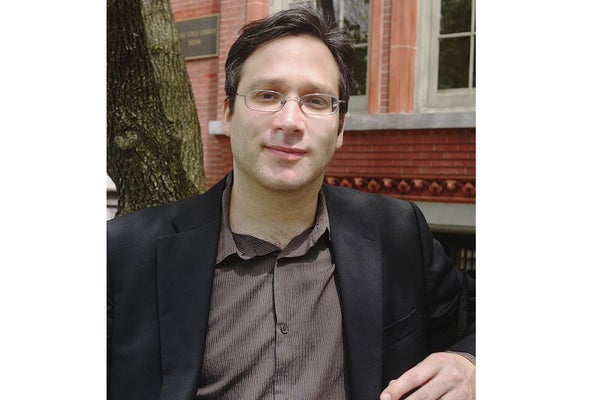
Gary Marcus suffers from what a friend jokingly describes as congenital arrhythmia—the inability, despite many hours of his youth spent practicing and taking lessons, to learn to play a musical instrument. A few years ago Marcus, a cognitive psychologist at New York University, decided at 38 to make one last try when he took up guitar. No surprise: He did not succeed in becoming the next Jimi Hendrix, but managed to acquire a modicum of skill—and went on to describe his experience in Guitar Zero: The New Musician and the Science of Learning.
Marcus says his personal experience jibes with current theories in neuroscience that adult brains are plastic—that, in practice, they can learn new skills that scientists once thought had to be acquired during the so-called critical period of prepubescent childhood. Marcus, though, calls into question the conventional wisdom that hard work alone suffices. Raw talent also plays a role, he says—a message that will come as a surprise to many people in an era that lauds "tiger moms" and 10,000-hour apprenticeships. Marcus spoke with Scientific American about music and the brain. Excerpts
[An edited transcript of the interview follows.]
On supporting science journalism
If you're enjoying this article, consider supporting our award-winning journalism by subscribing. By purchasing a subscription you are helping to ensure the future of impactful stories about the discoveries and ideas shaping our world today.
What is a critical period?
It's supposed to be a window in development that defines the only period in which a thing can be learned.
How has our understanding about this concept changed?
There used to be an idea that there were very strict critical periods, that you had to learn something by a certain time or you wouldn't be able to do it all. That's the dominant idea in the textbooks. What we've found in the last decade is that there's a gradual decline rather than an immediate falloff.
Neurons do become less flexible over time, which makes learning more difficult, but not all in one moment. There's sort of a gradual decline. The other thing that gets in the way relates to interferences with what's learned early in life. So if you try to learn a new language that works differently from your old language, you sometimes get stuck when using the new language. Another reason for difficulty learning new things is that adults are simply busy with other obligations.
There have always been late bloomers. Grandma Moses and Anton Bruckner, among others.
For sure! People like that presumably have considerable innate talent, to begin with, and then later in life develop a passion that consumes them and leads them to great heights.
How far do you think someone could go? Do you think it would ever be possible to start playing at 50 and become a concert violinist?
I think it's possible. It's less likely; starting earlier is better. If you're starting later in life, I think you need to temper your ambitions. But I don't think it's completely impossible if you devote yourself to something—especially if you have some raw talent.
How important is talent? The popular psychology literature has focused a lot of attention on the question of motivation—the idea that 10,000 hours of concerted practice can make you an expert in virtually any field.
The idea of 10,000 hours is a nice first approximation, but also very much oversold. It's weird the way some prominent people seem to have forgotten about genes. Some people become experts faster, some slower, and it also depends on what skill you are trying to acquire.
The fact that practice is important doesn't mean that talent isn't. Most of the top performers in any field are people who combine industry with predisposition. You can actually see that in the original studies that inspired the "10,000 hour" rule of thumb—some people who had practiced for 10 years were better than others that practiced for 20, and that's what talent is. There is also a huge literature in twin studies that highlights the contributions of genes and heritability. Without talent you can become very good, but to be truly outstanding, you probably need the right genes, too.
Are there any things that children do better than adults?
It's been hard to nail down what kids do better. If you pick up a developmental psychology journal at random, you're likely to find an article on some interesting psychological task, and you'll find that adults are better than older kids, and older kids are better than younger kids. Most things, adults are better at. That's one reason I think learning at any age has to do with motivation and time devoted to tasks. Kids are better at acquiring language than adults but we don't really have a good explanation for why.
Any ideas?
The one place kids seem to be at an advantage is low-level acoustic phenomena. That may be one reason they're better at accents and cultivating perfect pitch
That seems to be a fairly circumscribed set of things.
I think that's right. I think the former paradigm was that you really had to learn a skill early. And it's still probably better to learn it early. But you don't have to give up hope if you want to continue learning
What in the neuroscience literature demonstrates this plasticity?
Some of best studies are by Eric Knudsen at Stanford. He showed adult barn owls could do similar things as young owls if they learned them incrementally. Another study showed that the older owls could do just as well in a real-world context if there were predators around. The way I interpret these studies is that incentive and motivation are critical.
Are there a set of recommendations you could give to adults who want to take up an instrument?
Take it slow, give yourself space. Don't expect success overnight and invest a lot of time. People expect kids to take a long time but they sort of want adults to be done right away. Adults pick up a guitar and want to play their favorite song right away, and kids are more accepting that "I'm just playing these three notes today."
Do you think there's a role for new technologies like transcranial magnetic stimulation that may allow us to turn off interfering mental processes in the brain that prevent learning?
As we better understand the dynamics of memory we may be able to overcome some of the problem interferences place on learning new things—and that might come pharmacologically or using techniques like brain stimulation.
What were your original goals when you started to play guitar, and did you proceed further than expected?
My original goal was just be able to play at all. And then to make music for myself. I've succeeded more than I imagined, and it brings me enormous pleasure.

