
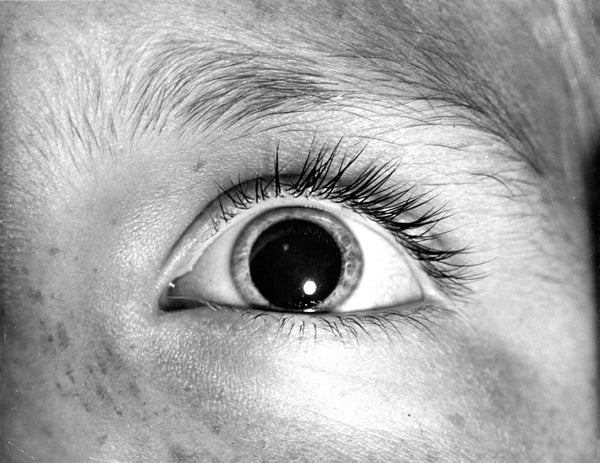
What do an orgasm, a multiplication problem and a photo of a dead body have in common? Each induces a slight, irrepressible expansion of the pupils in our eyes.
For more than a century scientists have known that our eyes' pupils respond to more than changes in light. They also betray mental and emotional commotion. In fact, pupil dilation correlates with arousal so consistently that researchers use pupil size, or pupillometry, to investigate a wide range of psychological phenomena. And they do this without knowing exactly why our eyes behave this way.
"Nobody really knows for sure what these changes do," says Stuart Steinhauer, director of the Biometrics Research Lab at the University of Pittsburgh School of Medicine. He views the dilations as a by-product of the nervous system processing important information.
On supporting science journalism
If you're enjoying this article, consider supporting our award-winning journalism by subscribing. By purchasing a subscription you are helping to ensure the future of impactful stories about the discoveries and ideas shaping our world today.
The visual cortex in the back of the brain assembles the actual images we see. But a different, older part of the nervous system—the autonomic—manages the continuous tuning of pupil size (along with other involuntary functions such as heart rate and perspiration). Specifically, it dictates the movement of the iris to regulate the amount of light that enters the eye, similar to a camera aperture. The iris is made of two types of muscle: a ring of sphincter muscles that encircle and constrict the pupil down to a couple of millimeters across to prevent too much light from entering; and a set of dilator muscles laid out like bicycle spokes that can expand the pupil up to eight millimeters—approximately the diameter of a chickpea—in low light.
Stimulation of the autonomic nervous system's sympathetic branch, known for triggering "fight or flight" responses when the body is under stress, induces pupil dilation. Whereas stimulation of the parasympathetic system, known for "rest and digest" functions, causes constriction. Inhibition of the latter system can therefore also cause dilation. The size of the pupils at any given time reflects the balance of these forces acting simultaneously.
The pupil response to cognitive and emotional events occurs on an even smaller scale than the light reflex, with changes generally less than half a millimeter. By recording subjects' eyes with infrared cameras and controlling factors that might affect pupil size, such as ambient brightness, color and distance, scientists can use pupil movements as a proxy for other processes, like mental strain.
Princeton University psychologist Daniel Kahneman showed several decades ago that pupil size increases in proportion to the difficulty of a task at hand. Calculate nine times 13 and your pupils will dilate slightly. Try 29 times 13 and they will widen further and remain dilated until you reach the answer or stop trying. Kahneman says in his book, Thinking Fast and Slow, that he could divine when someone gave up on a multiplication problem simply by watching for pupil contraction during the experiment.
"The pupils reflect the extent of mental effort in an incredibly precise way," Kahneman said in an interview with the German news magazine Der Spiegel, adding, "I have never done any work in which the measurement is so precise." When he instructed subjects to remember and recite a series of seven digits, their pupils grew steadily as the numbers were presented one by one and shrunk steadily as they unloaded the digits from memory.
Subsequent research found that the pupils of more intelligent people (as defined by their Scholastic Aptitude Test scores) dilated less in response to cognitive tasks compared with those of lower-scoring participants, indicating more efficient use of brainpower.
Scientists have since used pupillometry to assess everything from sleepiness, introversion and sexual interest to race bias, schizophrenia, moral judgment, autism and depression. And whereas they haven't been reading people's thoughts per se, they've come pretty close.
"Pupil dilation can betray an individual's decision before it is openly revealed," concluded a 2010 study led by Wolfgang Einhäuser-Treyer, a neurophysicist at Philipps University Marburg in Germany. Participants were told to press a button at any point during a 10-second interval, and their pupil sizes correlated with the timing of their decisions. Dilation began about one second before they pressed the button and peaked one to two seconds after.
But are pupils informative outside the lab? Can pupil size be used to "read" a person's intentions and feelings? According to Men's Health magazine a man can tell when it is "time to make your move" by watching his date's pupils, but some skepticism is warranted. "It is unclear to me to what extent this can be exploited in completely unrestrained settings," Einhäuser-Treyer wrote in an e-mail, pointing out that light conditions could easily interfere with amateur attempts at interpersonal pupillometry.
Other efforts to exploit pupil dilations for purposes beyond scientific research have failed. During the Cold War, Canadian government officials tried to develop a device they called the "fruit machine" to detect homosexuality among civil service employees by measuring how the pupils in their eyes responded to racy images of women and men. The machine, which never worked, was to aid the government's purge of gay men and lesbians from the civil service and thereby purportedly reduce vulnerability to Soviet blackmail.
A pupil test for sexual orientation remains as unlikely as it was in the 1960s. Researchers at Cornell University recently showed that sexual orientation correlated with pupil dilation to erotic videos of their preferred gender, but only on average and only for male subjects. Although pupillometry shows promise as a noninvasive measure of sexual response, they concluded, "not every participant’s sexual orientation was correctly classified" and "an observable amount of variability in pupil dilation was unrelated to the participant's sexual orientation."
Pupillometry also became popular in the advertising industry during the 1970s as a way to test consumers' responses to television commercials, says Jagdish Sheth, a marketing professor at Emory University. But the practice was eventually abandoned. "There was no scientific way to establish whether it measured interest or anxiety," Sheth says.
Despite these limitations, pupillometry is a valuable tool for psychological research, says Pittsburgh's Steinhauer, because our eyes are easy to observe as well as provide a sensitive indicator of cognitive, emotional and sensory response. "It's like having an electrode permanently implanted in the brain," he says. "And all we can do is watch the change at the end. We can't monitor everything going into it."
This article is provided by Scienceline, a project of New York University's Science, Health and Environmental Reporting Program.
