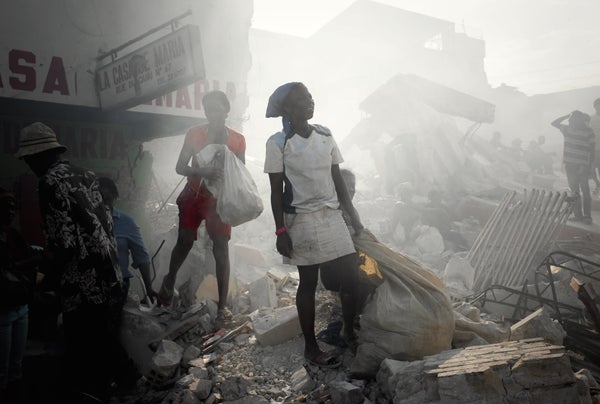
Whether last weekend's 6.5 magnitude temblor off the coast of Northern California's Humboldt County and the Haiti earthquake two days later are linked is yet to be determined. Seismologists now widely recognize that a large earthquake in one place can trigger another vulnerable fault thousands of miles away. Yeats calls it the "pulling the buttons off your shirt" idea—by releasing tension on one stressed point, the force shifts and can rupture another "locked" point. "You pull one button off," he said, "and the next one is ready to go." A paper published last October in Nature reported the large 2004 seismic events near the Indonesian island Sumatra that spurred the devastating Indian Ocean tsunami had an impact on the San Andreas fault in California.
In the meantime, seismologists will be watching Haiti closely, Blanpied noted in the USGS podcast, and they expect to see aftershocks for days to come. The largest aftershocks so far have already rumbled in at magnitude 5.9, and more could strike at any time.
And Yeats is not convinced that this latest quake at Haiti is the most severe one the Caribbean is likely to see in the near future. "It's not the big one," he said in a January 13 follow-up interview. He added he is now worried that a larger one could hit other cities in the region, such as Santa Domingo in the Dominican Republic or Kingston, Jamaica. The Caribbean Plate, he noted, is "just sort of sitting there while the North American and South American plates move" west (due to sea floor spreading in the Atlantic). But the next big earthquake could be years or decades from now, he said. "We're good at placing these forecasts and probabilistic terms on a geological time scale, but we're not good at putting it at scales that matter to you and me." And even probability forecasts can turn out to be wrong. The southern San Andreas was pegged as likely to produce a major earthquake before this one was, he noted.
Read more about these hazards in ScientificAmerican.com's In-Depth Report on earthquakes.


See what we're tweeting about


51 Comments
Add CommentOK,
Reply | Report Abuse | Link to thisIwas reading today that this was the big one. And this quake in fact did unlock the SAN ANDRAS FAULT. I feel we are having this told to all of us as yes?
Is this the one we have been waiting for here is CALIFORNIA? The big one?
Hi,
Reply | Report Abuse | Link to thisI have been reading that the quake that hit HAITI was the big quakTHAT WAS TO HIT CALIFORNIA.
We also were reading that, this quake took the pressure and unlocked the SAN ANDRES FAULT. So what is really the truth? My family and i are feel there is alot of double talk,going on.So what is what?
FAULT
First of all, an earthquake that might be expected for California cannot hit Haiti "instead". Earthquakes don't substitute for each other like that. California is 1000's of miles from Haiti, sits on a crustal plate boundary/fault zone that is similar in type to the boundary that slipped at Haiti, but involves different plates. There is no direct relationship between the two. Go here to see the maps of the fault zones/plate boundaries near Haiti:
Reply | Report Abuse | Link to thishttp://earthquake.usgs.gov/earthquakes/recenteqsww/Quakes/us2010rja6.php#summary.
However, can earth shaking from one earthquake have an "effect" on another, similarly "locked" boundary/fault zone 1000's of miles away? I'm a geologist, but not a seismologist, so can't really answer that, there are too many possible variables, but my short answer would be "unlikely".
Try an Ask a Geologist web source to answer that question: http://walrus.wr.usgs.gov/ask-a-geologist/ right now to try to find out.
Thank you for the reply,
Reply | Report Abuse | Link to thisI did want you to know that alot of us here did read from a geologist from ENGLAND said that, the Quake that hit HAITI did take off the stress from the FAULT here in ca, It was posted it the times on line here. Again thank you very much.
OK.............
Reply | Report Abuse | Link to thisNow you are talking BIBLE CRAP. Do you have proof the bible is not just a book someone named joe wrote?. I for one think this is it once we die thats it. Prove me wrong.
HERE WE GO.......
Reply | Report Abuse | Link to thisTime to take the bible out. The BEAST IS MAN KIND. I guess this site is for crazy people good by,delete.
Well, I'd want to see the data! If stress somewhere along the San Andreas fault system (it's not just a single fault) had been relieved as a result of the Haiti slip, that's a very fast return of data as the quake occurred only 24 hrs before this post! Still, even assuming that possibility, where is the data coming from? I did send an Ask-a-geologist query to the USGS site above; they're likely swamped but I hope for a reply.
Reply | Report Abuse | Link to thisFinally, I'd be very cautious with terminology! Relief of stress usually occurs because of actual motion along a fault (ie. earthquake) that in itself, may or may not "unlock" a locked segment. "Relief of stress" does not necessarily equate with "unlock" and the problem of terminology is that we can quantify "relief of stress" (ie.the data I'm looking for above) but an "unlocked" fault zone usually means an earthquake HAS occurred there! In other words, the quake "unlocks" the lock!
All that said, there was a 6+ relatively shallow earthquake near Eureka, CA a few days ago. I think that latitude is too far north to be part of the San Andreas system, but that ground motion may have produced some detectable (data?) relief of some stress in the San Andreas.
THANK YOU, You seem to be the only one here that makes sence. Nice to know a person with brains is on this site.
Reply | Report Abuse | Link to thishttp://scienceblogs.com/highlyallochthonous/2010/01/tectonics_of_the_haiti_earthqu.php
Reply | Report Abuse | Link to thisThis geologist's blog was listed as a resource on the London Times on line: scroll down the comments to #27 about the LACK of relationship between San Andreas and Haiti.
Haha, thank YOU! I teach college earth and space sciences and it's quite distressing to see how many people haven't been exposed to the basics of earth and space science. Crazy-making in fact! It doesn't take college; middle and high school-level courses would bring many people up to that basic level of earth/space science literacy!
Reply | Report Abuse | Link to thisIf any "unlocking" were to occur one needs to worry about two areas closer than California. There is the fault zone in the middle of the USA waiting to be sprung.
Reply | Report Abuse | Link to thisScarier still, the two volcanic island systems due east of Haiti across the Atlantic. There they are waiting for a massive flank slough-off (landslide) which could cause a tsunami to sweep back across the Atlantic. Though the Mid-Atlantic ridge lies between the quake and those islands, some vibrations are sure to pass through the ridge. What type of construction are the Azores? Could they be effected also?
Related quakes hypothesis: slight perturbations in the position of the earth due to magnetic interference from solar wind. Are these not the magnetic perturbartions ever so slightly affecting the precision of the GPS? What data is coming back from laser reflectors on the moon?
Reply | Report Abuse | Link to thisThis is a very complex subject, and when scientists and teachers try to simplify it enough to be understandable to the public, much seems to get lost in translation...but let me take a stab at it and the experts can then tell me where I have it wrong.
Reply | Report Abuse | Link to thisImagine the surface of the earth is like puzzle pieces from different puzzles, so they don't fit together perfectly (the reason they don't is because the inner earth is churning out new crust material--lava). It really helps to cut up some cardboard into irregular pieces so you can visualize. As the earth pushes out new crust, the pieces start sliding around. Sometimes, the puzzle pieces slide next to other pieces, shearing off edges (hold two irregular shaped puzzle pieces next to each other and slide one past the other--notice the edges softening?). Other times, one puzzle piece will slip under another piece, raising that piece up. That's how some (but not all) our mts got to be here. Sometimes as they move past each other, a puzzle piece sort of rumples up, like when you push a flexible throw rug--do that and you'll see folds that look like little mts and valleys, not unlike our Appalachian chain.
If you have all your cardboard puzzle pieces in a confined space (like a box), you'll notice that when you move one piece, it effects all the pieces it touches, but sometimes the piece that buckles up is not the one next to the one you moved, but over one. The earth's surface is also a confined space, so the same thing happens when pieces move. The Caribbean plate moved east, which affected the N. American plate, which affects the Pacific plate-- in many complex ways that are difficult to simplify with a puzzle piece metaphor, but basically it causes pressure build up in some places, pressure release in others, shearing in others. I believe the Haiti earthquake was the place of shearing.
Now the siesmologists can correct what I got wrong--but please try to correct using the puzzle piece analogy if possible. Thanks.
Professor Khandro, I an 51. I was an A student in school, and then majored in a science in college. My recollection is that plate tectonics were barely covered (if at all) in elementary through high school science classes. I don't know if that's because it was too new or because the teachers didn't understand it enough themselves to teach it. I learned what little I know from a single introductory geology class that was required by my life-science major, but certainly wasn't required for the large majority of students--and now, just this winter, the university decided to get rid of the ENTIRE geology dept. (If that disturbs you, please contact Michigan State University and complain.) So that means folks like you will have to be the johnny appleseeds of geology and plate tectonics to the rest of us....thanks for that!!!
Reply | Report Abuse | Link to thisThis is Scientific American, not Religious American--please take your religious views to a more appropriate forum.
Reply | Report Abuse | Link to thisThis is Scientific American, not Religious American, so please take the religious views and discussion to another, more appropriate forum.
Reply | Report Abuse | Link to thislimnologist said: "This is Scientific American, not Religious American, so please take the religious views and discussion to another, more appropriate forum. "
Reply | Report Abuse | Link to thisPlease say that to those that seem to equate religion to some of the wackos in here. There are many doomsday proclaimers here referring to Atlantis and ET that are getting lumped into the Religious bucket and that is not fair. I am religious but I also think that science (which means knowledge) is not incompatable with religion.
I do wish some of the vocal childish ones could be purged from this forum since they do not contribute anything significant and because there are in violation of the rules of posting to these forums.
Seems like the biggest lesson here is: Listen to Robert Yeats.
Reply | Report Abuse | Link to thisIf someone makes enough predictions,sooner or later they will get one right.Does that mean they saw the future?Or did they just gather enough data to make a good guess?
Reply | Report Abuse | Link to thisReply to: " magnetic interference from solar wind" etc; earth's magnetic field deflects the solar wind, and neither affects the motion of tectonic plates or earthquakes.
Reply | Report Abuse | Link to thisReply to: " volcanic island systems due east of Haiti across the Atlantic" etc; a tsunami at the Azores generated by an underwater "land"slide rather than a deep-focus earthquake and subsequent sea-floor drop, such as Sumatra 04 is not likely to reach the Americas.
Reply to:" Caribbean plate moved east, which affected the N. American plate, which affects the Pacific plate". Good analogies with puzzles etc, but up to a point! The box analogy is ok until we deal with the real scales and complexities of real crustal (actually lithospheric) plate motions on a planetary sphere. The stress released during one earthquake may be detectable at another nearby fault, but there is such a mass of crust between, for example, Haiti and California, that no residual seismic energy is likely to reach that far, even if it was direct, ie from east to west. But you are also suggesting transferring energy from the Carib plate to the North Am plate to the Pacific plate, and that stretches the analogy too far. Finally, this earthquake was a strike-slip (side to side) motion on a transform boundary/fault between Carib and North Am plates, but I believe your imagery would have the Carib plate moving perpendicular to the North Am plate, like in the arc of volcanic islands further east...that's where the North Am plate is descending beneath the Carib, producing those volcanic islands. I may be misinterpreting that part of your question, but either way, the effect on the huge mass of the North Am plate, whichever the type of quake motion is minuscule.
You're welcome! Plate tectonics didn't emerge as an overarching earth history & processes theory until 1965, and it was a near-overnight success because it answered so many tough questions, though it took some time to get to the schools and colleges. The details can be complex, but it's not a difficult picture overall! You should see a class of middle-school kids pushing pieces of cardboard around a table top to simulate plate motions (and they GET IT that there are only 3 possible boundary types!) If MSU has dropped the Geo dept, boo to them, bad idea! Especially as we ALL need to know the basics of earth history & processes more than ever, as there are so many of us conducting so many uncontrolled experiments on planet earth & climate & biosphere, etcetc. Sorry, don't want to get off track...Haiti is sad enough.
Reply | Report Abuse | Link to thisIt's quite possible to predict THAT an earthquake will occur on most plate boundaries or faults, they are in motion after all; better data on the history and dynamics of a certain area of a certain fault will narrow that probability down to something like, "very likely in the near or far future within some portion of a fault", but even that strong a predictive statement has to be said with a great deal of caution! Seismologists are not "seeing the future", they are gathering historical and current data and evidence, and they are not guessing. Seismologists did talk to the gov't of Haiti (CBC broadcast today) in 08 warning them about the potential failure of a fault that had not moved in some time; but given that information a year ago, what would you have done in or for a city of 2 million with the kind of infrastructure and poverty there? It was a perfect storm of perfectly horrific proportions and no science cannot assuage the grief there, or here. Can we learn from these events? If nothing else, we have to understand that THEY HAPPEN, that the earth's surface is not static or still, it moves, and we are in the way, not the other way around.
Reply | Report Abuse | Link to thishttp://www.scientificamerican.com/article.cfm?id=volcano-monitoring-jindal
Reply | Report Abuse | Link to thisCheck this out about volcanic monitoring, and consider that seismologists are monitoring earthquake zones in similar ways for similar purposes...awareness and preparedness. But an incipient eruption can be detected with more short-term advance warning than an earthquake, so earthquake prediction is nearly impossible.
Mr Hanlon; I erred here, and a friend sent me this: http://www.es.ucsc.edu/~ward/papers/La_Palma_grl.pdf.
Reply | Report Abuse | Link to thisBut there are still some problems: first of all, a tsunami itself would not affect the seafloor (ie Mid Atlantic Ridge) away from the coastlines (ask me later about "shallow water waves" if you want, but don't use Wikipedia!).
The collapse of the volcano would certainly affect human habitation in the area, depending on the kind of eruption and seismicity. Same for the local seafloor; but again, the Atlantic seafloor is too wide to transmit seismic energy to such a degree that there would be damage on the other side, though N Am seismometers would certainly register it. I think that's what you're suggesting, not sure, if I have it wrong it's late, sorry!
So often in a moment of crisis it makes everyone jittery and concerned about their "own faults" and in consideration of 85% of California's who can and fail to prepare for their own earthquake it seems we should be more understanding of those who have weathered many storms and are horribly poor and unable to prepare for such an event. Little could be done in many respects, thus we should simply support them and for those who wish to become acquainted with "their faults," perhaps surfing the Net might enlighten them because it is packed wall to wall with data on every fault in the world. However, as to moving toward preparedness, we should recall they have e-mail to send, a TV program to watch and everything and anything is more important. And after a decade in working for them to offer more safety I can't go house to house, so as to what lies ahead, only willingness on their behalf to address their future needs is missing. I suggest they hop down to the store and pick up an earthquake safety whistle and the rest of their needs immediately because in less than 48 hours it won't matter to them anymore.
Reply | Report Abuse | Link to thisWhat we must understand, is that all the tectonic plates are connected, a shift in one, affects all of them, this must be taken as a warning, for all those that live along fault lines. A week before, the 6.5 magnitude temblor off the coast of Northern California's Humboldt County sliped, a week later Haiti. This is what I would call, The cascading effect. Once we begin to understand this, we can at least warn those, who live in the vicinity of fault lines. And time and time again, we see this, yet no one focuses on this relation ! This must be a new point of study, we must open our eye's.
Reply | Report Abuse | Link to thisCorrection, these two events were only 24 hours apart !
Reply | Report Abuse | Link to thisAnd when seismologist make these predictions, it seems that no one takes them seriously, there not selling snake oil !
Reply | Report Abuse | Link to thisi HAD A PREMONITION OF A MASSIVE QUAKE THAT WILL DEVASTATE SEOUL KOREA...
Reply | Report Abuse | Link to thisI have had a recent premonition..where SEOUL KOREA IS TO BE DEVASTATED BY A MASSIVE QUAKE ALSO..
Reply | Report Abuse | Link to thisHello Tabu,
Reply | Report Abuse | Link to thisOne event does not affect "all faults", but some yes and the theory of p-103 wave triggering supports the M 6.5 on the North Coast of CA at 43 degrees from Haiti as being the trigger for that event. But it only works when faults are near failure so it would have gone on it's own in the relative near future. However, in the realm of prediction few if any believe anyone no matter the means of issuing predictions, so until we "put some faith in it" we should not anticipate success. But in regard to Haiti perhaps we should imagine that some who received a personal warning may have left, because they are the only one's who could have been saved. There were to many complications to do much of anything with this situation.
But this is not really true, thus you won't find the seismologists focusing on it! A movement on the San Andreas fault, for example, is going to have no effect whatsoever across the Pacific to the east side of the European plate, or to movements between the African and European plates! Please do some fact-finding by going to a reputable (ie scientific) source, such as US Geological Survey (USGS)
Reply | Report Abuse | Link to thisReply to: " magnetic interference from solar wind" etc; earth's magnetic field deflects the solar wind, and neither affects the motion of tectonic plates or earthquakes.
Reply | Report Abuse | Link to thisReply to: " volcanic island systems due east of Haiti across the Atlantic" etc; a tsunami at the Azores generated by an underwater "land"slide rather than a deep-focus earthquake and subsequent sea-floor drop, such as Sumatra 04 is not likely to reach the Americas.
Reply to:" Caribbean plate moved east, which affected the N. American plate, which affects the Pacific plate". Good analogies with puzzles etc, but up to a point! The box analogy is ok until we deal with the real scales and complexities of real crustal (actually lithospheric) plate motions on a planetary sphere. The stress released during one earthquake may be detectable at another nearby fault, but there is such a mass of crust between, for example, Haiti and California, that no residual seismic energy is likely to reach that far, even if it was direct, ie from east to west. But you are also suggesting transferring energy from the Carib plate to the North Am plate to the Pacific plate, and that stretches the analogy too far. Finally, this earthquake was a strike-slip (side to side) motion on a transform boundary/fault between Carib and North Am plates, but I believe your imagery would have the Carib plate moving perpendicular to the North Am plate, like in the arc of volcanic islands further east...that's where the North Am plate is descending beneath the Carib, producing those volcanic islands. I may be misinterpreting that part of your question, but either way, the effect on the huge mass of the North Am plate, whichever the type of quake motion is minuscule.
Reply to: " magnetic interference from solar wind" etc; earth's magnetic field deflects the solar wind, and neither affects the motion of tectonic plates or earthquakes.
Reply | Report Abuse | Link to thisReply to: " volcanic island systems due east of Haiti across the Atlantic" etc; a tsunami at the Azores generated by an underwater "land"slide rather than a deep-focus earthquake and subsequent sea-floor drop, such as Sumatra 04 is not likely to reach the Americas.
Reply to:" Caribbean plate moved east, which affected the N. American plate, which affects the Pacific plate". Good analogies with puzzles etc, but up to a point! The box analogy is ok until we deal with the real scales and complexities of real crustal (actually lithospheric) plate motions on a planetary sphere. The stress released during one earthquake may be detectable at another nearby fault, but there is such a mass of crust between, for example, Haiti and California, that no residual seismic energy is likely to reach that far, even if it was direct, ie from east to west. But you are also suggesting transferring energy from the Carib plate to the North Am plate to the Pacific plate, and that stretches the analogy too far. Finally, this earthquake was a strike-slip (side to side) motion on a transform boundary/fault between Carib and North Am plates, but I believe your imagery would have the Carib plate moving perpendicular to the North Am plate, like in the arc of volcanic islands further east...that's where the North Am plate is descending beneath the Carib, producing those volcanic islands. I may be misinterpreting that part of your question, but either way, the effect on the huge mass of the North Am plate, whichever the type of quake motion is minuscule.
How little you know! I've spent 11 years of my life researching the issue of earthquake prediction and I would say I'm highly informed and because you have "your opinion" does not mean it is "the correct opinion", but just one persons opinion. And as you know far field triggering is yet in it's infancy in seismology; though it is gaining ground after a decade. But few understand how it works because they've never taken a serious look and actually worked with it. And I would venture to say, you have not and therefore your opinion is of little value.
Reply | Report Abuse | Link to thisTo Khandro
Reply | Report Abuse | Link to thisWe are staying inland in South Africa,I've never experienced an earthquake. Can earthquakes happen every where in the world or only certain places?
I am staying inland in South Africa.I've luckily never experienced an earthquake.
Reply | Report Abuse | Link to thisCan earthquakes happen anywhere or only certain places in the world?
As a long time reader of SciAm, it's disappointing that the only story on the magazine's homepage is an "I told you so" regarding the Haiti earth quake. There are plenty of medical/public health/science stories out there that also put humanitarian attention on this disaster.
Reply | Report Abuse | Link to thisPlease ignore my previous comment. It was a couple days old and I hit send by accident. I see SciAm has added several stories on Haiti--good ones, as I'd expect to see.
Reply | Report Abuse | Link to thisI wanted to offer a comment in regard to persons who have posted here in mentioning religion and rather than ignore their contributions, I thought I might offer the link of Dr. Amos Nur of Stanford and his work in multi-disiplinary research projects in the Middle East for those who might have an interest. He has appeared on PBS several times and noted how through their research what was said in the Bible has been confirmed and it's rather fascinating.
Reply | Report Abuse | Link to thishttp://srb.stanford.edu/nur/
I'm not a seismologist, nor do I play one on tv. But, with regard to Southern California:
Reply | Report Abuse | Link to thisGet out! Get out now! Before it's too late.
You've been WARNED.
In reply to your comment where you said the other guy is talking Bible crap, I'm not sure where that came from, but I think the guy (stew6302) was correct when he said the "big one" is the meteor/tsunami that will determined to occur in just under two decades, and if it is confirmed, then it will actually occur in just two and a half decades from now. However I also have no idea what he's talking about when he says atlantis and all that stuff. If the meteor does hit Earth, then it will land somewhere west of California in the Pacific Ocean and send devastating tsunamis towards North America.
Reply | Report Abuse | Link to thisHello! I don't know the seismic picture for South Africa, and can't do the research just now, so I'd suggest directing your question to experts in South Africa. Globally, earthquakes do occur, if rarely, in random places not associated with plate boundaries. But where there is a plate boundary, there are earthquakes.
Reply | Report Abuse | Link to thisWas there earth geo-sensing devices placed in Haiti before January 12th?
Reply | Report Abuse | Link to thisWe have been lecturing on ProyectoKarina for about two years now ever since the Pisco Earthquake.
Reply | Report Abuse | Link to thisOur project is utterly interdisciplinary and uses an iteration
of the neural network concept into a large learning system
we feel that this type of system could have saved lives in haiti
we are currently planning to set up a skeletal system of this
nature in Lima as soon as possible in view of a two year danger horizon that at least one expert sees in Lima
for details e mail me at pblass@live.com I am writing a book
about such matters
We have written a book and a number of lecture notes
Reply | Report Abuse | Link to thison a new system for earthquake prediction
called proyecto Karina---please e mail me for details
pblass@live.com
Dummies! A and lot are TWO words. There is no such word as ALOT. Are you confusing it with the word ALLOT? Well, look that up. If you don't own a dictionary, just google the word for a definition.
Reply | Report Abuse | Link to thisPatrick Charles, a Geologist and former Professor at the Geological Institute of Havana, Cuba said that a major earthquake will strike Port-au-Prince with a vengeance .
Reply | Report Abuse | Link to thisIt also believed that earthquake and wheather modification could be man made refers to the followings links:
http://newdawnmagazine.com.au/Articles/Earthquakes_Natural_or_Man_Made.html
http://www.whale.to/b/jeffrey1.html
http://www.haarp.net/
http://www.mathaba.net/0_index.shtml?x=592591
http://www.goodnewsaboutgod.com/studies/political/weather_control/mancontrol_weather.htm
http://www.staticbrain.com/archive/haarp-weather-modification-for-weather-warfare/
http://www.rense.com/political/weapons/earthqk.htm
http://earthchangescentral.com/eccarticles/WeatherManipulation_Fact_or_Fantasy01.htm
l
Geologist and former Professor at the Geological Institute of Havana, Cuba, Patrick Charles pointed out in 2008 that a major earthquake will strike Port-au-Prince with a devastating blow.
Reply | Report Abuse | Link to thisThere are speculation that certain countries have the technology to cause tsunami and earthquakes .See following links:
http://newdawnmagazine.com.au/Articles/Earthquakes_Natural_or_Man_Made.html
http://www.whale.to/b/jeffrey1.html
http://www.haarp.net/
http://www.mathaba.net/0_index.shtml?x=592591
http://www.goodnewsaboutgod.com/studies/political/weather_control/mancontrol_weather.htm
http://www.staticbrain.com/archive/haarp-weather-modification-for-weather-warfare/
http://www.rense.com/political/weapons/earthqk.htm
http://earthchangescentral.com/eccarticles/WeatherManipulation_Fact_or_Fantasy01.htm
l
i have to go with.....the beast. the most original and intelligent theory yet. way to go. you had me at Atlantis. i often jump from Atlantis to the Bible too. it's inevitable.
Reply | Report Abuse | Link to thisp.s.Seriously. Khandro, thanks for the links.
I always uncovered earthquakes ahead of time:
Reply | Report Abuse | Link to thishttp://www.youtube.com/watch?v=jm_cTpcSdbI