
Bioinformatician Bernhard Haubold of the Max Planck Institute of Chemical Ecology provides this explanation:

Image: COURTESY OF BERNHARD HAUBOLD |
Humans, chimpanzees, gorillas, orangutans and their extinct ancestors form a family of organisms known as the Hominidae. Researchers generally agree that among the living animals in this group, humans are most closely related to chimpanzees, judging from comparisons of anatomy and genetics.
On supporting science journalism
If you're enjoying this article, consider supporting our award-winning journalism by subscribing. By purchasing a subscription you are helping to ensure the future of impactful stories about the discoveries and ideas shaping our world today.
If life is the result of "descent with modification," as Charles Darwin put it, we can try to represent its history as a kind of family tree derived from these morphological and genetic characteristics. The tips of such a tree show organisms that are alive today. The nodes of the tree denote the common ancestors of all the tips connected to that node. Biologists refer to such nodes as the last common ancestor of a group of organisms, and all tips that connect to a particular node form a clade. In the diagram of the Hominidae at right, the clade designated by node 2 includes gorillas, humans and chimps. Within that clade the animal with which humans share the most recent common ancestor is the chimpanzee.
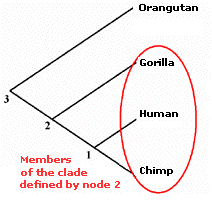
Source: COURTESY OF BERNHARD HAUBOLD FAMILY TREE of the Hominidae shows that chimpanzees are our closest living relatives. |
There are two major classes of evidence that allow us to estimate how old a particular clade is: fossil data and comparative data from living organisms. Fossils are conceptually easy to interpret. Once the age of the fossil is determined (using radiocarbon or thermoluminescence dating techniques, for example), we then know that an ancestor of the organism in question existed at least that long ago. There are, however, few good fossils available compared with the vast biodiversity around us. Thus, researchers also consider comparative data. We all know that siblings are more similar to each other than are cousins, which reflects the fact that siblings have a more recent common ancestor (parents) than do cousins (grandparents). Analogously, the greater similarity between humans and chimps than between humans and plants is taken as evidence that the last common ancestor of humans and chimps is far more recent than the last common ancestor of humans and plants. Similarity, in this context, refers to morphological features such as eyes and skeletal structure.
One problem with morphological data is that it is sometimes difficult to interpret. For example, ascertaining which similarities resulted from common ancestry and which resulted from convergent evolution can, on occasion, prove tricky. Furthermore, it is almost impossible to obtain time estimates from these data. So despite analyses of anatomy, the evolutionary relationships among many groups of organisms remained unclear due to lack of suitable data.
This changed in the 1950s and 1960s when protein sequence data and DNA sequence data, respectively, became available. The sequences of a protein (say, hemoglobin) from two organisms can be compared and the number of positions where the two sequences differ counted. It was soon learned from such studies that for a given protein, the number of amino acid substitutions per year could--as a first approximation--be treated as constant. This discovery became known as the "molecular clock." If the clock is calibrated using fossil data or data on continental drift, then the ages of various groups of organisms can theoretically be calculated based on comparisons of their sequences.
Using such reasoning, it has been estimated that the last common ancestor of humans and chimpanzees (with whom we share 99 percent of our genes) lived five million years ago. Going back a little farther, the Hominidae clade is 13 million years old. If we continue farther back in time, we find that placental mammals are between 60 and 80 million years old and that the oldest four-limbed animal, or tetrapod, lived between 300 and 350 million years ago and the earliest chordates (animals with a notochord) appeared about 990 million years ago. Humans belong to each of these successively broader groups.
How far back can we go in this way? If we try to trace all life on our planet, we are constrained by the earth's age of 4.5 billion years. The oldest bacteria-like fossils are 3.5 billion years old, so this is the upper estimate for the age of life on the earth. The question is whether at some point before this date a last common ancestor for all forms of life, a "universal ancestor," existed. Over the past 30 years the underlying biochemical unity of all plants, animals and microbes has become increasingly apparent. All organisms share a similar genetic machinery and certain biochemical motifs related to metabolism. It is therefore very likely that there once existed a universal ancestor and, in this sense, all things alive are related to each other. It took more than two billion years for this earliest form of life to evolve into the first eukaryotic cell. This gave rise to the last common ancestor of plants, fungi and animals, which lived some 1.6 billion years ago.
The controversies surrounding biological evolution today reflect the fact that biologists were late in accepting evolutionary thinking. One reason for this is that significant modifications of living things are difficult to observe during a lifetime. Darwin never saw evolution taking place in nature and had to rely on evidence from fossils, as well as plant and animal breeding. His idea that the differences observed within a species are transformed in time into differences between species remained the most plausible theory of biodiversity in his time, but there was an awkward lack of direct observations of this process. Today this situation has changed. There are now a number of very striking accounts of evolution in nature, including exceptional work on the finches of the Galapagos Islands--the same animals that first inspired Darwin's work.
FURTHER READING:
The Beak of the Finch : A Story of Evolution in Our Time (Vintage Books, 1995)
