
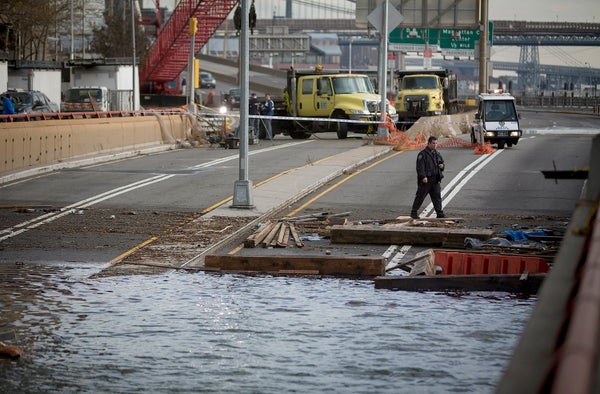
GOWANUS, BROOKLYN—Superstorm Sandy's surge halted a little more than a block from my home, mirroring almost precisely the border of two different nearby flood zones on New York City's evacuation map. Homes, stores and warehouses closer to the Gowanus Canal at the westernmost end of Long Island—one of the most polluted sites in the U.S. as a result of an industrial legacy paired with sewage overflows in heavy rains, qualifying its bottom muck, waters and adjacent land for Superfund designation—saw basements and lower floors turned into stinking pools. The foul waters remained trapped by sandbags and other would-be antiflood precautions even the day after.
Throughout the New York metropolitan region and farther south in New Jersey, Sandy's hurricane-force winds brought down trees and power lines, causing an estimated $20 billion or more in damage. But the more than 74-mile-per-hour winds’ most enduring impact may have been from the massive swell of water they pushed atop land, obliterating beaches, drowning boardwalks, filling subway tunnels, destroying electrical infrastructure and wrecking lives.
Although it may be hard to believe, the event could have been even more damaging. "This was not the worst case," says storm surge specialist Jamie Rhome of the National Hurricane Center (NHC) at the U.S. National Oceanic and Atmospheric Administration. "A worst case would have been a stronger storm with the exact same track" that also came ashore at the same time as high tide. "That would have produced even more flooding," he adds.
On supporting science journalism
If you're enjoying this article, consider supporting our award-winning journalism by subscribing. By purchasing a subscription you are helping to ensure the future of impactful stories about the discoveries and ideas shaping our world today.
Yet, Superstorm Sandy's massive flooding is already unprecedented in recent decades. According to experts, however, it is only going to become more likely in coming decades, thanks to a combination of local geography, vulnerable coastal development and already-happening sea-level rise as a result of climate change. In the future, it will not take a frankenstorm like Sandy to inundate the region. Given that reality, the best defense may be to accept the inevitability of flooding and prepare infrastructure to withstand it, as is common in other regions more historically prone to storm surge flooding.
Not the first flood
The New York metropolitan area has, of course, suffered damaging storm surges throughout its history, although most were not as severe. For example, in 1960 Hurricane Donna stormed up the entire Eastern seaboard as a Category 2 tropical cyclone, boasting winds above 105 mph. Even though Donna had mitigating factors—it arrived at low tide and that storm (like last year’s Category 1 Hurricane Irene) traveled parallel to the coast rather than striking it head on—those winds pushed enough seawater into New York Harbor to cause a storm surge of more than six feet that similarly inundated parts of Manhattan.
In contrast, Sandy's larger surge is a result of the post-tropical cyclone's track, which saw the superstorm turn in to and then smash the coast of New Jersey, pushing a punishing wall of water in front of it into the Garden State’s coast as well as north into New York Harbor.
How do winds create a storm surge? In a tropical cyclone, air pressure is highest at the edges and low at the center. The air flows, at speeds above 74 mph, to fill that low-pressure area. In addition, the low pressure itself helps raise the sea's level beneath it, heightening the surge where the center of the storm makes landfall. Wave action itself can also enhance the effect, adding even more height to a storm surge as the waves pile into shore one on top of the next.
There is another important factor in the surge’s ultimate impact: coastal geography. "Storm surge is like real estate: location, location, location," Rhome says. In New York Harbor, the surrounding coastline acted as a funnel, channeling more and more of the incoming water into a narrower and narrower region. When a massive volume of water gets confined in that way, "it has no choice but to spill out and flood the surrounding land," Rhome notes. And, in places where the shore gently slopes out to sea, rather than precipitously drops off, an even larger storm surge results. New York City, with some 305 square miles of area, is particularly vulnerable to storm surge because of its more than 500 miles of coastline feature small bays, inlets and other potential funnels that can channel rising seawaters far inland.
The art of surge prediction
An important part of coping with such floodwaters is knowing how likely they are to hit, and how high they will be when they do come ashore. The National Hurricane Center's Storm Surge Unit bases its projections on the amount of water that will physically move atop land, called the "wet" line above sea level. Of course, predictions can never be perfect, Rhome (who is also a former hurricane specialist) notes of his unit, as the parameters that influence storm surge change hour to hour: precise location of landfall, strength of the winds, the angle of approach to the coast, how fast the storm is moving, how big it is, among others.
In fact, the NHC is one of the few such facilities in the world that offers multiple predictions of storm surge to help emergency planners cope. It starts with a computer model that takes into account data on the coast itself, including its contours, its depths, natural structures and man-made ones, and where the rivers enter and other factors. The computer then simulates storm surge based on input wind speeds, the speed of the storm itself and its total size, which are in turn based on the best projection of the NHC's human hurricane specialists. That single best guess is where most storm surge predictions end.
But even the best meteorologists with the best tools and the most experience cannot precisely predict any of those things, so the NHC runs the model multiple times with multiple variations of the storm inputs, such as wind speed or the total area of the storm. The level of a storm surge can change quickly with relatively small fluctuations in such factors. "It's very tricky," Rhome says. "Just a subtle change in the meteorology makes a huge difference."
For example, Hurricane Ivan in 2004 shifted its track, and its eye passed to the east of Mobile Bay rather than just to the west, where it had been expected based on forecasts. This directional change of less than 30 miles cut the actual storm surge by 10 feet, according to Rhome, pushing water out of the bay rather than into it. "Anyone who thinks they can predict landfall within 30 miles two to three days in advance doesn't know what they're doing," Rhome says.
Or take Sandy, which remained only the weakest level of hurricane, boasting sustained winds above 74 mph, despite having the lowest pressure ever recorded for any storm north of North Carolina—943 millibars just prior to landfall in New Jersey. Instead Superstorm Sandy's sheer size—with winds spread over a massive area of more than 1,000 square miles—generated the enormous surge of ocean waters. To appreciate the difference, think of a smaller storm as like running a finger through a bathtub—it won’t disturb much water—whereas a larger storm is like moving a whole arm through—you can make a significant swell.
In fact, Sandy's sprawling wind field is still pushing water above normal levels, even days after the center of the storm made landfall.
The cost of creating better protection
Low-lying New York City, with all of its coastal development, is particularly vulnerable to those higher waters. In areas such as the Gulf Coast and eastern Florida that see more hurricane activity, flood walls, levees and even engineered wetlands help lessen storm impacts. There are proposals, for instance, to extend a dike around Galveston, Tex., to protect it from storms similar in magnitude to 2008's Hurricane Ike.
To fully protect Manhattan would require a flood wall that is tall, long and continuous, wrapping around the island on both sides, similar to the 16-kilometer-long, five-meter-high and nearly five-meter-thick (at its base) sea wall along the Galveston shorefront. In the aftermath of Hurricane Donna in 1960, such a sea wall actually was proposed for Coney Island—but never built.
That is not to say such a wall would be a cure-all. Even if such a defense were built, the wall could also function to keep water in as well as out during severe flooding, much as happened in Galveston after Hurricane Ike. Such an approach isn’t always popular for other reasons as well: it blocks ocean views. "You also have an aesthetic issue," notes geomorphologist Chris Houser of Texas A&M University.
In theory, nature’s protections—wetlands, forests and barrier islands—could blunt storm impacts. "It's like a sea wall but it's made of sand," Houser says of barrier islands and their dunes, his primary area of research. The way that such barrier islands jut out—their convex shape—acts as a break to storm surges, compared to the funneling effect of concave-shaped bays and inlets, such as those in New York Harbor. But there isn’t sufficient available real estate around New York City to restore natural defenses such as wetlands or forests.
Blocking the effects of future superstorms will require bigger-than-natural barrier islands, in any case. In Louisiana, for example, manmade barriers will be three times higher than naturally occurring islands to shield coastal property and oil and gas infrastructure. A similarly outsized manmade barrier island would need to be raised in New York Harbor.
That leaves possibly too-expensive alternatives, such as tidal barriers like the one in the Thames River to protect London or a massive system of levees, dikes and other water control structures, such as those in the Netherlands. But the Thames Barrier cost nearly $2 billion to build and some $10 million per year to operate. That kind of tidal barrier has been a dream of some New York City planners for at least a century, or more.
Adapting to climate change
As if all that weren’t enough to manage, there's the additional trial of coping with sea-level rise. Two major factors are at work in New York City. First, land rebounding farther north after the removal of the massive weight of Ice Age glaciers has caused the island of Manhattan itself to slowly sink. Second, at the same time, the oceans have risen by nearly three inches locally over the course of the 20th century, according to the U.S. Geological Survey. These changes will make creating long-lasting protection from storm surges even more challenging. "You're starting from a new zero," Rhome says. "The exact same storm is going to produce an even worse storm surge in a future time."
The Netherlands, for example, is planning for nearly a meter of sea level rise by the end of the century, though that is at the high end of scientific projections. The Dutch plan is to both strengthen and heighten existing dikes and levees but also, as has been the practice for hundreds of years, to prepare certain areas as fail-safe flood zones, ready to be inundated when necessary.
In the future, preparing for such inevitable flooding will be as vital—if not more important—than attempting to prevent such events. "The chance that Manhattan will get another storm surge is higher and higher," Houser notes. Infrastructure—particularly that located below ground, such as subway tunnels and vital equipment—must be made flood ready. Basement generators or fuel tanks can be relocated, for example, and pumps in tunnels can be protected so they can later do their job of water removal.
That will help New York City face future superstorms, which could produce more flooding than Sandy. Fortunately for the metropolitan region, this post-tropical cyclone didn't dump rain on the same places where it dumped seawater. Where rainfall and storm surge combine, flooding will be even worse. "Some storms see a tremendous surge at the mouth of a river at the same time as a lot of rain," Rhome explains. "They can come together to produce incredibly damaging results."
In fact, the New York City flood zone maps, like similar maps for municipalities across the U.S., are a direct result of off-season computer modeling to see what could happen in the worst case. So, Zone A is likely to be inundated by any tropical cyclone strength storm in the region, while Zone C requires a major hurricane boasting winds above 110 mph. "Zone C is your worst case scenario," Rhome explains.
That is born out by hard experience here in the Zone C section of Gowanus, where even a typical northeastern rain storm produces sewage outflows into the canal and, in harder rains, can see local streets turn into rivers. Pair that with the kind of seawater surge that Superstorm Sandy produced and even more catastrophic flooding will occur. It's a future New York City—and all coastal cities—should be preparing for now. Superstorm Sandy's lesson, as New York State Governor Andrew Cuomo noted in a press conference on Halloween, is "the recognition that climate change is a reality, extreme weather is a reality. It is a reality that we are vulnerable."
