
Key concepts
Liquids and solids
Viscosity
Pressure
From National Science Education Standards: Properties of objects and materials
Introduction
Why is it so hard to get out of quicksand? Is it a solid? Is it a liquid? Can it be both? In this activity, you will make a substance that is similar to quicksand—but much more fun. Play around with it and find out how it acts differently from a normal liquid and a normal solid.
Other, more familiar substances change states (from solids to liquids to gases) when we change the temperature, such as freezing water into ice or boiling it away into steam. But this simple mixture shows how changes in pressure, instead of temperature, can change the properties of some materials.
Background
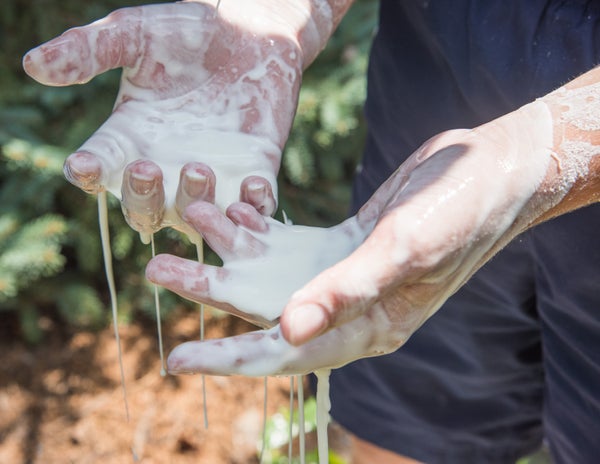
Applying pressure to the mixture increases its viscosity (thickness). A quick tap on the surface of Oobleck will make it feel hard, because it forces the cornstarch particles together. But dip your hand slowly into the mix, and see what happens—your fingers slide in as easily as through water. Moving slowly gives the cornstarch particles time to move out of the way.
Oobleck and other pressure-dependent substances (such as Silly Putty and quicksand) are not liquids such as water or oil. They are known as non-Newtonian fluids. This substance's funny name comes from a Dr. Seuss book called Bartholomew and the Oobleck.
On supporting science journalism
If you're enjoying this article, consider supporting our award-winning journalism by subscribing. By purchasing a subscription you are helping to ensure the future of impactful stories about the discoveries and ideas shaping our world today.
Materials
• 1 cup of water
• 1 to 2 cups of cornstarch
• Mixing bowl
• Food coloring (optional)
Preparation
• Pour one cup of cornstarch into the mixing bowl, and dip your hands into it. Can you feel how smooth the powder is? It's made up of super-fine particles.
• Now pour the water in, mixing slowly as you go. Keep adding more water until the mixture becomes thick (and hardens when you tap on it). Add more cornstarch if it gets too runny, and more water if it becomes too thick.
• Add a few drops of food coloring if desired. (If you want to turn your Oobleck another hue, it’s easier to add the coloring to the water before you mix it with the cornstarch.)
• Oobleck is non-toxic, but please use caution when doing any science activity. Be careful not to get it in your eyes, and wash your hands after handling the Oobleck.
Procedure
• Roll up your sleeves and prepare to get messy! Drop your hands quickly into the Oobleck, then slowly lower your hands into it. Notice the difference!
• Hold a handful in your open palm—what happens?
• Try squeezing it in your fist or rolling it between your hands—how does it behave differently?
• Move your fingers through the mixture slowly, then try moving them faster.
• What else can you do to test the mixture's properties?
• Extra: If you have a large plastic bin or tub, you can make a big batch of Oobleck. Multiply the quantity of each ingredient by 10 or more and mix it up. Take off your shoes and socks and try standing in the Oobleck! Can you walk across it without sinking in? Let you feet sink down and then try wiggling your toes. What happens?
Read on for observations, results and more resources.
Observations and results
What is happening when you squeeze the Oobleck? What is happening when you release the pressure? Does the Oobleck remind you of anything else?
The Oobleck mixture isn't your typical liquid—or solid. The cornstarch-and-water mixture creates a fluid that acts more like quicksand than water: applying force (squeezing or tapping it) causes it to become thicker. If you were trapped in a tub of Oobleck, what would be the best way to escape?
Share your Oobleck observations and results! Leave a comment below or share your photos and feedback on Scientific American's Facebook page.
Cleanup
Wash hands with water. Add plenty of extra water to the mixture before pouring it down the drain. Wipe up any dried cornstarch with a dry cloth before cleaning up any remaining residue with a damp sponge.
More to explore
"What is Jell-O?" from Scientific American
"Ask the Experts: What Is Quicksand?" from Scientific American
"States of Matter" overview from Idaho Public Television's Dialogue for Kids
Slime and Goo activities from the American Chemical Society's Science for Kids
Oobleck, Slime & Dancing Spaghetti: Twenty terrific at-home science experiments inspired by favorite children's books by Jennifer Williams, ages 4–8
The Everything Kids' Easy Science Experiments Book: Explore the world of science through quick and easy experiments! By J. Elizabeth Mills, ages 9–12
Up next…
The Magic of Gravity
What you'll need
• Coin
• Bottle, jar or canister with a small top opening (larger—but not too much bigger—than the coin)
• 3- by-5-inch note card or other sturdy piece of paper
• Scissors
• Tape
• Pen or pencil
• Water (optional)
