
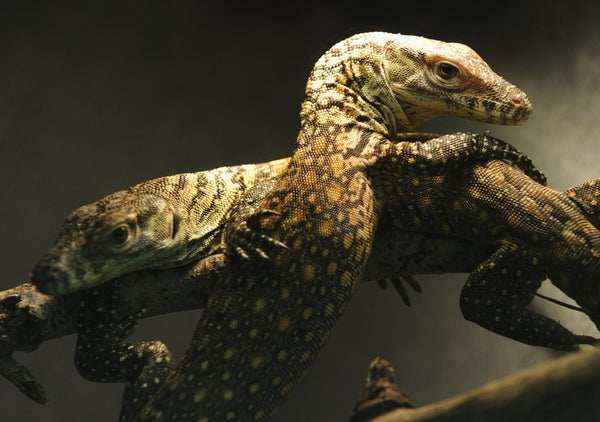
Indonesian dragons can breed without the benefit of masculine companionship. Last week, researchers reported in Nature that the only two sexually mature female Komodo dragons in all of Europe laid viable eggs without insemination from a male. One Komodo, named Flora, lives at the Chester Zoo in England and has never been kept with a male; yet a few months ago she laid a clutch of 11 eggs, eight of which seem to be developing normally and may hatch as soon as January. Earlier this year, a now deceased female named Sungai from the London Zoo laid a clutch of 22 eggs, four of which yielded normal male dragons--even though Sungai hadn't had a date in two and a half years.
Some reptiles can hold onto sperm for several years, so initially researchers considered that Sungai's eggs had a father. But genetic analysis ruled that out, unless the father were somehow genetically identical to her. (Sungai did later mate with a male and laid a normally fertilized clutch, so don't think she died a virgin.)
These "virgin births" raised eyebrows because this asexual method of reproduction, called parthenogenesis, is rare among vertebrates: only about 70 backboned species can do it (that's about 0.1 percent of all vertebrates). Biologists have known that some lizards can engage in parthenogenesis, but nonetheless seeing it among Komodo dragons surprised zookeepers.
On supporting science journalism
If you're enjoying this article, consider supporting our award-winning journalism by subscribing. By purchasing a subscription you are helping to ensure the future of impactful stories about the discoveries and ideas shaping our world today.
Despite having only a mother, the offspring are not clones. That's because an unfertilized egg has only half the genes of the mother. The sperm is supposed to provide the other half. In parthenogenesis, the mother's half-set of chromosomes doubles up to generate the full complement. Hence, the offspring derives all its genes from the mother, but they are not a duplicate of her genome.
Komodos have a curious twist in their sex determination as well. Although we think of females being XX (that is, having two X chromosomes) and males as being XY, it's the other way around in these giant monitor lizards. Two identical sex chromosomes make a male Komodo, and two different ones make a female. Biologists label the Komodo's sex chromosomes as W and Z, so ZZ makes a male and WZ makes a female. Birds, some insects and a few other lizard species also rely on this sex-determination system. (Embryos of some reptiles--notably crocodiles and turtles--don't have any sex chromosomes; rather, the incubation temperature dictates their gender.)
In Komodo females, each egg contains either a W or a Z. Parthenogenesis hence leads to embryos that are either WW or ZZ. Eggs that consist of WW material are not viable and die off (just as YY is not a viable combination); in contrast, ZZ does work. So all the Komodo hatchlings have been and will be male (ZZ).
Evidently, in the case of these Komodos, the doubling of the egg genes occurred when, in essence, another egg, rather than sperm, did the job of fertilization. Oogenesis, the biological process of making an egg cell, typically also yields a polar body--a mini ovum of sorts, containing a duplicate copy of egg DNA. Normally, this polar body shrivels up and disappears. In the case of the Komodos, though, polar bodies evidently acted as sperm and turned ova into embryos.
The ability to reproduce both sexually and parthenogenetically probably resulted from the Komodo dragon's isolated natural habitat, living as it does on islands in the Indonesian archipelago. Researchers have seen other species resort to parthenogenesis when isolated, such as damselflies in the Azores. The ability, researchers speculate, may have enabled the dragons to establish new colonies if females had found themselves washed up alone on neighboring shores, as might happen during a storm.
High school biology texts tend to gloss over parthenogenesis, typically mentioning the process as rare and restricted to mostly small invertebrates. But the phenomenon has emerged from the backwaters in recent years, primarily as a tool for science. Some scientists hope to exploit the phenomenon to get around ethical concerns surrounding embryonic stem cell research. They can fool an unfertilized human egg to divide by pricking it, thereby simulating the penetration of sperm. Such deceived eggs continue dividing into the blastocyst stage of 50 to 100 cells before petering out naturally.
In principle, it may be possible to keep that cell dividing. In 2004, as a means to elucidate the details of how fertilized eggs develop, scientists in Japan engaged in some genetic trickery to create a fatherless mouse. Such a developmental process probably didn't happen in the little town of Bethlehem two millennia ago--the mistranslation of "young girl or maid" into "virgin" explains the story a lot better. But as the Komodo dragons' astonishing parthenogenesis feat shows, nature has plenty to teach us about making do without a mate.
