
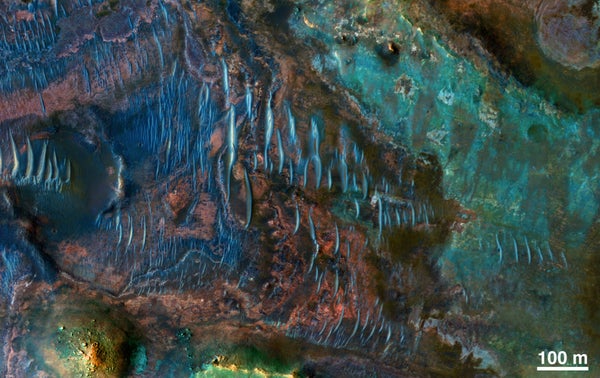
Yesterday marked the tenth anniversary of NASA’s Mars Reconnaissance Orbiter’s (MRO) arrival into Martian orbit, on a mission that would revolutionize our views of the planet. Ancient river valleys and flow channels first seen by orbiters in the 1970s told scientists Mars had briefly been a warm, wet world nearly four billion years ago. But after that short spate of activity the planet had apparently lapsed into senescence, becoming little more than an inert, rusty rock.
Across a decade and about 45,000 orbits, MRO’s advanced cameras, spectrographs and radar have helped researchers chart the history of Mars’s shift from warm and wet to cold and dry, but more importantly the information has revealed a world more dynamic and decidedly less drab than previously appreciated. Ever since it slipped into orbit, it has beamed back some 264 terabits of data, more than all of humanity’s other interplanetary probes combined. A disproportionate amount of that data comes from a single instrument onboard, the High Resolution Imaging Science Experiment (HiRISE), a camera fed by a 0.5-meter telescope.
Seen through HiRISE’s optics, which can reveal surface features as small as a desk, Mars suddenly becomes a different place, a livelier planet that, though still relatively inert on large scales, teems with activity on smaller ones. HiRISE’s Mars is a world of tumbling landslides, creeping glaciers and marching sand dunes. Whirling dust devils meander across the sun-warmed equator, and in the colder mid-latitudes water vapor wafts from once-buried ice exposed in fresh impact craters.
On supporting science journalism
If you're enjoying this article, consider supporting our award-winning journalism by subscribing. By purchasing a subscription you are helping to ensure the future of impactful stories about the discoveries and ideas shaping our world today.
The sharpness of HiRISE’s vision comes at a price—a narrow field-of-view that has limited its coverage to less than 2.5 percent of the planet’s surface during MRO’s decade in orbit. Other instruments on MRO, such as its Compact Reconnaissance Imaging Spectrometer (CRISM), have managed to map more than 95 percent of Mars at lower resolutions, providing their own new perspective on the planet’s past and present. All that data could also intimately shape Mars’s future, as NASA uses it to find landing sites for human outposts and long-term habitation.
To celebrate MRO’s tenth anniversary, we have gathered some of the spacecraft’s best images as suggested by several of the mission’s leading scientists. MRO, originally intended for a primary mission lasting only about two years, is now well past its designed lifetime, and its systems and instruments are showing their age with degraded performance and more frequent glitches. We may only be an errant cosmic ray, solar flare or micrometeorite strike away from hardware failures that draw the curtain down on MRO’s revolutionary observations. There are at present no firm plans for a replacement, though NASA is seriously considering the possibility of building and launching an even more advanced orbiter to Mars as early as 2022.
