New Issue: Orbital Catastrophe Ahead? Read Now

2 Chemicals Together May Knock Out Zika-Carrying Mosquitoes

The CDC reports that spraying a controversial insecticide and applying larvicide may be best tools for combating local Zika

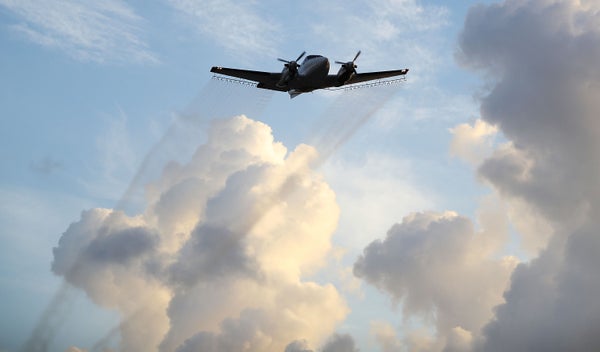
A plane sprays pesticide over the Wynwood neighborhood in the hope of controlling and reducing the number of mosquitos, some of which may be capable of spreading the Zika virus on August 6, 2016 in Miami, Florida.

Join Our Community of Science Lovers!

Aerial spraying of the insecticide naled, followed by a product that targets mosquitoes when they are in the larval stage, may be responsible for a sharp drop in Aedes aegypti mosquitoes in a part of Miami where local transmission of the Zika virus was first found, the Centers for Disease Control and Prevention reported Friday.

CDC Director Dr. Tom Frieden said the apparent success of the combination in the Miami neighborhood of Wynwood may represent a new standard for control of Aedes aegypti mosquitoes.

“It appears that the aerial application of this one-two punch has the ability to rapidly interrupt transmission,” Frieden said during a media conference Friday.


On supporting science journalism

If you're enjoying this article, consider supporting our award-winning journalism by subscribing. By purchasing a subscription you are helping to ensure the future of impactful stories about the discoveries and ideas shaping our world today.


“The findings are quite striking,” he added. “Those who’ve worked in the field of arbovirology and control of diseases spread by Aedes aegypti and have looked carefully at this data are struck that we haven’t seen similar control in other diseases spread by this particular mosquito species.”

Aedes aegypti mosquitoes are extremely difficult to control. The females, which need a blood meal to procreate, prefer to bite humans. As a result, they live close to people, in or around homes. They need only small amounts of water to lay their eggs—as little as the amount that a discarded bottle cap could hold—which adds to the difficulty of getting rid of this species.

The bugs are resistant to some of the chemicals that have been used against them in the past, which is why public health officials turned to the combination of naled and a biological product called Bacillus thuringiensis subspecies israelensis—Bti—that kills larvae.

Naled alone didn’t appear to knock down the mosquito populations as successfully, Frieden said. It was tried in a different part of the city.

The CDC’s report noted that local hospital admission records were checked to see if people came in complaining of respiratory problems or skin rashes followed spraying of the chemicals. There was no evidence that happened.

A number of protesters in Miami objected to the spraying. And earlier, Puerto Rico dropped a plan to use this approach there over public objections.

Duane Gubler, an expert in mosquito transmitted diseases, was cautious about interpreting the results, saying several methods of mosquito control were used in the Wynwood neighborhood, and it’s not clear the drop in mosquitoes can be attributed to the aerial spraying.

A former head of the CDC’s dengue branch in Puerto Rico, Gubler had been skeptical of the aerial spraying plan before the work was undertaken.

Republished with permission from STAT. This article originally appeared on September 23, 2016

Helen Branswell is STAT's infectious diseases and public health reporter. She comes from the Canadian Press, where she was the medical reporter for the past 15 years. Helen cut her infectious diseases teeth during Toronto's SARS outbreak in 2003 and spent the summer of 2004 embedded at the US Centers for Disease Control and Prevention. In 2010-11 she was a Nieman Global Health Fellow at Harvard, where she focused on polio eradication. Warning: Helen asks lots of questions.

More by Helen Branswell

STAT delivers fast, deep, and tough-minded journalism. We take you inside science labs and hospitals, biotech boardrooms, and political backrooms. We dissect crucial discoveries. We examine controversies and puncture hype. We hold individuals and institutions accountable. We introduce you to the power brokers and personalities who are driving a revolution in human health. These are the stories that matter to us all.

More by STAT

Subscribe to Support Independent Journalism

Great science journalism requires human expertise, time, effort and creativity. And it costs money. That’s why I and the journalists here at Scientific American hope you’ll join our community.

When you subscribe, you are supporting staff and freelance journalists who are passionate about telling science stories that are true, important and compelling. Our editors and reporters are often experts in their fields, which means they understand the nuances of big discoveries and can untangle the breakthroughs from the hype. With a subscription, you are also supporting rigorous fact-checking to ensure the words we publish are precise and accurate. And you’re supporting original illustrations, graphics and photos that bring you closer to an advanced laboratory, an ice sheet in Antarctica or a space mission in orbit. You’re helping us craft other types of high-quality journalism as well: Our newsletters are carefully written, edited and curated by staffers you have or will come to know and love. Our Science Quickly podcast is based on original reporting, collaboration with editors and scientists and exacting production.

Subscriptions keep this engine running so we can continue to deliver thoughtful, rigorous and independent science journalism to you. In an era of viral misinformation, this work is crucial. If you value what we do, I hope you’ll consider joining us as a subscriber

Thank you,

Jeanna Bryner, Editor in Chief, Scientific American

Subscribe