
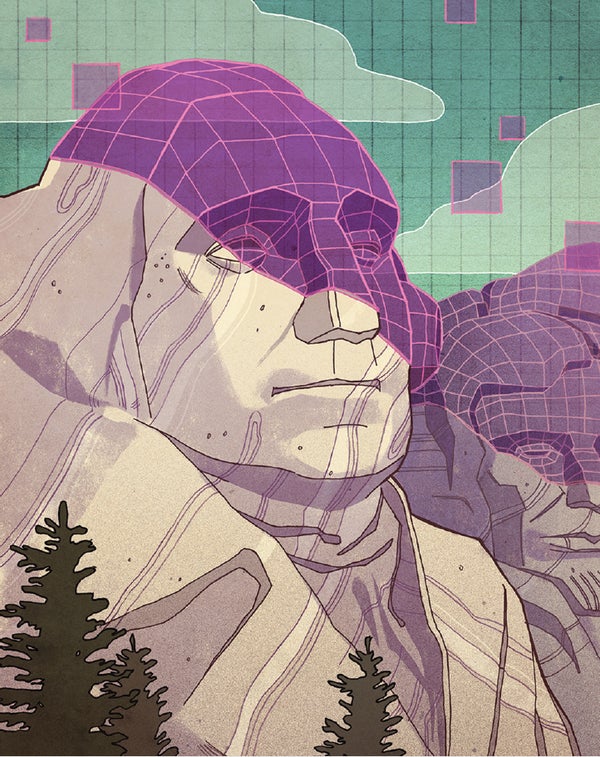
Across 163 different countries, 1,000 natural and cultural historic places constitute our most precious human heritage. UNESCO calls them World Heritage Sites, and they range from the Democratic Republic of the Congo's endangered Virunga National Park to Syria's ancient city of Palmyra to Mount Rushmore in the U.S.
We lose a little of that heritage every day. War, climate change and pollution take a toll, as do wind and rain. Already gone are the Buddhas of Bamiyan in Afghanistan (dynamited by the Taliban in 2001) and Palmyra (partially destroyed by ISIS in 2015). The $4 million a year that UNESCO allocates for preservation is not nearly enough to take care of even the four dozen sites considered at imminent risk of being lost forever. But there is an alternative. New digital-conservation technologies let us hold on to them, at least virtually, through 3-D scanning, modeling and digital storage. Such projects can be accomplished through partnerships of governments, universities, industry and nonprofits.
To make a 3-D model, a laser scanner bounces light off an object and collects the resulting topological cloud of points. To reproduce every nook and cranny, the scanner snaps overlapping images from all possible angles. A computer then sews together one large surface image and draws lines from one point to another to create a wire-frame model. High-resolution digital cameras add color and texture. When fully assembled, the models can be viewed, printed or manipulated.
On supporting science journalism
If you're enjoying this article, consider supporting our award-winning journalism by subscribing. By purchasing a subscription you are helping to ensure the future of impactful stories about the discoveries and ideas shaping our world today.
These scans do more than pickle a memory in a database. With highly accurate measurements, archaeologists can find hidden passages or reveal ancient engineering tricks. Schoolkids can explore places they might otherwise never see. And when a site is destroyed, the scans can even be used to reconstruct what was there. That has already happened for one World Heritage Site, the Kasubi Tombs in Uganda. Built of wood in 1882, they were destroyed by fire in 2010 and rebuilt in 2014, based in large part on 3-D models made in 2009. More than 100 World Heritage Sites have been already preserved as 3-D models, and conservationists are racing to record as many more as possible, especially in the conflict-torn Middle East and northern Africa.
In 2003 Ben Kacyra, an Iraqi-American born in Mosul, co-founded the nonprofit CyArk, now a leader in 3-D digital preservation. Kacyra made his fortune developing and deploying the world's first portable 3-D-laser-scanning systems; his organization was also the first—and is now the largest—to apply that technology to preservation on a grand scale. The CyArk 500 project aims to digitally preserve 500 World Heritage Sites, mixing public and private financing, government support and cutting-edge research to make the work as accurate and useful as possible. All projects are archived on public servers and in safe database bunkers.
Conservationists around the world are emulating CyArk's methods. To scan Mount Rushmore, the nonprofit provided people, expertise and some funding. The U.S. National Park Service added funding plus a technical climbing team to scan the presidents' nostrils and underneath their eyebrows. A local engineering firm and university mining department consulted on the local geology. Historic Scotland, the Scottish National Heritage agency and the Digital Design Studio of the Glasgow School of Art collected data and deployed them as tools for visualizing and conserving the mountain.
Buildings of local importance can also be preserved this way. Because engineering, architectural and other firms use 3-D scanning in their work, many cities have local scanning companies. Tim Crammond, manager of Pittsburgh-based Laser Scanning America, charges about $1,000 a day to acquire and process data, but, he says, “despite the numerous requests we receive from entities interested in using 3-D scanning for historic preservation, the funding doesn't seem to be in place for it.”
Although each one is unique, a typical World Heritage scanning project costs roughly $50,000. For $50 million, models of all 1,000 World Heritage Sites could be stored forever. We urge governments, universities and nonprofits to support digital conservation to capture our history before it is lost.