
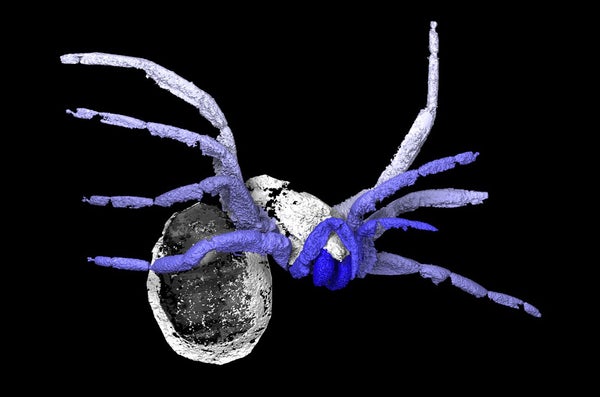
A new fossil found in France is almost a spider, but not quite.
The arachnid, locked in iron carbonate for 305 million years, reveals the stepwise evolution of arachnids into spiders. Dubbed Idmonarachne brasieri after the Greek mythological figure Idmon, father of Arachne, a weaver turned into a spider by a jealous goddess, the "almost spider" lacks only the spinnerets that spiders use to turn silk into webs.
"It's not quite a spider, but it's very close to being one," said study researcher Russell Garwood, a paleontologist at the University of Manchester in the United Kingdom. [See Images of the Fossilized 'Almost Spider']
On supporting science journalism
If you're enjoying this article, consider supporting our award-winning journalism by subscribing. By purchasing a subscription you are helping to ensure the future of impactful stories about the discoveries and ideas shaping our world today.
Locked in rock
Arachnids are an ancient group with murky origins, Garwood told Live Science. The creatures were among the first land-dwellers, adopting a terrestrial life at least 420 million years ago. There are very few rocks laid down on land from that time, so little of arachnids' early history is preserved, Garwood said. And figuring out arachnid evolutionary relationships from DNA is likewise difficult because arachnids diversified so early, leaving few traceable evolutionary changes in their genes.
The oldest known spider fossil comes from the Montceau-les-Mines, a coal seam in eastern France. That spider was 305 million years old. The newfound fossil from the same time period reveals that these ancient spiders lived alongside not-quite-spider cousins.
The 0.4-inch-long (10 millimeters) arachnid was discovered decades ago, but no one could make much of it, because the front half of the fossil is buried in rock. Computed tomography unlocked the mystery by allowing Garwood and his colleagues to peer inside the rock at the arachnid's walking legs and mouthparts, which are important for identifying the genus and species of this kind of creature.

In the mid-1970s, an amateur fossil hunter discovered what ultimately turned out to be the closest known relative of modern-day spiders.
Photo courtesy of Garwood RJ et al., Proc. R. Soc. B, (2016)
Long-lost cousin
The arachnid turned out to have had spiderlike mouthparts and legs. But unlike true spiders, it lacked spinnerets. It also had a segmented abdomen, rather than a fused abdomen, which modern spiders have.
"We're looking at a line of spiderlike arachnids that haven't survived but must have split off before 305 million years ago," Garwood said.
Members of an earlier arachnid branch, called the Uraraneida, known from 385-million-year-old fossils, were also spiderlike in appearance, Garwood said, but had a long, tail-like structure called the flagellum that disappeared before I. brasieri branched off the family tree. Uraraneida did not have spinnerets, but did have structures called spigots that could have excreted silk. As a result, the researchers said they suspect that I. brasieri might have produced silk, too, just without the spectacular weaving abilities that spinnerets allow.

Suggested appearance of the spiderlike arachnid Idmonarachne brasieri.
Illustration courtesy of Garwood RJ et al., Proc. R. Soc. B, (2016)
The researchers said they plan to examine other fossils to get a better understanding of the rise of spiders. Very little is known about how spiders and other arachnids, such as scorpions and harvestmen, fit together in a family tree, Garwood said.
"Arachnids as a whole are an incredibly successful group," he said. "They're the most diverse group of living organisms after insects. They're really, really successful—but we have a very limited understanding of how they are related to each other."
Copyright 2016 LiveScience, a Purch company. All rights reserved. This material may not be published, broadcast, rewritten or redistributed.