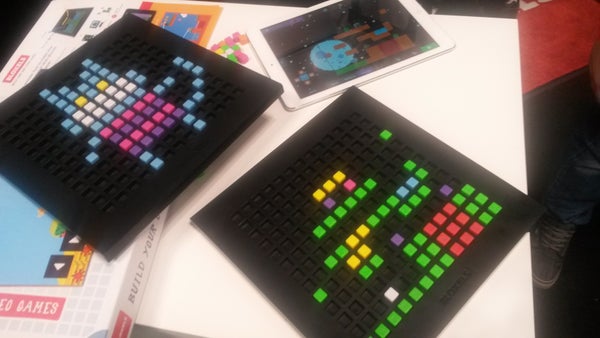
Bloxels ($49.95; available now) With its colorful squares and simple-to-understand game board, the video game–creation platform Bloxels grounds digital game design in physical, tactile creativity. Color-coded cubes on a board represent pixels during character creation or squares on a map for level building. By snapping a picture of their design using Bloxels’s free app, players can turn the physical scheme into a digital world to explore. When developing a level, each cube color represents a building feature, such as land (green), enemies (purple) and coins (yellow). User-created maps, made up of multiple individual levels built on the game board, can become complex games that can be explored for hours. Players can share their designs via the app and use the coins they earn via gameplay to buy other players’ designs.
Jennifer Hackett
Join Our Community of Science Lovers!
On supporting science journalism
If you're enjoying this article, consider supporting our award-winning journalism by subscribing. By purchasing a subscription you are helping to ensure the future of impactful stories about the discoveries and ideas shaping our world today.
Everyone feels like a kid when they attend the annual American International Toy Fair, held in New York City’s Javits Center. Seemingly endless colorful booths full of the next big thing crowded the center’s multiple floors for the four-day show held February 13–16. Bot-building kits shared floor space with flavored edible bubbles, quadcopters and adorable plush cats. Scientific American played with some of the coolest science and technology toys of 2016. Here’s a selection of some new fun gizmos that caught our eye.
Subscribe to Support Independent Journalism
Great science journalism requires human expertise, time, effort and creativity. And it costs money. That’s why I and the journalists here at Scientific American hope you’ll join our community.
When you subscribe, you are supporting staff and freelance journalists who are passionate about telling science stories that are true, important and compelling. Our editors and reporters are often experts in their fields, which means they understand the nuances of big discoveries and can untangle the breakthroughs from the hype. With a subscription, you are also supporting rigorous fact-checking to ensure the words we publish are precise and accurate. And you’re supporting original illustrations, graphics and photos that bring you closer to an advanced laboratory, an ice sheet in Antarctica or a space mission in orbit. You’re helping us craft other types of high-quality journalism as well: Our newsletters are carefully written, edited and curated by staffers you have or will come to know and love. Our Science Quickly podcast is based on original reporting, collaboration with editors and scientists and exacting production.
Subscriptions keep this engine running so we can continue to deliver thoughtful, rigorous and independent science journalism to you. In an era of viral misinformation, this work is crucial. If you value what we do, I hope you’ll consider joining us as a subscriber
Thank you,
Jeanna Bryner, Editor in Chief, Scientific American