
On supporting science journalism
If you're enjoying this article, consider supporting our award-winning journalism by subscribing. By purchasing a subscription you are helping to ensure the future of impactful stories about the discoveries and ideas shaping our world today.
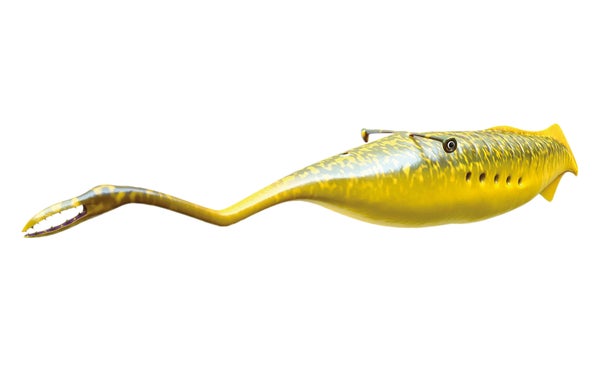
In 1955 amateur fossil hunter Francis Tully discovered an exceedingly odd specimen in Mazon Creek, a collecting hotspot near Chicago. Imprinted on Tully's rock were the remains of a tubular creature with stalk eyeballs and a long mouth apparatus terminating in a feature that resembled an alligator clip. Dubbed the Tully monster, the 300-million-year-old specimen later became Illinois's official state fossil. Despite its popularity, though, researchers have made neither heads nor tails of it—until now.
According to findings published in Nature, the organism traces its evolutionary legacy to modern-day lampreys: jawless, bloodsucking fish. Researchers arrived at this conclusion after analyzing 1,200 Tully monster specimens—most about 15 to 20 centimeters long—and realizing that what was previously assumed to be part of the creature's gut is actually a notochord, a primitive backbone. The notochord's downward curvature pointed the team toward lampreys, which also share that physiological quirk.
Victoria McCoy, a paleontologist at the University of Leicester in England who led the study while at Yale University, is not ready to declare the case closed, however. “We still know very little about how the Tully monster lived,” she says. “But we can now use modern lampreys and other fishes as analogues and, we hope, start to better understand the mysterious lifestyle of this ancient monster.”
