
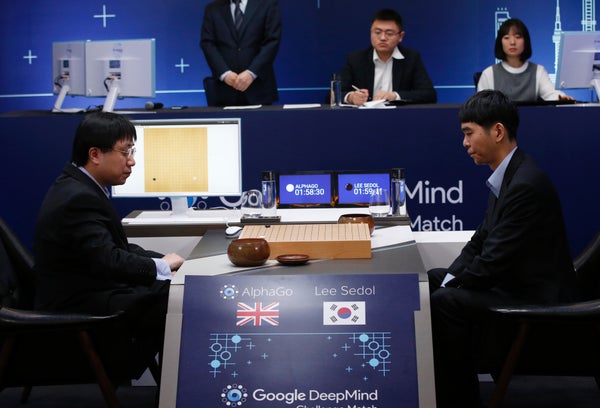
Tanguy Chouard, an editor with Nature, saw Google-DeepMind’s AI system AlphaGo defeat a human professional for the first time last year at the ancient board game Go. This week, he is watching top professional Lee Sedol take on AlphaGo, in Seoul, for a $1 million prize.
As I’m sure you’ve heard, one of humanity’s best Go players, Lee Sedol, just lost his first game in a best-of-five series against AlphaGo, the artificial intelligence system created by Google DeepMind. “I’m in shock,” Lee said at the post-match press conference.
I was surprised too by my emotional reaction to the result. Before I saw the game, which I watched alongside DeepMind’s CEO Demis Hassabis, and David Silver, one of the lead researchers on AlphaGo, I didn’t know who I wanted to win.
On supporting science journalism
If you're enjoying this article, consider supporting our award-winning journalism by subscribing. By purchasing a subscription you are helping to ensure the future of impactful stories about the discoveries and ideas shaping our world today.
Now—to my surprise—I find myself rooting for the very personable and human Lee Sedol.
For me, the key moment came when I saw Hassabis passing his iPhone to other Google executives in our VIP room, some three hours into the game. From their smiles, you knew straight away that they were pretty sure they were winning—although the experts providing live public commentary on the match weren’t clear on the matter, and remained confused up to the end of the game just before Lee resigned.
Hassabis’s certainty came from Google’s technical team, who pore over AlphaGo’s evaluation of its position, information that isn’t publicly available. I’d been asking Silver how AlphaGo saw the game going, and he’d already whispered back: “It’s looking good”.
And I realised I had a lump in my throat. From that point on, it was crushing for me to watch Lee’s struggle.
Towards the end of the match, Michael Redmond, an American commentator who is the only westerner to reach the top rank of 9 dan pro, said the game was still “very close”. But Hassabis was frowning and shaking his head—he knew that AlphaGo was definitely winning. And then Lee resigned, three and a half hours in.
At the post-game press conference, Lee said he felt he’d made a mistake early in the game, and had to drag that burden throughout the match. We’d certainly seen Lee looking tense early on: Redmond had already told us—and the hundreds of journalists watching in two overflow rooms—that AlphaGo was playing more aggressively, in contrast to its relatively peaceful games last year against Fan Hui.
"AlphaGo played like a human professional player, but with the emotional element carved out,” said one Korean commentator, Kim Sung-ryong. He said that all top-level pro players were in shock. Silver said that—judging from the statistics he’d seen when sitting in Google’s technical room—“Lee Sedol pushed AlphaGo to its limits”.
Does this mean that AI has finally defeated humanity at what may be the most complex board game we've ever invented? Not quite. There are still four games to go; tomorrow (10 March) we may see a different kind of match, as AlphaGo will play first, with the black stones, rather than second, with the white ones.
Lee said he wouldn’t be affected psychologically by the loss. “This game is not going to affect how I play in the next games,” he said. As Redmond told me after the game: "he's a very tough guy".
Can't wait to see him fight back!
This article is reproduced with permission and was first published on March 9, 2016.