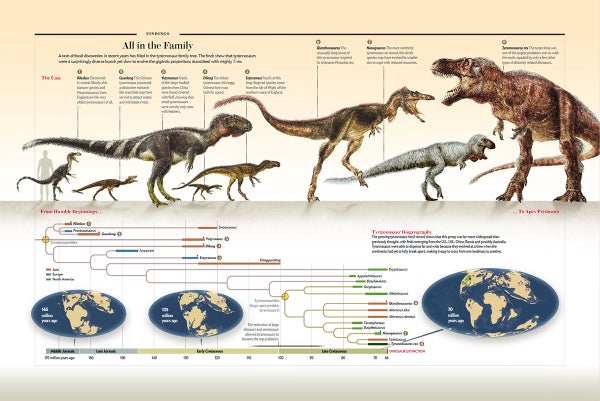
A rash of fossil discoveries in recent years has filled in the tyrannosaur family tree. The finds show that tyrannosaurs were a surprisingly diverse bunch yet slow to evolve the gigantic proportions associated with mighty T.Rex
Join Our Community of Science Lovers!
On supporting science journalism
If you're enjoying this article, consider supporting our award-winning journalism by subscribing. By purchasing a subscription you are helping to ensure the future of impactful stories about the discoveries and ideas shaping our world today.
Credit: Illustration by Todd Marshall (dinosaurs), Graphics by 5W Infographics; SOURCE: PLATE TECTONIC AND PALEOGEOGRAPHIC MAPS BY C. R. SCOTESE, PALEOMAP PROJECT, 2009 (maps)
It’s Time to Stand Up for Science
If you enjoyed this article, I’d like to ask for your support. Scientific American has served as an advocate for science and industry for 180 years, and right now may be the most critical moment in that two-century history.
I’ve been a Scientific American subscriber since I was 12 years old, and it helped shape the way I look at the world. SciAm always educates and delights me, and inspires a sense of awe for our vast, beautiful universe. I hope it does that for you, too.
If you subscribe to Scientific American, you help ensure that our coverage is centered on meaningful research and discovery; that we have the resources to report on the decisions that threaten labs across the U.S.; and that we support both budding and working scientists at a time when the value of science itself too often goes unrecognized.