
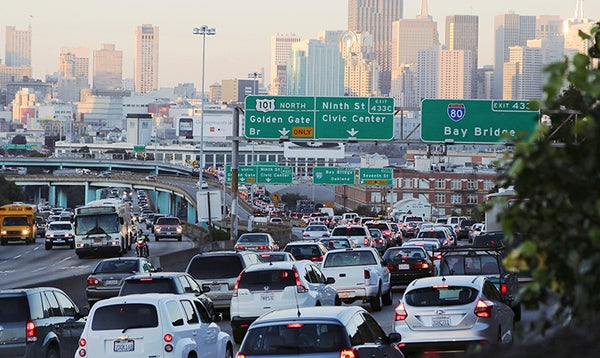
Americans drove more miles than ever before in 2015, a departure from totals that have stayed mostly flat since 2004.
Driving jumped 3.5* percent over 2014, the largest uptick in more than a decade, according to new data released by the Department of Transportation's Federal Highway Administration.
They show that Americans drove more than 3.15 trillion miles in 2015, equivalent to around 337 round trips from Earth to Pluto. The previous record, around 3 trillion miles, was set in 2007.
On supporting science journalism
If you're enjoying this article, consider supporting our award-winning journalism by subscribing. By purchasing a subscription you are helping to ensure the future of impactful stories about the discoveries and ideas shaping our world today.
"This makes our work on efficiency and alternative fuels all the more pressing," said Dave Cooke, a senior vehicles analyst with the Union of Concerned Scientists. He called reducing driving itself, through policies like sustainable city planning, "a very long-term game plan."
The transportation sector, mostly vehicles, contributes nearly a third of the country's greenhouse gas emissions. Emissions from the sector increased nearly 16 percent from 1990 to 2013, according to U.S. EPA, reflecting a 35 percent rise in miles driven.
The long-term increase in miles traveled in the United States slowed starting in the early 2000s, hovering near 3 trillion a year throughout years of economic decline. The only other comparable slowing in year-over-year increases in miles driven occurred during the early 1970s and '80s.
Some observers suggested that the last decade's numbers signaled a structural shift in driving patterns, with more people using public transit and fewer young adults getting into cars. The portion of people under 35 with driver's licenses has dropped at least 10 percent from the 1980s, according to the latest analysis by University of Michigan researchers. Less than a quarter of 16-year-olds had licenses in 2014, down from 46 percent in 1983.
But every month since March 2014 has seen an increase in miles traveled over the previous year. In December 2015, Americans drove more than in any other previous month in history, when adjusted for seasonal variations.
Per-capita driving totals had been falling since a peak in 2004, but that started to reverse in 2014. The numbers for total licensed drivers in 2015 have not been compiled yet, according to the Federal Highway Administration, but early estimates show that the trend is likely to continue in 2015. Using the number of 2014 licensed drivers, the 2015 per-capita miles driven surpassed those in 2004.
Adie Tomer, a fellow at the Brookings Institution's Metropolitan Policy Program, suggested that may mean the slowing in driving in the past decade was a "blip."
"Maybe that progress wasn't as good as it seemed," he said. "Many Americans are effectively tethered to their cars."
The driving increase reflects a growing economy, he said. Unemployment fell to an eight-year low of 4.9 percent in January, according to the Bureau of Labor Statistics.
More older adults are staying on the roads as they age, Tomer said, enough to counterbalance the drop in younger drivers. People age 60 and above held almost 26 percent of all driver's licenses in 2014, up from 20.6 percent in 2004, according to Federal Highway Administration data. Those younger than 30 saw their share of licenses drop 1 percent during that time.
The "elephant in the room" driving the increase in miles traveled, however, is the plummeting price of fuel, said Tomer. A gallon of gas cost $2 by the end of the year, according to the U.S. Energy Information Administration. That helped trigger record auto sales and a shift toward less fuel-efficient trucks and SUVs -- and more trips.
"When gas prices change, even if it's a relatively inelastic demand, people think, 'Hey, maybe we can afford that summer road trip,'" Tomer said. "It does allow certain behaviors that weren't there before."
The most recent numbers fall in line with Department of Transportation projections for increased driving in the future. The "Beyond Traffic" report issued last year forecast driving per capita remaining stable and overall driving increasing by 23 to 27 percent over the next 30 years, buoyed by a rising population and more urban sprawl. The department has been calling for more funding to fix and prepare infrastructure for the rise.
Fuel efficiency has increased every year, meeting standards tightened by President Obama. Those hoping to reduce emissions from the transportation sector see clean vehicles as a priority.
*Correction: An earlier version of this article mistakenly said the change in miles traveled in 2015 over 2014 was 4.5 percent because of incomplete data. The change was 3.5 percent.
Reprinted from Climatewire with permission from Environment & Energy Publishing, LLC. www.eenews.net, 202-628-6500