
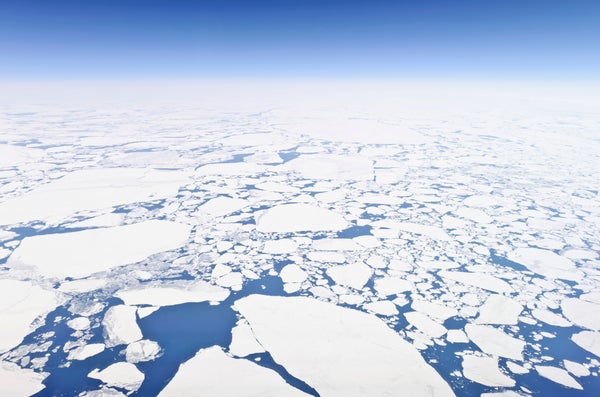
Unusually high air temperatures over the Arctic Ocean and a strong negative atmospheric circulation in the region caused Arctic sea ice to shrink to the lowest level ever recorded by satellite for the month of January, according to the National Snow and Ice Data Center.
Arctic sea ice extended an average of 5.2 million square miles in January, which was 35,000 square miles less than the previous low in January 2011.
NSIDC scientist Julienne Stroeve said that the sea ice extent could continue to remain low this month as Arctic temperatures stay above normal. Arctic sea ice levels usually peak in late February or early March.
On supporting science journalism
If you're enjoying this article, consider supporting our award-winning journalism by subscribing. By purchasing a subscription you are helping to ensure the future of impactful stories about the discoveries and ideas shaping our world today.
The ice center described January as “a remarkably warm month,” with Arctic air temperatures reaching 13 degrees Fahrenheit above average across most of the Arctic Ocean.
Scientists say the higher temperatures are likely related to a strongly negative Arctic Oscillation, an atmospheric circulation pattern in which the atmospheric pressure over the polar region flows opposite of that over mid-latitudes. Those patterns can affect weather in locations thousands of miles away from the Arctic, including Europe and North America.
Those factors caused unusually sparse sea ice levels in the Barents, Kara and East Greenland seas in the northern Atlantic Ocean region. Ice conditions were also below average in the Bering Sea southwest of Alaska and the Sea of Okhotsk along Russia’s southeastern coast.
Lower ice levels were also reported in the Gulf of St. Lawrence, an important habitat for harp seals along Canada’s southeastern coast.
However, Stroeve said low sea ice levels in January do not necessarily signal an early breakup of Arctic Ocean sea ice. That change will be determined by future weather patterns and ice thickness.
The record-low January sea ice extent continued a historic trend that has seen ice declining by 3.2 percent per decade from 1979 through this year, the report said.
The Arctic warmed at a record pace during 2015, according to a December analysis by the National Oceanic and Atmospheric Administration (ClimateWire, Dec. 16, 2015).
The average air temperature in the region was about 2.3 F above average between October 2014 and September 2015—the highest level chronicled since records began in 1900.
Last winter, the maximum sea ice extent in the Arctic Ocean was the lowest on record and occurred two weeks earlier than average. Meanwhile, June snow cover in the North American Arctic was the second-lowest since satellite studies began in 1978.
The report noted that surface temperatures in all regions of the Arctic Ocean are increasing, with areas like the Chukchi Sea witnessing nearly 1 F of temperature rise per decade.
Reprinted from Climatewire with permission from Environment & Energy Publishing, LLC. www.eenews.net, 202-628-6500