
El Niño has become a hot topic. Most people in the general public now know the term, and they have a vague idea that it is some kind of pattern in the Pacific Ocean that means the U.S. will have a warm winter…or snowy winter…or hot summer—or something. Almost every day, somewhere in the country, a meteorologist is blaming El Niño for unusual weather. The perceived wisdoms, and misunderstandings, are widespread. Atmospheric scientists are the first to acknowledge that only certain effects can be linked to a strong El Niño, and that they are unsure about others.
The current 2015–16 El Niño is one of the three strongest ever recorded. The other two occurred in 1982–83 and 1997–98. In between these events El Niño may have been weak or absent, and its cousin, La Niña, may have been strong in some seasons during that period. In the Northern Hemisphere El Niño’s effects peak during the winter, and are typically sorted out and summed up by the following April.
We asked Emily Becker, a research scientist at the National Oceanic and Atmospheric Administration who specializes in climate diagnostics, to clarify how much of our unusual weather we can blame on El Niño. Becker also writes a detailed, yet easy to understand blog about El Niño for NOAA. She responded to questions by e-mail and phone.
On supporting science journalism
If you're enjoying this article, consider supporting our award-winning journalism by subscribing. By purchasing a subscription you are helping to ensure the future of impactful stories about the discoveries and ideas shaping our world today.
[An edited transcript of the interview follows.]
First, what exactly is El Niño?
El Niño is part of a naturally occurring, irregular cycle that occurs every two to seven years in the equatorial Pacific Ocean. El Niño is characterized by a large area of warmer-than-average ocean surface temperatures in the central and eastern Pacific. The other half of the cycle is La Niña, when the surface waters are cooler than normal. There's also a neutral phase, when the temperatures are about average.
How does El Niño influence weather?
All that extra heat in the Pacific warms the air above, leading to more rising air than normal in that region, which affects the global atmospheric circulation. It may seem crazy that a couple of extra degrees of heat in one spot in the ocean can affect the world, but it's a lot of extra energy entering the atmosphere.
Does it affect just North America or the rest of the world?
It affects North America most directly. It does not really affect Europe. There are influences in Indonesia and Africa that are pretty consistent.
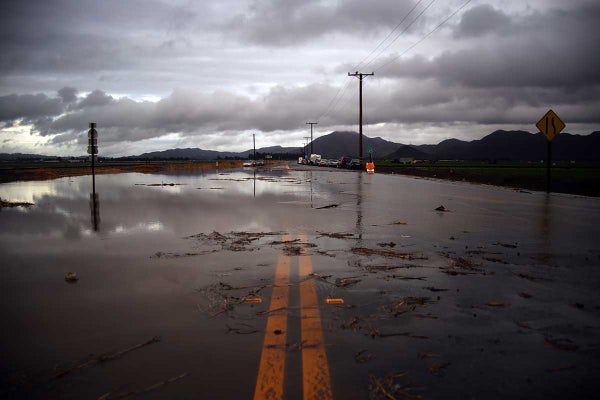
We keep hearing that the strong El Niño is bringing flooding rains to California. Is that True?
The changes in the atmospheric circulation include things like a stronger subtropical jet stream. It usually runs from the Pacific across Mexico, but when El Niño is strong it may move north, more over the U.S. That jet often steers Pacific storms toward California. But we have to say they are “El Niño influenced” storms. No one storm can be called “an El Niño storm.”
We also heard that El Niño made the U.S. Northeast so unusually warm in December. Also true?
There’s no strong El Niño effect linked to heating the Northeast. El Niño was part of it, but not the whole story. Remember the “polar vortex?” It was strong in December, so it kept cold air bottled up high in the Arctic. There was also a big bend in the polar jet stream. [It typically runs across southern Canada and the northern U.S., different from the subtropical jet stream.] But that was not synced to El Niño. All these factors came together in December.
Some extreme weather that occurs during one El Niño year might be reversed during another El Niño year, is that right? For example, in early 1998, during a strong El Niño, there was tremendous flood damage in California. Yet there had been even more flood damage the winter before, when there was no El Niño.
Right. The whole atmospheric system is so complicated that it never changes in the same way.
Are weather forecasters and the public linking too many weather events to the current, strong El Niño?
There is so much going on in the global climate, it's hard to point at one thing and say "that's because of El Niño." It's like trying to attribute one sneeze to allergy season.
What about hurricanes?
El Niño can make the Pacific hurricane season stronger, because warm water provides more power. And it can make the Atlantic season weaker, in part because it can make wind shear stronger in the Atlantic, which can pull hurricanes apart when they are trying to form. But you're still going to get some hurricanes in the Atlantic, and you can't pick out one storm in the Pacific and say "that's El Niño."
Some headlines blame tornadoes on El Niño.
I wouldn’t agree with that. Tornadoes are very sensitive to a lot of atmospheric conditions.
How about more wildfires in Indonesia?
Yes, there are fewer storms in Indonesia and therefore less rain. Dry conditions fuel wildfires. Just realize that a lot of them are set by humans, often to clear land.
Any other notable patterns around the world?
East Africa tends to get a lot more rain from October through December. Yet there seems to be less rain in southern Africa.
Some forecasters, and headline writers, have called the current strong pattern a Super El Niño, or the Godzilla El Niño. Okay? Not okay?
There is a lot of crazy stuff out there. Calling it Godzilla seems a bit silly, since that makes it sound like it's a huge monster that's going to step on your house.
Additional Reading
Unusual weather
https://www.scientificamerican.com/video/instant-egghead-is-extreme-weathe2012-09-11/
Effects peak during the winter
https://www.scientificamerican.com/article/strong-el-nino-to-usher-in-lots-of-winter-rain/
Becker’s blog
https://www.climate.gov/author/emily-becker
Hurricanes
https://www.scientificamerican.com/video/instant-egghead-how-do-2012-05-18/
Tornadoes
https://www.scientificamerican.com/video/how-do-tornadoes-form2013-04-23/