
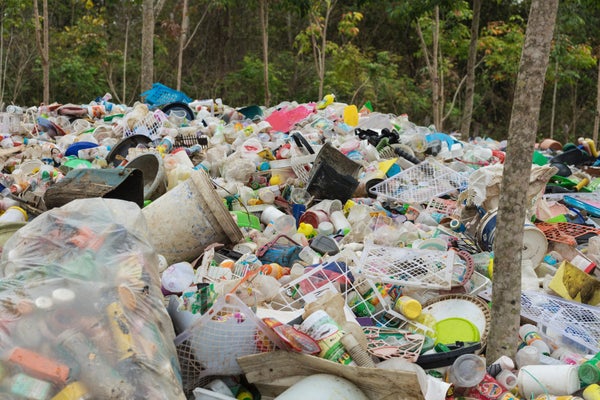
A tiny microbe one day could devour the millions of metric tons of polyethylene terephthalate, or PET, that pile up in landfills each year. Researchers in Japan have discovered the world’s first PET-eating bacterium, a critter that uses PET as its major carbon and energy source.
Each year, plastic manufacturers pump out more than 45 million metric tons of PET to make water bottles, salad domes, peanut butter jars, and other products—all of which sport a stamp with the number one inside a recycle symbol.
PET is the most recycled plastic in the U.S., according to PETRA, the PET Resin Association. But recycling rates still only reach about 31% nationwide. The European Union does better, recycling roughly half of its PET. Even so, tens of millions of metric tons of the plastic wind up in landfills each year, where the polymer’s strong ester bonds resist breakdown.
On supporting science journalism
If you're enjoying this article, consider supporting our award-winning journalism by subscribing. By purchasing a subscription you are helping to ensure the future of impactful stories about the discoveries and ideas shaping our world today.
To find microbes that could pull PET apart, a team led by Kohei Oda of Kyoto Institute of Technology and Kenji Miyamoto of Keio University screened 250 sediment, soil, wastewater, and activated sludge samples from a PET bottle recycling facility in Sakai, Japan. After some careful microbial sleuthing, they found one bacterium that thrived on PET films and named it Ideonella sakaiensis after the city where it was found (Science 2016, DOI: 10.1126/science.aad6359).
PET can be hydrolyzed to its monomers chemically, but this process can be slow and usually requires high temperatures and pressures. Fungi that can break down PET have been identified previously, but the bacterium identified by Oda and Miyamoto’s group appears to be more efficient than these. In fact, I. sakaiensis dices up polymer at a surprisingly mild 30 °C.
The researchers further found that I. sakaiensis uses one enzyme, which they call a PETase, to break the plastic down into the intermediate mono(2-hydroxyethyl) terephthalic acid, or MHET. Another enzyme, dubbed MHETase, hydrolyzes the MHET into the monomers terephthalic acid and ethylene glycol. The scientists think this enzymatic machinery could one day remediate PET-contaminated environments or reclaim the plastic’s starting materials, which at present are derived from petroleum.
“This could provide huge savings in the production of new polymer without the need for petrol-based starting materials,” notes Uwe T. Bornscheuer, an enzyme catalysis expert at the University of Greifswald, in a commentary that accompanies the paper.
At the moment I. sakaiensis and its enzymes need some tweaking before they’re ready to chow down on the world’s PET waste. The bacterium prefers to dine on amorphous PET, rather than the crystalline PET used in products, and the enzymes work too slowly to be used industrially.
The study’s first author, Shosuke Yoshida of Keio University, says that a PET pretreatment that would enlarge the polymer’s amorphous areas would make waste more appetizing for the bacterium. Also, he notes, it might be possible to engineer the enzymes to make them faster and more practical.
This article is reproduced with permission from Chemical & Engineering News (© American Chemical Society). The article was first published on March 10, 2016.
