
On Friday (April 22), the world will celebrate Earth Day, and honor the only planet known to host life. But where else in the solar system might life thrive? Our friends at ThinkGeek.com recently asked 2,400 readers this very question, and the results are pretty interesting.
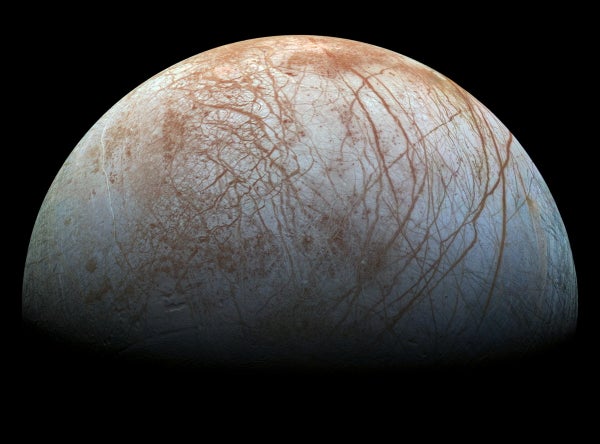
Not surprisingly, Jupiter's moon Europa took the top spot, garnering 47 percent of votes. The 1,900-mile-wide (3,100 kilometers) satellite harbors a huge ocean of liquid water beneath an icy shell, and scientists think this ocean is in contact with Europa's rocky mantle, making possible all sorts of interesting chemical reactions.
NASA is planning to launch a mission in the 2020s to gauge Europa's potential to host life. The Europa spacecraft will perform dozens of flybys of the moon from Jupiter orbit, and NASA is investigating the possibility of adding a lander to the mission as well. [Photos: Europa, Mysterious Icy Moon of Jupiter]
On supporting science journalism
If you're enjoying this article, consider supporting our award-winning journalism by subscribing. By purchasing a subscription you are helping to ensure the future of impactful stories about the discoveries and ideas shaping our world today.

ThinkGeek.com asked readers where in the solar system alien life might be found. The results were pretty interesting.
Credit: ThinkGeek.com
Mars came in second, with 23 percent of the vote. Observations by NASA's Mars rover Curiosity and other spacecraft have shown that at least some parts of the Red Planet were habitable billions of years ago. Back then, Mars was relatively warm and wet, with large expanses of liquid water on the surface.
Mars has since lost most of its atmosphere to space, and the planet became cold, dry and radiation-blasted as a result. But some researchers think microbial life could still survive beneath the Red Planet's surface today. (The European Space Agency and NASA will launch rovers toward Mars in 2018 and 2020, respectively, to hunt for signs of past and present life.)

Mars as seen from orbit by NASA’s Viking mission.
Credit: NASA/JPL
Saturn's huge moon Titan was the choice of 16 percent of respondents. The 3,200-mile-wide (5,150 km) moon is the only world in the solar system apart from Earth known to host stable bodies of liquid on its surface—but Titan's seas and lakes are full of hydrocarbons such as ethane rather than water.
So if life exists on the Saturn satellite, it's likely to be very different than that of Earth, which is intimately tied to water, researchers have said.
Another Saturn satellite, Enceladus, came in fourth, with just over 9 percent of the votes. Like Europa, Enceladus harbors a global subsurface ocean beneath an icy shell. But Enceladus is much smaller than the Jovian moon, with a diameter of just 310 miles (500 km).
Enceladus is famous for the jets of water-ice and organic material that blast into space from the satellite's south polar region. This geyser material likely comes from the moon's ocean, and thus provides a way for a probe to sample this potentially life-friendly environment without even touching down. Several research teams have drawn up mission concepts that would hunt for signs of life in Enceladus' geyser plume, but none of these ideas have yet been approved or funded by NASA. (The agency's Saturn-orbiting Cassini spacecraft has flown through Enceladus' plume multiple times, but that probe does not possess life-detection instruments.)

An enhanced-color view of the Saturn moon Enceladus captured by NASA’s Cassini spacecraft. This image shows the “tiger stripes” in the southern hemisphere from which Enceladus’ geysers erupt.
Credit: NASA/JPL/Space Science Institute
About 2.5 percent of people pegged Jupiter itself, rather than Europa or another Jovian satellite, as a promising abode for life. Temperatures are a frosty minus 234 degrees Fahrenheit (minus 145 degrees Celsius) in Jupiter's clouds, beneath which swirls a huge ocean of liquid, metallic hydrogen. So Jupiter life would have to be strange and hardy indeed.
Venus came in sixth, with just over 2 percent of the vote. Like Mars, Venus was probably quite habitable in the ancient past. But a runaway greenhouse effect caused the second planet from the sun to get incredibly hot over the eons: Surface temperatures on Venus now hover around 860 degrees Fahrenheit (460 degrees Celsius).
That being said, there are some temperate environments left on Venus. Microbial life could theoretically survive 30 miles (50 km) or so above the planet's surface, where temperatures and pressures are quite Earth-like. Indeed, some researchers want to explore the atmosphere of Venus, and have devised plans for airships—both robotic and crewed—that would cruise the planet's skies. (Again, these ideas remain concepts at the moment, without a path to launch.)
The ThinkGeek survey also asked respondents about how prepared they are to live off of their home planet. The vast majority of respondents were open to the idea; only 13.5 percent said Earth is the only place for them.
While this poll is far from a random and representative sampling of the people of Earth, it should provide some encouragement to the entrepreneurs hoping to build private outposts in orbit and on the surface of the moon and Mars.
Copyright 2016 SPACE.com, a Purch company. All rights reserved. This material may not be published, broadcast, rewritten or redistributed.