
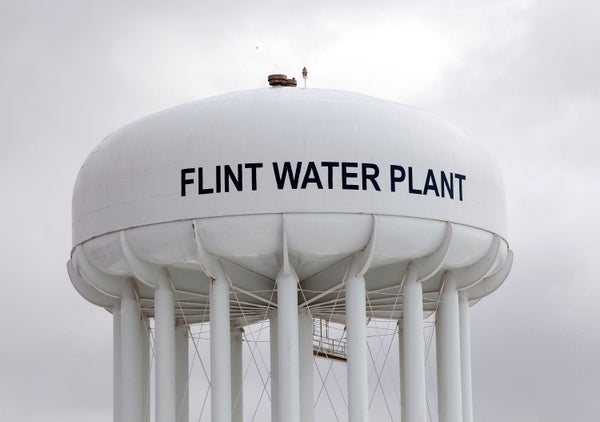
The tainted water crisis in Flint, Mich., didn’t just poison children with lead; it also likely contributed to two outbreaks of Legionnaires’ disease, according to a new study (Environ. Sci. Technol. Lett. 2016, DOI:10.1021/acs.estlett.6b00192). When Flint switched its drinking water source in 2014 from Lake Huron to the Flint River, the corrosive river water created ideal growth conditions for deadly Legionella bacteria. The first to link pipe corrosion to risk of disease at the community scale, the study is a wake-up call to the many cities failing to address corrosion in their aging water pipes.
Legionnaires’ disease is a deadly pneumonia caused by inhaling Legionella pneumophila or other species of Legionella bacteria that lurk in the organic matter lining drinking water pipes. The disease has been on the rise in the U.S., with cases quadrupling over the last 10 years. Headline-grabbing outbreaks often occur from a contaminated ventilation or hot water system in a hospital, and that’s where monitoring and prevention efforts have been focused.
Yet the majority of Legionnaires’ disease cases in the U.S. arise in private homes with no common link other than their water supply, underscoring that drinking water distribution systems are the ultimate source of outbreaks. “Furthermore, lab-scale type studies have illustrated that corrosion in drinking water pipes can stimulate the growth of Legionella,” says Amy Pruden, an environmental microbiologist at Virginia Tech and an author of the study. Corrosive water dissolves the protective mineral lining in pipes and then leaches iron out of old iron pipes. Iron is a micronutrient that boosts Legionella reproduction. The metal also reacts with and inactivates chlorine disinfectant that otherwise would kill the bacteria.
On supporting science journalism
If you're enjoying this article, consider supporting our award-winning journalism by subscribing. By purchasing a subscription you are helping to ensure the future of impactful stories about the discoveries and ideas shaping our world today.
“Our team recognized that the conditions in Flint—a corrosive new water source in an aging water system—were just right for Legionella,” Pruden says. So before the city switched back to Lake Huron water in October 2015, the scientists decided to sample Flint’s water for Legionella, iron, and free chlorine. At the time of sampling, Flint had already experienced outbreaks of Legionnaires’ disease in June 2014 and May 2015, but the researchers were unaware because public health agencies did not notify the public about the outbreak.
The Virginia Tech team, led by environmental engineer Marc A. Edwards, collected tap water samples from homes and hospitals in and around Flint and determined Legionellaconcentrations by counting copies of genes unique to Legionella using quantitative polymerase chain reaction methods. They compared the measurements to those from baseline U.S. water surveys that they and the U.S. EPA carried out in the absence of outbreaks and from Flint buildings that remained on Lake Huron water.
In homes supplied with Flint River water, the scientists recorded Legionella concentrations roughly seven times as high as those found in the baseline surveys. The researchers measured a mean concentration of 1,890 gene copies/mL of L. pneumophila in the hospitals, about 470 times as high as the alert threshold of 4 gene copies/mL suggested by a recent study (Mol. Cell. Probes 2015, DOI: 10.1016/j.mcp.2014.09.002). In more than half the water samples from Flint, the researchers could not detect any chlorine, which they expected due to corrosion. The team reported no measurable iron in the baseline surveys and the control group of buildings using Lake Huron water, but found high levels of 51 ppb in the Flint homes and hospitals. NoLegionella were detected in the buildings using Lake Huron water.
“This paper shows that the water quality disruptions in Flint directly contributed to the presence of Legionella bacteria and the disease cases that subsequently occurred,” says Janet E. Stout, director of the Special Pathogens Laboratory Pittsburgh, the nation’s leading Legionella testing laboratory. She and Pruden support calls for the Environmental Protection Agency to require testing for Legionella in drinking water systems. “Water operators need to understand that when water service is disrupted, the risk of Legionnaires’ disease can go up and the community should be notified,” she concludes.
This article is reproduced with permission from Chemical & Engineering News (© American Chemical Society). The article was first published on July 25, 2016.