
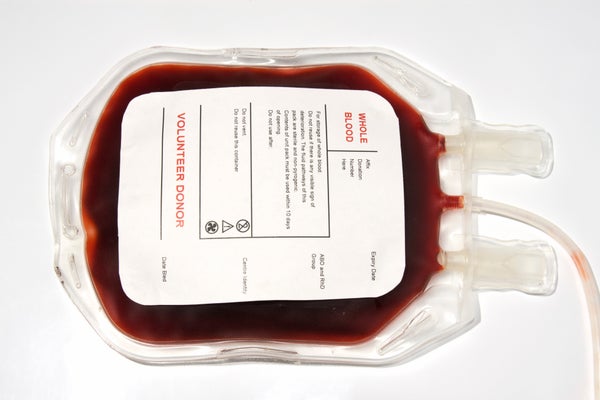
Gay and bisexual men who want to donate blood after the shooting in Orlando, Florida, are largely unable to do so, because of a federal rule that prohibits men who are currently sexually active with other men from donating blood. Now, some are suggesting that it's time for the Food and Drug Administration to reconsider the policy.
The FDA's blood donation guidelines—which all blood donation centers in the U.S. must follow—mandate that men who are sexually active with other men wait at least 12 months following their most recent sexual encounter before donating blood. The rule is aimed at reducing the risk of transmitting the human immunodeficiency virus (HIV) through blood transfusions.
The 12-month waiting period was introduced in December 2015, replacing an earlier FDA policy established in 1985 that prohibited men who had sex with men (MSM) from ever giving blood.
On supporting science journalism
If you're enjoying this article, consider supporting our award-winning journalism by subscribing. By purchasing a subscription you are helping to ensure the future of impactful stories about the discoveries and ideas shaping our world today.
Gay and bisexual men in the U.S. are more severely affected by HIV than any other group of people in the country, according to the Centers for Disease Control and Prevention. For example, in 2010, MSM accounted for 63 percent of estimated new HIV infections in the United States, but the group represents about 2 percent of the U.S. population.
The reason for the change to the 12-month waiting period (also called a deferral period), according to FDA officials, was that recent research determined that the risk of HIV transmission from blood donations from MSM was comparable to that of donations from people who had accidentally been exposed to another person's blood, or had recently received a blood transfusion themselves. Both of these groups must wait 12 months before donating blood. [The 9 Deadliest Viruses on Earth]
And data from other nations with 12-month blood donation deferral periods for MSM—including Australia and the U.K.—showed that a 12-month window did not increase the risk of HIV transmission from blood supplies, according to an FDA statement.
In the statement, released Dec. 2, 2015, Stephen Ostroff, acting commissioner of the FDA, said, "We have taken great care to ensure this policy revision is backed by sound science and continues to protect our blood supply."
But many are suggesting that it's time for the FDA to reconsider the MSM deferral.
On June 13, California Rep. Barbara Lee tweeted her support for lifting the ban, an action she had already proposed to the FDA.
"Low-risk MSM who wish to donate blood and help saves lives should not be exclusively and categorically excluded because of outdated stereotypes," Lee said in the tweet.
R.T. Winston Berkman, a law and public policy graduate student at New York University, told Live Science, "As a public health measure, it's overly broad and casts a discriminatory net." Berkman co-authored a study published May 2015 in the Columbia Medical Review, analyzing the FDA's blood donation ban from a cultural as well as a scientific perspective.
"The ban takes someone's sexual identity and associates it de facto with serious infection and risk," Berkman said. By deferring all MSM, the FDA "maintains a categorical association between gay sex, risky sex and HIV," Berkman and co-author Li Zhou wrote in the study.
"Following this attack, we're seeing gay men come forward who have lost friends and loved ones or know someone who's a survivor, and they're unable to stand in line and donate," Berkman said.
In Italy, blood donation centers review prospective MSM donors on a case-by-case basis, Berkman said. By identifying specific sexual behaviors, such as the number of sex partners a man has and whether he uses protection, officials get a much more accurate picture of whether a donor should be considered a high risk for HIV transmission.
"So far, Italy has not had an increase in transfusion-based transmission—a sign that the policy is effective," Berkman added.
An FDA representative told Live Science in an email that there is currently enough donated blood to meet the needs of the Orlando shooting victims. "We empathize with those who might wish to donate, but reiterate that at this time no one who needs blood is doing without it," the FDA representative said.
For now at least, the current deferral policy will stand, although the FDA will re-evaluate its policies as new scientific information becomes available, the representative said.
But even if the current blood emergency is covered, removing the 12-month deferral period could greatly expand the donor pool in the U.S., Berkman wrote in his study. Based on the number of HIV-negative adult men who are eligible to give blood and who are likely to donate, the change could allow an additional 130,150 men to donate blood, bringing in an estimated 219,200 additional pints of blood per year.
Copyright 2016 LiveScience.com, a Purch company. All rights reserved. This material may not be published, broadcast, rewritten or redistributed.