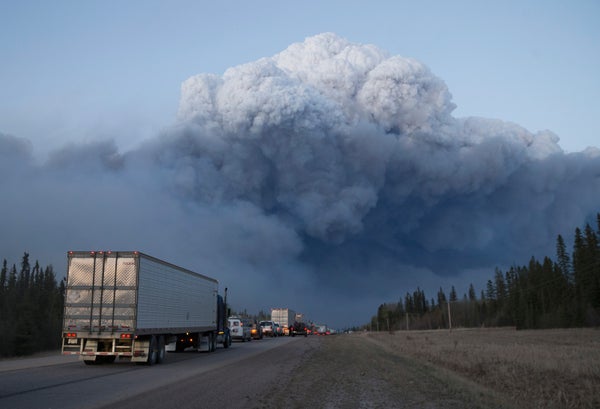
FORT MCMURRAY, AB - MAY 05, 2016: Drivers wait for clearance to take firefighting supplies into town on May 05, 2016 outside of Fort McMurray, Alberta. Wildfires, which are still burning out of control, have forced the evacuation of more than 80,000 residents from the town.
Scott Olson/Getty Images
Join Our Community of Science Lovers!
On supporting science journalism
If you're enjoying this article, consider supporting our award-winning journalism by subscribing. By purchasing a subscription you are helping to ensure the future of impactful stories about the discoveries and ideas shaping our world today.
The intense wildfire that has forced thousands of people to evacuate Fort McMurray and surrounding areas in Alberta arrived early in the wildfire season, fueled by hot, windy weather. Scientists say big fires will ignite sooner and sooner in the year in the western U.S. and Canada as the snow pack continues to dwindle during warmer winters or dries out sooner during warmer springs, leaving terrain parched for more weeks of the year. In the American West a 1-degree Celsius rise in average temperature could increase the annual acreage burned by up to 600 percent in certain regions. See the map below for details.
Sources: University of Washington; U.S. Forest Service Graphic by Bryan Christie
This map was first posted online May 17, 2011.
Subscribe to Support Independent Journalism
Great science journalism requires human expertise, time, effort and creativity. And it costs money. That’s why I and the journalists here at Scientific American hope you’ll join our community.
When you subscribe, you are supporting staff and freelance journalists who are passionate about telling science stories that are true, important and compelling. Our editors and reporters are often experts in their fields, which means they understand the nuances of big discoveries and can untangle the breakthroughs from the hype. With a subscription, you are also supporting rigorous fact-checking to ensure the words we publish are precise and accurate. And you’re supporting original illustrations, graphics and photos that bring you closer to an advanced laboratory, an ice sheet in Antarctica or a space mission in orbit. You’re helping us craft other types of high-quality journalism as well: Our newsletters are carefully written, edited and curated by staffers you have or will come to know and love. Our Science Quickly podcast is based on original reporting, collaboration with editors and scientists and exacting production.
Subscriptions keep this engine running so we can continue to deliver thoughtful, rigorous and independent science journalism to you. In an era of viral misinformation, this work is crucial. If you value what we do, I hope you’ll consider joining us as a subscriber
Thank you,
Jeanna Bryner, Editor in Chief, Scientific American