
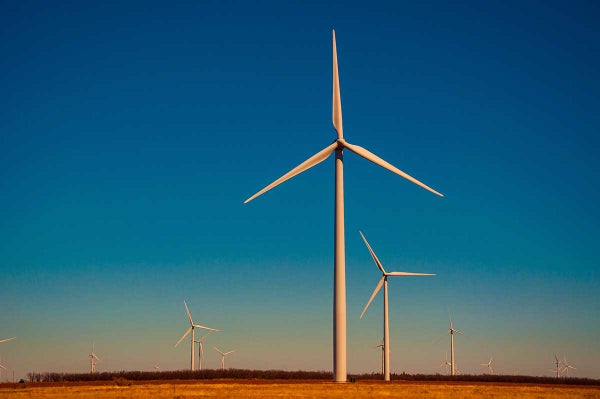
China solidified its standing as the world’s wind energy behemoth in 2015, adding almost as much wind power capacity in one year as the total installed capacity of the three largest U.S. wind-producing states: Texas, Iowa and California.
New data from Bloomberg New Energy Finance show China installed just under 29 gigawatts of new wind energy capacity in 2015, surpassing its previous record of roughly 21 GW set in 2014. The country also accounted for more than 46 percent of all wind power installed globally for the year, eclipsing the next largest market, the United States, which added 8.6 GW (ClimateWire, Jan. 28).
Amy Grace, head of wind insight at BNEF, said the Chinese growth figure was the biggest surprise of 2015 and roughly 4 GW higher than analysts predicted. After China and the United States, the world’s largest markets for new wind power in 2015 were Germany, India and Brazil, with gross installs of 3.7, 2.6 and 2.6 GW, respectively.
On supporting science journalism
If you're enjoying this article, consider supporting our award-winning journalism by subscribing. By purchasing a subscription you are helping to ensure the future of impactful stories about the discoveries and ideas shaping our world today.
Grace noted in an email that Chinese developers “got very excited about qualifying projects” before the government implemented a second round of reductions to its feed-in tariff program for onshore wind farms. The reforms, initiated in early 2015, reduced payments to turbine owners by roughly 3 cents per kilowatt-hour across the country’s primary wind-energy-producing regions in the north and west of the country.
But a rush to collect cash wasn’t the only driving factor behind China’s wind energy boom, according to other experts who track the country’s energy indicators. Nor does a boom in Chinese turbine installations necessarily translate into a proportionate gain in electricity flowing to China’s grid.
Joanna Lewis, an associate professor of science, technology and international affairs at Georgetown University’s Edmund A. Walsh School of Foreign Service, said China’s wind power sector has also been aided by a steep decline in manufacturing and installation costs, as well as the establishment of a robust domestic supply chain, led by the nation’s industry leader, Goldwind.
“The feed-in tariff is still important as a driver,” Lewis said, “but there are other government policies and incentives that are continuing to drive the rapid pace” of wind power development in China. They include the central government’s commitment to replace heavily polluting coal-fired power plants, which are blamed for wrenching air conditions in China’s cities, with non-emitting resources such as wind, solar and hydropower.
As part of that commitment, the government has pledged to produce 15 percent of all electricity by 2020 using renewable resources, including 250 GW of wind power expected to come online by the end of the decade.
“This is partly about reducing carbon emissions, but it’s also an air quality issue that has become very, very urgent,” said Kate Gordon, vice chairwoman for climate and sustainable urbanization at the Paulson Institute, the China-focused environmental policy think tank led by former Treasury Secretary Henry Paulson.
Gordon and Lewis also stressed that China’s clean energy story is only partly about capacity additions. The country still has considerable work ahead to effectively integrate renewable energy resources into the national grid. Among the hurdles are basic grid connectivity, but also the need for more effective management of the country’s power supply so that renewable energy resources are optimized.
While investment in China’s power grid has risen substantially, the country still has some of the world’s highest curtailment rates for renewable energy, meaning thousands of turbines are taken offline, even under optimum wind conditions, because grid operators lack the knowledge and skills to integrate the clean energy with other sources, including baseload power from coal plants.
Because of those limitations, Lewis said the United States remains a world leader in wind energy because capacity factors and utilization rates are much higher on average for U.S. wind turbines than for Chinese turbines.
But China’s turbine technology is improving quickly, and it is closing the gap in the wind industry supply chain against other global brands.
According to BNEF, Beijing-based Goldwind dominated the Chinese domestic market in 2015, accounting for 7.7 GW of China’s new capacity, followed by rival Guodian United Power Technology Co. Ltd. with 2.9 GW, and Envision Energy and Ming Yang Wind Power Group Ltd., each with 2.7 GW of new capacity.
Reprinted from Climatewire with permission from Environment & Energy Publishing, LLC. www.eenews.net, 202-628-6500