
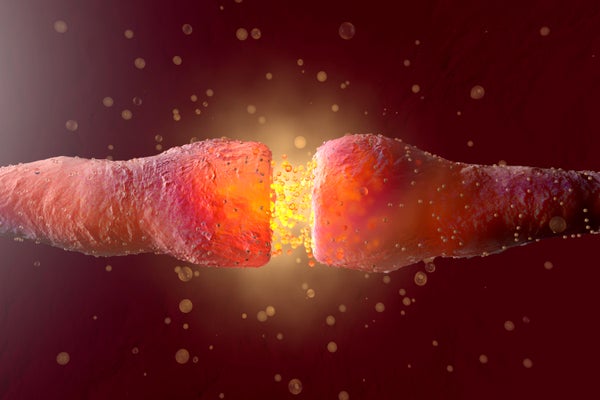
Once a memory is lost, is it gone forever? Most research points to yes. Yet a study published in the online journal eLife now suggests that traces of a lost memory might remain in a cell's nucleus, perhaps enabling future recall or at least the easy formation of a new, related memory.
The current theory accepted by neurobiologists is that long-term memories live at synapses, which are the spaces where impulses pass from one nerve cell to another. Lasting memories are dependent on a strong network of such neural connections; memories weaken or fade if the synapses degrade.
In the new study, researchers at the University of California, Los Angeles, studied sea slugs' neurons in a cell culture dish. Over several days the neurons spontaneously formed a number of synapses. The scientists then administered the neurotransmitter serotonin to the neurons, causing them to create many more synapses—the same process by which a living creature would form a long-term memory. When they inhibited a memory-forming enzyme and checked the neurons after 48 hours, the number of synapses had returned to the initial number—but they were not the same individual synapses as before. Some of the original and some of the new synapses retracted to create the exact number the cells started with.
On supporting science journalism
If you're enjoying this article, consider supporting our award-winning journalism by subscribing. By purchasing a subscription you are helping to ensure the future of impactful stories about the discoveries and ideas shaping our world today.
The finding is surprising because it suggests that a nerve cell body “knows” how many synapses it is supposed to form, meaning it is encoding a crucial part of memory. The researchers also ran a similar experiment on live sea slugs, in which they found that a long-term memory could be totally erased (as gauged by its synapses being destroyed) and then re-formed with only a small reminder stimulus—again suggesting that some information was being stored in a neuron's body.
Synapses may be like a concert pianist's fingers, explains principal investigator David Glanzman, a neurologist at U.C.L.A. Even if Chopin did not have his fingers, he would still know how to play his sonatas. “This is a radical idea, and I don't deny it: memory really isn't stored in synapses,” Glanzman says.
Other memory experts are intrigued by the findings but cautious about interpreting the results. Even if neurons retain information about how many synapses to form, it is unclear how the cells could know where to put the synapses or how strong they should be—which are crucial components of memory storage. Yet the work indeed suggests that synapses might not be set in stone as they encode memory: they may wither and re-form as a memory waxes and wanes. “The results are really just kind of surprising,” says Todd Sacktor, a neurologist at SUNY Downstate Medical Center. “It has always been this assumption that it's the same synapses that are storing the memory,” he says. “And the essence of what [Glanzman] is saying is that it's far more dynamic.”
