
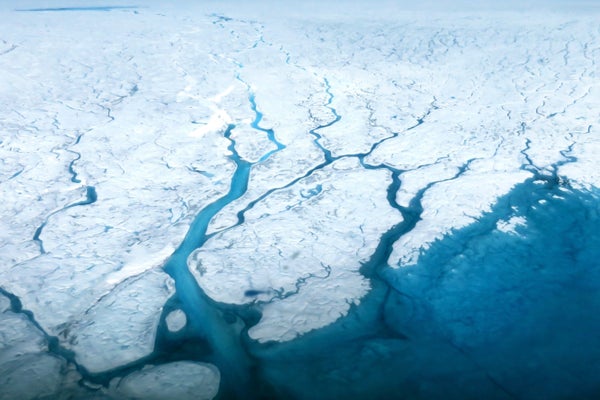
Greenland’s snow-white ice is getting darker and melting faster, a new study shows.
Soot deposited from forest fires is helping to color the snow, drawing in warmth like a black car in summer. But even cleaner ice may be melting faster due to higher temperatures that cause the formation of larger ice grains, according to the study, published in the European Geosciences Union journal The Cryosphere.
“It’s a self-feeding process, which is ultimately very important because it accelerates warming,” said the study’s lead author, Marco Tedesco, a professor at Columbia University’s Lamont-Doherty Earth Observatory.
On supporting science journalism
If you're enjoying this article, consider supporting our award-winning journalism by subscribing. By purchasing a subscription you are helping to ensure the future of impactful stories about the discoveries and ideas shaping our world today.
The surface’s reflectivity, which scientists call albedo, could decrease by as much as 10 percent by the end of the century, the study finds. That’s a big deal for Greenland, which holds a tenth of the world’s ice mass, according to the U.S. Geological Survey.
That, according to Tedesco, could have large implications globally, as fresh meltwater from Greenland pours into the ocean, raising sea levels and affecting ocean ecology and circulation.
“The ice sheet is more preconditioned every year to become more sensitive,” Tedesco said.
A positive feedback loop compounds the speed of melting, he added.
The whiter the ice, the more reflective it is, and the less heat it absorbs from the sun. The converse of this also holds true: The darker the ice gets, the more heat it absorbs and the more quickly it melts. And the more quickly the ice melts, the darker it gets—causing even more melting.
“When snow first falls, snow grains are quite small, and as snowpack ages, and particularly for warmer snowpack, you get consolidation of those grains into larger clumps,” said Sarah Doherty, a researcher at the University of Washington who co-authored the paper.
After checking the satellite data for accuracy, scientists determined that the ice’s larger grain size was a key factor in the melting.
“Basically, we’re taking satellite observations that say it’s getting darker and taking a model that simulates temperature and snow morphology and using that to calculate how snowpack has evolved,” Doherty said.
Though soot levels have fallen in recent decades, she said, the ice continues to melt more quickly. That’s evidence that more pollution isn’t necessarily the culprit, she said.
Better understanding the reasons behind Greenland’s ice melt can give scientists more insight into a warmer future in other regions.
“If we can understand that,” said Columbia’s Tedesco, “then we can predict better what’s going to happen in future with a warmer Arctic.”
Reprinted from Climatewire with permission from Environment & Energy Publishing, LLC. www.eenews.net, 202-628-6500