
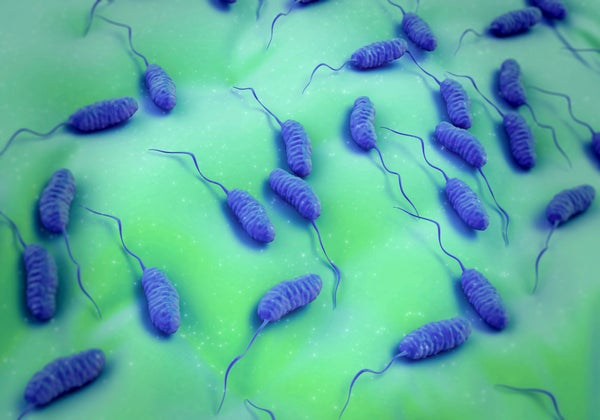
Deadly bacteria are spreading through the oceans as waters warm up, and are increasing infection risks, according to a new study.
Multiple species of rod-shaped Vibrio bacteria live in the world’s oceans, and their populations rise and fall based on many different variables, changing the likelihood of making people sick.
A report published yesterday in the journal Proceedings of the National Academy of Sciencesexamined the role of the changing climate in Vibrio infections.
On supporting science journalism
If you're enjoying this article, consider supporting our award-winning journalism by subscribing. By purchasing a subscription you are helping to ensure the future of impactful stories about the discoveries and ideas shaping our world today.
In the United States, Vibrio bacteria cause about 80,000 illnesses and 100 deaths each year. The species that causes the devastating diarrheal disease cholera, Vibrio cholerae, is responsible for up to 142,000 deaths around the world annually, according to the World Health Organization.
Other species, like Vibrio vulnificus, can also infect humans, often through undercooked seafood or from wounds exposed to contaminated seawater.
Infection risks tend to rise when water temperatures go up, so researchers sought to figure out whether rising temperatures have played a role in the bacteria’s abundance.
Co-author Rita Colwell, a professor at the University of Maryland and the Johns Hopkins Bloomberg School of Public Health, explained that her team looked at records of plankton, tiny organisms that drift and float at the ocean’s surface. This includes small animals as well as bacteria.
“We picked up stored samples of plankton collected every year for 50 years,” Colwell said. “What’s beautiful about this is it’s ground truth. It’s actually taking measurements on the ground.”
These plankton samples were collected from nine areas in the North Atlantic and the North Sea between 1958 and 2011. During this time frame, sea surface temperatures increased by roughly 1.5 degrees Celsius.
From the plankton samples, researchers measured the presence and abundance of Vibriobacteria and compared the information to climate records. Controlling for other variables like ocean salinity and acidity, researchers found that Vibrio bacteria populations increased as sea surface temperatures rose.
“Such increases are associated with an unprecedented occurrence of environmentally acquiredVibrio infections in the human population of Northern Europe and the Atlantic coast of the United States in recent years,” researchers wrote in the study.
For most developed countries, good water management can mitigate much of the harm associated with an increase in ocean bacteria. “As long as those treatment facilities remain intact, I don’t think we’re going to see outbreaks of cholera [in Europe and the United States] again,” Colwell said.
The bigger problems may lurk in developing countries, where sanitation systems are not as good and may be vulnerable to extreme weather like floods and typhoons. An increased abundance of bacteria may pose a greater infection risk as salt water and brackish water flood coastal areas.
“That’s going to be a problem,” Colwell said.
Rising ocean temperatures also mean more of the world’s waterways are becoming hospitable toVibrio, which starts growing at 15 degrees Celsius, increasing the likelihood of communities coming into contact with these infections for the first time, whether through seafood or recreational exposure.
Colwell said the next step is to develop methods to anticipate and rapidly diagnose Vibriooutbreaks, using satellite data to track plankton populations in the ocean and deploying genome sequencing techniques to identify the bacterial culprits.
Reprinted from ClimateWire with permission from Environment & Energy Publishing, LLC. E&E provides daily coverage of essential energy and environmental news at www.eenews.net. Click here for the original story.
