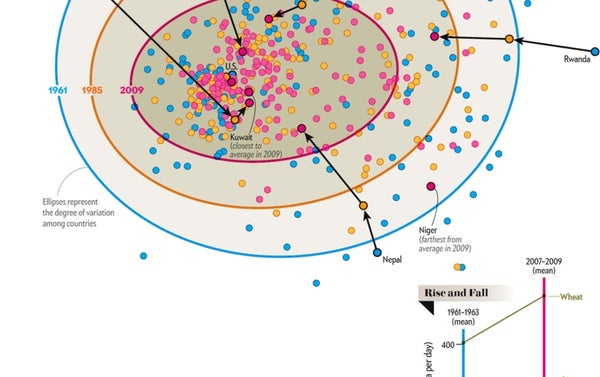
SOURCE: “INCREASING HOMOGENEITY IN GLOBAL FOOD SUPPLIES AND THE IMPLICATIONS FOR FOOD SECURITY,” BY COLIN K. KHOURY ET AL., IN PROCEEDINGS OF THE NATIONAL ACADEMY OF SCIENCES USA, VOL. 111, NO. 11; MARCH 18, 2014
Join Our Community of Science Lovers!
On supporting science journalism
If you're enjoying this article, consider supporting our award-winning journalism by subscribing. By purchasing a subscription you are helping to ensure the future of impactful stories about the discoveries and ideas shaping our world today.
Back in 1961, residents of far-flung countries ate very different mixes of crops (blue, below). By 1985 the disparities worldwide had shrunk (orange), and daily fare became even more homogeneous by 2009 (magenta). In nearly 50 years the differences in foods eaten narrowed by 68 percent. Prevalent staples such as wheat have become even more dominant, and oil crops such as soybean, palm and sunflower have risen sharply (bottomright). The convergence comes at the expense of many minor crops, says Colin Khoury of the International Center for Tropical Agriculture. People are consuming more processed foods made from a small number of ingredients and are frying with oils instead of steaming. Although the resultant increase in calories has been needed in certain regions, scientists say obesity, diabetes and heart disease are rising globally. They are also concerned that if one crop falters because of disease or drought, food prices could soar and supplies across continents could crumble.
SOURCE: “INCREASING HOMOGENEITY IN GLOBAL FOOD SUPPLIES AND THE IMPLICATIONS FOR FOOD SECURITY,” BY COLIN K. KHOURY ET AL., IN PROCEEDINGS OF THE NATIONAL ACADEMY OF SCIENCES USA, VOL. 111, NO. 11; MARCH 18, 2014. Graphic by Jen Christiansen
Subscribe to Support Independent Journalism
Great science journalism requires human expertise, time, effort and creativity. And it costs money. That’s why I and the journalists here at Scientific American hope you’ll join our community.
When you subscribe, you are supporting staff and freelance journalists who are passionate about telling science stories that are true, important and compelling. Our editors and reporters are often experts in their fields, which means they understand the nuances of big discoveries and can untangle the breakthroughs from the hype. With a subscription, you are also supporting rigorous fact-checking to ensure the words we publish are precise and accurate. And you’re supporting original illustrations, graphics and photos that bring you closer to an advanced laboratory, an ice sheet in Antarctica or a space mission in orbit. You’re helping us craft other types of high-quality journalism as well: Our newsletters are carefully written, edited and curated by staffers you have or will come to know and love. Our Science Quickly podcast is based on original reporting, collaboration with editors and scientists and exacting production.
Subscriptions keep this engine running so we can continue to deliver thoughtful, rigorous and independent science journalism to you. In an era of viral misinformation, this work is crucial. If you value what we do, I hope you’ll consider joining us as a subscriber
Thank you,
Jeanna Bryner, Editor in Chief, Scientific American