
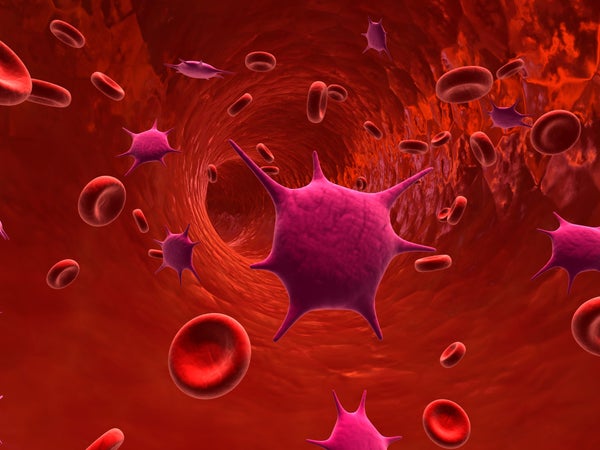
Researchers say that they have found a way to smuggle drug-carrying nanoparticles past the body’s immune system: by camouflaging them to look like cell fragments found in human blood.
Man-made nanoparticles — created from plastic or metal — can be designed to deliver a cargo of drugs to specific areas of the body. But they are often attacked and swallowed up by the body’s natural defence system, which sees them as foreign invaders.
The disguised particles are not only able to evade detection, but also exploit the natural properties of platelets to treat bacterial infections and to repair damaged blood vessels more effectively than conventional ways of delivering drugs, report the team. The researchers were led by Liangfang Zhang at the University of California, San Diego, and published their work in Nature on September 16.
On supporting science journalism
If you're enjoying this article, consider supporting our award-winning journalism by subscribing. By purchasing a subscription you are helping to ensure the future of impactful stories about the discoveries and ideas shaping our world today.
Zhang’s team began with 100-nanometer-wide particles made of the biodegradable polymer PLGA, and coated them in membranes taken from human platelets — cell fragments found in the blood that accumulate at sites of tissue damage and begin the clotting process. This helps the particles to evade the immune system, the authors say.
Researchers have previously tried to attach key parts of platelet membranes onto nanoparticles to avoid immune attack; in particular, the platelet’s CD47 protein. That protein sends out a 'don’t eat me' signal to the body's immune system, says Dennis Discher, a nanoengineer at the University of Pennsylvania in Philadelphia. But Zhang's nanoparticles boast the most complete set of membrane proteins yet, says Omid Farokhzad, a physician and nanotechnologist at the Brigham and Women’s Hospital in Boston, Massachusetts, who wrote a News & Views article that accompanied the paper.
Cloaked assassins
The platelet-coated nanoparticles have other advantages. Bacteria such as methicillin-resistantStaphylococcus aureus (MRSA), for instance, can stick to platelets — a feature they exploit to protect themselves from the immune system. This makes them naturally more likely to interact with coated nanoparticles. Platelets are also attracted to specific areas of the body where tissue damage is occurring.
The particles harness platelets' unique natural abilities, says Samir Mitragotri, a chemical engineer at the University of California, Santa Barbara, who was not involved in the work. “This a highly innovative approach,” he adds.
Zhang’s team injected cloaked nanoparticles — with antibiotics inside — into mice infected with MRSA. This reduced MRSA bacteria populations in the liver and spleen by 1,000 times compared to when mice were given conventional antibiotics, and required just one-sixth of the conventional drug dose. (In other organs nanoparticles were also more effective than conventional drug delivery, but the difference was less pronounced).
The team also exploited the fact that platelets tend to migrate to damaged blood vessels. They loaded camouflaged nanoparticles with a drug called docetaxel, to see if it could prevent the excess thickening of damaged artery walls (an effect that can cause problems after surgery). When these nanoparticles were injected into rats that had damaged blood vessels, the particles clustered in larger concentrations at the damaged sites than in the rats' healthy tissue. And the docetaxel treatment was more effective when delivered this way than when it was delivered into the blood stream without using nanoparticles, the team showed.
The ability to deliver high drug doses to these sites while avoiding immune-system cells called macrophages, which usually destroy most nanoparticles even at disease sites, is impressive, says Discher.
Question marks
But not everyone is convinced about the particles' cloaking ability. Although a small fraction of the particles clustered at sites of disease, the vast majority of them quickly ended up in the animals’ liver and spleen — suggesting that the majority of particles were still being caught by immune defenses in those locations, says Moein Moghimi, a specialist in nanotechnology pharmaceuticals at the University of Copenhagen. Moghimi thinks that a much more stringent examination of the body’s immune response to the particles is needed.
Zhang says that his team next plans to make larger amounts of the cloaked nanoparticles, and to test their use in larger animals before therapies could begin trials in humans. Because platelets tend to cluster around cancer cells in the blood, as well as around bacteria, the team will next see whether cloaked nanoparticles could be used to target cancer, he adds.
Developing therapies from hybrid nanoparticles that combine synthetic and biological components will be a long and bumpy road, says Farokhzad. “But is this a technology I would bet on? Absolutely. I think the promise is huge."
This article is reproduced with permission and was first published on September 16, 2015.