
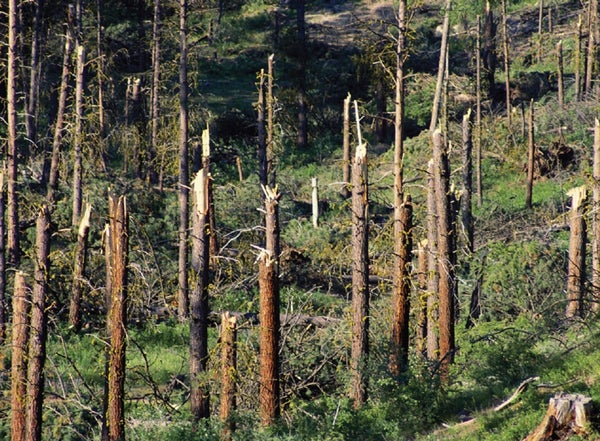
After a particularly strong storm named Klaus hit southwestern France in 2009, researchers made a curious observation about the devastation: nearly all the trees whipped by winds blowing at speeds of 94 miles per hour or more had snapped, regardless of their species, height or diameter, whereas most trees hit by gusts below that threshold were left intact. Was this wind-speed threshold really the arbiter of destruction?
Physicist Christophe Clanet and his colleagues at France's École Polytechnique and ESPCI ParisTech set to find out by fracturing beechwood rods of various lengths and diameters under controlled conditions. To do so, they inserted one end of a given rod into a hole of the same diameter in a block of steel and slowly added force to the other end, causing the rod to bend. They then measured the critical curvature at which the rod cracked and ran those values through mathematical fracturing formulas to determine a corresponding wind speed. What they found matched the real-world scenario of 2009: the calculated wind speed to break the rods—no matter the size—was about 94 mph. The study was recently published in Physical Review E.
Why such consistency? The results come down to a combination of physics and evolution. Although mathematics alone would predict that the wind speed required for tree fracture should depend on trunk diameter and tree height, nature does not make trees that are both thin and tall. Instead short trees are thin and tall ones thick. Even more, thicker trees have larger defects, such as knots, where stress concentrates when a tree bends.
On supporting science journalism
If you're enjoying this article, consider supporting our award-winning journalism by subscribing. By purchasing a subscription you are helping to ensure the future of impactful stories about the discoveries and ideas shaping our world today.
Together those characteristics—flaws, length and diameter—cancel one another out, leaving wind speed as the major determiner of a snap. So although a short tree has smaller stress points for cracks, it is thinner and could more easily split. On the other hand, a tall tree has width and stiffness going for it, but larger internal flaws undermine its sturdiness.
The finding is notable for its simplicity: one equation to understand tree mechanics. Several outside experts have concerns about this very quality, however. For example, Lee Frelich, director of the University of Minnesota Center for Forest Ecology, says that modeling trees as branchless cylinders neglects the streamlining of branches in the wind, which in turn changes the relation between force on the trunk and wind speed. In other words, the setup did not reflect the complex interactions of real-life biology, weather and physics. Regardless, Clanet and his colleagues do think the results have utility and plan to study whether wind gusts, as opposed to the steady wind speeds assumed for this project, change the breaking point.
