
Editor's Note (8/30/16): This story was updated at 3:30 P.M.
Sit! Stay! Good boy! Many of us use such words with our nonhuman best friends every day. Now new research suggests that they may actually understand at least some of what we say—and that they may be paying a lot of attention to how we say it.
The findings, published this week in Science, may prove what pooch-lovers have long believed to be true: Their beloved canines can process language in a more nuanced way than has long been assumed. “We think of words as being unique to humans but, in fact, dogs can process the meaning and tone of words—and they do it in a very similar way to humans,” says lead researcher Atilla Andics, a neuroscientist at Eötvös Loránd University in Budapest.
On supporting science journalism
If you're enjoying this article, consider supporting our award-winning journalism by subscribing. By purchasing a subscription you are helping to ensure the future of impactful stories about the discoveries and ideas shaping our world today.
Scientists have long believed that humans’ ability to form words—basic building blocks of language—emerged as a distinctive brain mechanism to support communication. Words are arbitrary sounds, Andics explains, and humans assign them meanings. Other animals do not generally exhibit this ability. But even though dogs do not vocalize words, they do seem to understand a wide variety of them, he notes. Dogs sit, fetch, shake paws and snuggle in response to endearments from their human companions every day.

Dogs can tell the difference between your excited voice and your angry one. Credit: BORBÁLA FERENCZY
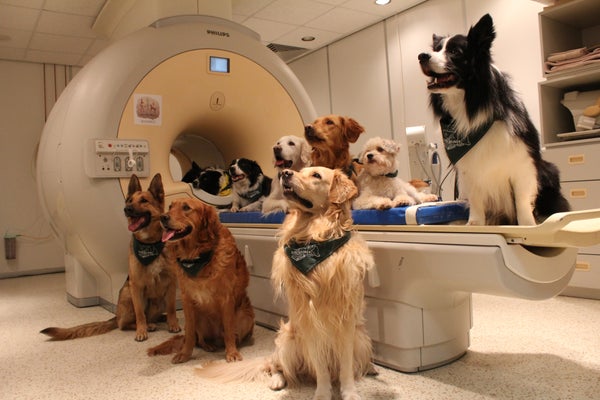
To test which verbal cues dogs really recognize, Andics and his team recruited 13 dogs of varying breeds, from border collies to golden retrievers. They trained the dogs to lie motionless inside a functional magnetic resonance imaging (fMRI) brain scanner for seven minutes and then the researchers played recordings of the dogs’ trainer. While the dogs listened, the scientists measured the animals’ brain activity.
The team tested different combinations of words and intonations. For example, one recording might have included praise such as “Well done!” spoken in an exuberant, high-pitched tone. In another the trainer might have said the same words in a neutral tone or spoken a gibberish sentence made of only conjunction words like “if” and “however.”
The researchers say the scan results indicated that dogs, like humans, use different regions of the brain to process different parts of speech. They use the left hemisphere to parse the meanings of words and the right hemisphere to analyze intonation. And the dogs in the experiment were also apparently able to put these two types of information together—when positive words were matched with positive tones, the dopamine reward centers of the dogs’ brains were activated. When positive words were combined with neutral tones, however, the reward circuits were slightly less active. And when neutral conjunctive words were spoken in a positive tone—essentially forming a gibberish sentence—the dogs’ reward circuits did not respond at all. “Dogs are very smart,” Andics says. “Praising them with the correct intonation can work just as well as other rewards like food or a pat on the back.”

Researchers visualize dogs’ brain activity. Credit: VANDA MOLNÁR, VILJA MOLNÁR
The results build on previous studies that show dogs can process nonverbal cues like the tone of someone’s voice, says Victoria Ratcliffe, an animal behavior researcher at the University of Sussex, who was not involved in thestudy. In her own research Ratcliffe found that dogs could distinguish between male and female voices and could even detect the intonation of a sentence spoken in a foreign language. “This new study shows that dogs pick up much more information than we thought,” she says.
Although we still don’t know exactly what dogs’ brains interpret when they hear “good job!,” the results suggest the words have some sort of representation and meaning, Ratcliffe says. And it is possible that other animals also use the same brain regions to process language. Studying animals that show similar hemispheric biases for their own vocalization—like primates, sea lions and horses—could reveal important clues about how ancient language-processing mechanisms are, she adds: “Evolutionarily, this could go far beyond primates to a common ancestor for all mammals.