
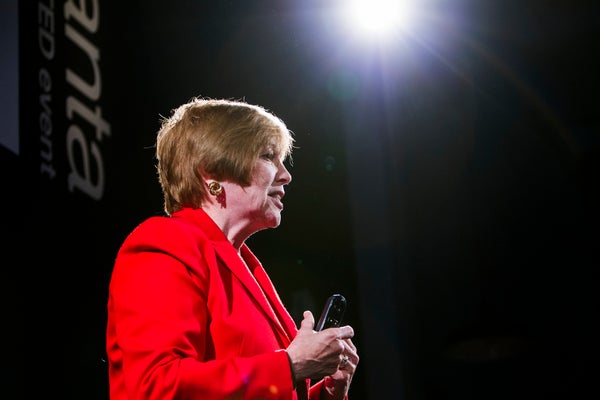
Georgia’s public health commissioner, an OB-GYN and two-time Republican candidate for Congress, has been named the next director of the Centers for Disease Control and Prevention.
Dr. Brenda Fitzgerald will replace Dr. Tom Frieden, who served as CDC director for eight years before stepping down in January.
Fitzgerald has practiced medicine for about three decades in Carrollton, a city west of Atlanta. But she does not appear to have a record of having conducted scientific research, a major function of the agency she has been nominated to lead.
On supporting science journalism
If you're enjoying this article, consider supporting our award-winning journalism by subscribing. By purchasing a subscription you are helping to ensure the future of impactful stories about the discoveries and ideas shaping our world today.
In announcing the appointment, Tom Price, the secretary of health and human services, said Fitzgerald “has a deep appreciation and understanding of medicine, public health, policy and leadership—all qualities that will prove vital as she leads the CDC.”
“It’s good that she has experience running a public health agency,” said Frieden, who was New York City’s health commissioner before taking the helm of the CDC.
“If she’s willing to listen to the staff and learn from the staff and then to understand that a large part of her role is to support them, yes, she can be very successful,” he said, noting it will be critical for Fitzgerald to protect the embattled agency’s budget.
The selection of Fitzgerald—an ally of former GOP House Speaker Newt Gingrich—may generate some controversy.
In 2014, during the West African Ebola crisis, Georgia Gov. Nathan Deal stated publicly that water destroys Ebola viruses — it does not—and attributed the notion to Fitzgerald.
And she has been involved in partisan politics, having run twice for the Republican nomination for Georgia’s 7th Congressional District in the early 1990s.
Fitzgerald did not win the nomination either time.
An Atlanta Journal-Constitution article analyzing Fitzgerald’s defeat in 1994 noted she faced attacks from anti-abortion activists; in the lead-up to the vote, some distributed flyers in church parking lots proclaiming that she had performed abortions.
Fitzgerald publicly denied the claim in a debate with Republican Bob Barr, who went on to win the nomination and the district.
“I’ve spent my entire life trying to help infertile couples,” Fitzgerald said. “In the entire time I’ve been a licensed physician, I’ve never performed an abortion.”
However, Fitzgerald’s position on abortion appeared to be more nuanced than anti-abortion forces in Georgia could abide. She was on the record in the early 1990s as saying while she opposed federal funding of abortion and favored some restrictions, the final decision should be left to a woman and her doctor.
Fitzgerald, who is in her early 70s, has also publicly endorsed vaccinations, which will hearten the public health community. Trump’s position on vaccines—he has stated that children receive too many vaccines too quickly in early childhood—has been a source of major concern in public health circles.
“Vaccination is our best protection against measles and a host of other infectious diseases,” Fitzgerald, by then Georgia’s public health commissioner, wrote in 2015 in a column in the Atlanta Journal-Constitution.
Fitzgerald was named state commissioner of public health in 2011.
She is a former major in the U.S. Air Force, and a one-time president of the Georgia OB-GYN Society. During Gingrich’s tenure as House speaker, she served as one of his health care policy advisers.
Fitzgerald received a Bachelor of Science degree from Georgia State University in 1972 and was awarded a medical degree from Emory University in 1977.
Republished with permission from STAT. This article originally appeared on July 6, 2017