
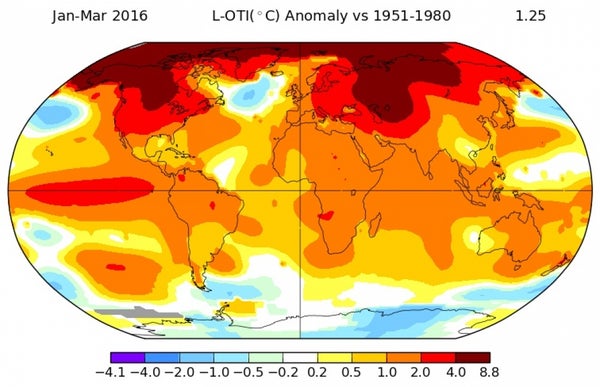
The past 11 months have been the hottest such months in 135 years of recordkeeping, a streak that has itself set a record and puts in clear terms just how much the planet has warmed due to the buildup of greenhouse gases in the atmosphere.
New global temperature data released on Friday by NASA put March at 2.3°F (1.28°C) above the 1951-1980 average for the month, making it the warmest March on record. It beat out the previous warmest March, from 2010, by 0.65°F (0.36°C)—a handy margin.
It also marked the 11th month in a row to set such a record, beating out the previous such streak of 10 months set back in 1944.
On supporting science journalism
If you're enjoying this article, consider supporting our award-winning journalism by subscribing. By purchasing a subscription you are helping to ensure the future of impactful stories about the discoveries and ideas shaping our world today.
March also marked six straight months with temperatures that were more than 1°C above average, a notable mark given the stated goal of international climate talks to keep warming in the 21st century below 2°C (with some talk of even aiming for 1.5°C).

March wasn’t as anomalously warm as February, which retains its title as the most anomalously warm month on record. (January 2016 had previously held the number one position.)
Several other agencies around the world keep their own global temperature records, including the National Oceanic and Atmospheric Administration, which will release its March numbers next Tuesday. So far this year, the NOAA and NASA data has tracked fairly closely.
The Japan Meteorological Agency put March at 1.93°F (1.07°C) above the 20th century average. Each agency uses different baselines and their numbers can differ slightly from each other because of different ways of processing the temperature data.
For the last few months, global temperatures have received a boost from an exceptionally strong El Niño, but the bulk of the temperature rise is due to the excess heat trapped in the atmosphere by carbon dioxide and other greenhouse gases emitted by human activities.
The succession of temperature records has also been accompanied by other notable climate records, including thebiggest ever year-to-year jump in carbon dioxide levels at the Mauna Loa observatory in Hawaii, as well as a record low winter Arctic sea ice peak. The Arctic, in fact, has been one of the most anomalously warm areas of the planet over the past year and is warming at twice the rate of the planet as a whole.
So far, 2016 is on track to beat out 2015 as the warmest year on record, but the year is only three months old. El Niño is waning, and it could usher in a La Niña later in the year, which tends to have a cooling effect on global temperatures. But how much of a role any La Niña plays will depend on how strong it is and when it forms and it is likely to have more of an influence on 2017’s temperatures than this year’s.
This article is reproduced with permission from Climate Central. The article was first published on April 15, 2016.