
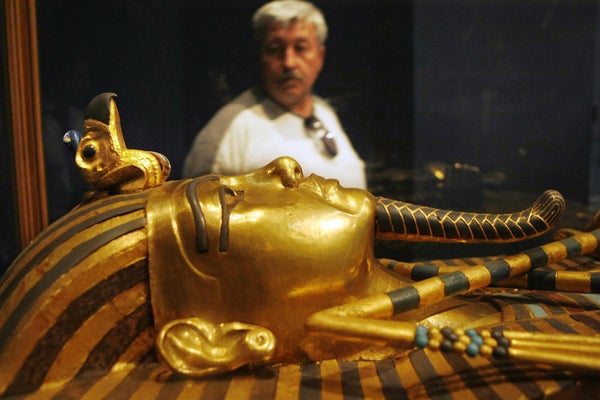
Radar experts are casting doubt on claims that King Tutankhamun's tomb contains hidden, undiscovered chambers — and they're calling for more data to be released.
At a March 17 newsconference, officials at Egypt's antiquities ministry released radar data that they said showed the presence of hidden cavities inside the tomb of King Tut. The scans, carried out by Japanese radar technologist Hirokatsu Watanabe, "suggest the presence of two empty spaces or cavities beyond the decorated North and West walls of the burial chamber," they said in a statement. The scans also suggest the "presence of metallic and organic substances," and show what could be door lintels that indicate the presence of doorways, they said.
Egyptologist Nicholas Reeves, Director of the Amarna Royal Tombs Project, said the cavities may contain the burial of Tutankhamun's stepmom, Queen Nefertiti. [See Photos of King Tut's Burial and Radar Scans]
On supporting science journalism
If you're enjoying this article, consider supporting our award-winning journalism by subscribing. By purchasing a subscription you are helping to ensure the future of impactful stories about the discoveries and ideas shaping our world today.
However, Live Science contacted radar experts not affiliated with the project, and they said they doubt the validity of these claims. Some of these experts noted that the geology of the Valley of the Kings, which contains many natural voids, makes it difficult for radar to distinguish archaeological features from natural ones.
"It does not appear that these GPR [ground-penetrating radar] data have been processed, or that any of the so-called anomalies are visible in the raw data that are provided," said Lawrence Conyers, a professor of anthropology at the University of Denver. Conyers literally wrote the book (now in its third edition) on the use of ground-penetrating radar in archaeology.
"My suggestion to those who are collecting it is that they release the raw data for some peer review by other GPR people before they allow the antiquities people to hold a press conference about all the 'riches' that might be in these supposed tombs," Conyers said. "That [peer review] would cut down on all the speculation and critiques that have been going around by email the last few days, as there might be many scientists who could reach a consensus in advance of the speculation in the press."
Michele Pipan, a geosciences professor at the University of Trieste in Italy, said the radar images released by the antiquities ministry show "many interesting features" but that the absence of vertical or horizontal scales on the images makes it difficult to determine how many feet behind the wall they are located.
"I may only say that cavities and metals may fall within the reasonable detection range of a survey like that, but I obviously know nothing about the kind of inversion/interpretation procedure adopted by Watanabe," Pipan said, noting that more information on radar velocity is also needed. The inversion/interpretation procedure refers to the techniques used to gather and analyze the radar data.
Live Science talked to other radar experts who agreed to comment only off the record. They also expressed doubts on the findings, and said there was a need for third-party review and the release of more data.
The Egyptian antiquities ministry said more radar surveys will be conducted in the next few days, and another news conference is scheduled to take place on April 1 in Luxor.
Economic crunch
Egypt's tourism numbers have plummeted since the 2011 revolution that drove then-President Hosni Mubarak from power, according to other experts who spoke with Live Science. The country has been subject to terrorist attacks, including an attack by the Islamic State group that brought down a Russian plane in the Sinai Desert.
Egyptologists have expressed hope that if Tutankhamun's tomb does, indeed, hold Nefertiti's tomb, it may help to bring back tourists and the badly needed jobs and income.
Reeves recently told The New York Times that now is a good time to visit Egypt. "For anyone interested in Egyptian history, this is the time to plan a trip, because you're not going to get jostled by others the way you would have prerevolution. And, it's also a more affordable destination because prices have dropped," Reeves said.
Reeves did not immediately return Live Science's requests for comment.
Copyright 2016 LiveScience, a Purch company. All rights reserved. This material may not be published, broadcast, rewritten or redistributed.
