
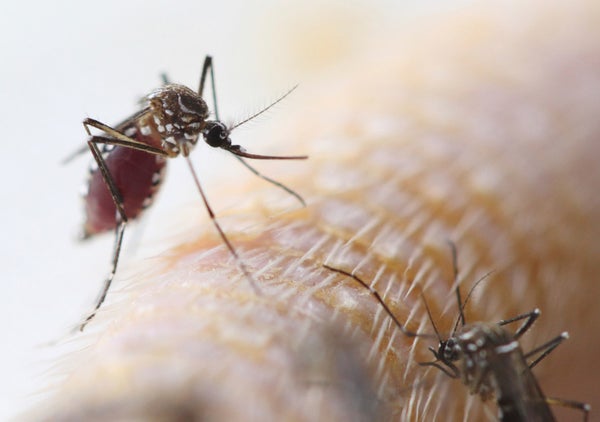
U.S. health regulators said a genetically engineered mosquito being used in the fight against Zika will not have a significant impact on the environment, possibly paving the way for the technique to be used in the country.
The self-limiting strain of the Aedes aegypti mosquito was developed by Oxitec, the U.K.-subsidiary of U.S. synthetic biology company Intrexon Corp. The male mosquitoes are modified so their offspring will die before reaching adulthood and being able to reproduce.
Preliminary findings of an investigational trial by the U.S. Food and Drug Administration conducted in the Florida Keys region ruled that the genetically modified mosquitoes will not have a significant impact on the environment, effectively agreeing with an environmental assessment submitted by Oxitec.
On supporting science journalism
If you're enjoying this article, consider supporting our award-winning journalism by subscribing. By purchasing a subscription you are helping to ensure the future of impactful stories about the discoveries and ideas shaping our world today.
The findings come on the heels of rising concern over Zika virus in the United States, with Florida declaring a public health emergency last month.
Zika virus, first detected in Africa in the 1940s, was unknown in the Americas until last year when it appeared in northeastern Brazil, where it has been linked to a spike in birth defects in thousands of babies.
Florida's warm climate and nearly year-round mosquito season make it particularly vulnerable to spreading, although so far all of the state's cases were acquired abroad, officials have said.
"If we do get permission from the FDA to go ahead, we are hoping that we will start running the program sometime in 2016," Oxitec Chief Executive Hadyn Parry said on a media call on Friday.
Oxitec, which was spun off from Oxford University, was acquired last year by Intrexon.
Efficacy trials in Brazil, Panama, and the Cayman Islands showed that this approach has helped reduce the Aedes aegypti population by more than 90 percent, Oxitec said.
Parry added that until now mosquito control techniques in the United States have only been able to reduce population by about 50 percent.
However, the concept of wiping out an entire mosquito species also raises ecological questions, as it runs counter to preserving biodiversity.
A petition on Change.org by Mila de Mier, a Key West resident, has gathered more than 161,000 supporters, and calls for the FDA to not approve the genetically modified mosquitoes .
The public can submit comments on the conclusion for the next 30 days, starting Monday. (1.usa.gov/229sDd2)
Intrexon's shares closed up 8.5 percent at $37.97 on the New York Stock Exchange on Friday.
(Reporting by Yashaswini Swamynathan and Natalie Grover in Bengaluru; Editing by Saumyadeb Chakrabarty and Sriraj Kalluvila)