
Despite its rows and rows of chisel- and needle-like teeth, a newly described prehistoric marine reptile wasn't a fearsome predator but rather an herbivorous giant that acted like a lawnmower for the sea, a new study finds.
The crocodile-size reptile lived about 242 million years ago, during the Middle Triassic period. Researchers discovered the first specimen in 2014 in southern China, but because it was poorly preserved, they reported that it had a beak like a flamingo's.
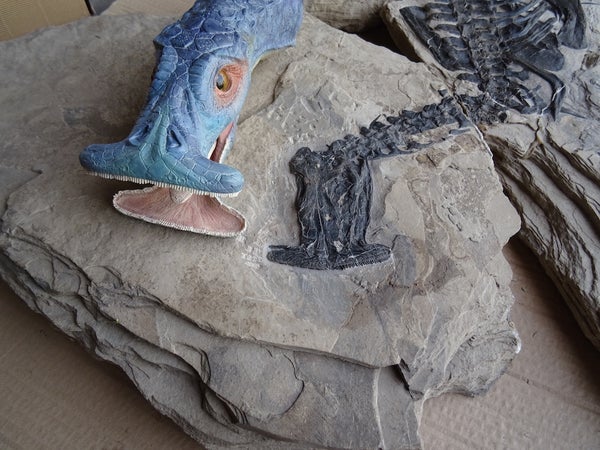
Now, two newly discovered specimens show that the beast was far more bizarre: It sported a hammerhead-shaped snout that it likely used to graze on plants lining the ocean floor, the researchers said. It's also the earliest herbivorous marine reptile on record by about 8 million years, they said. [The 12 Weirdest Animal Discoveries]
On supporting science journalism
If you're enjoying this article, consider supporting our award-winning journalism by subscribing. By purchasing a subscription you are helping to ensure the future of impactful stories about the discoveries and ideas shaping our world today.

To determine the way that Atopodenatus unicus’s jaw worked, the scientists made models out of children's clay and toothpicks.
Credit: © Olivier Rieppel, The Field Museum
"I haven't seen anything like it before," said study co-researcher Olivier Rieppel, the Rowe family curator of evolutionary biology at The Field Museum of Natural History in Chicago.
Weird reptile
The reptile's name—Atopodentatus unicus—hints at its weird anatomy. In Latin, the genus and species names translate to "unique strangely toothed," the researchers said. The newly analyzed specimens show that the creature had a mouthful of chisel-shaped teeth — one row on the upper jaw and two rows on the lower jaw.
"The remaining parts of the jaw [are filled with] densely packed needle-shaped teeth forming a mesh," the researchers wrote in the study, published online today (May 6) in the journal Science Advances. This mesh likely helped A. unicus collect plant material, much like a baleen whale catches krill, said Louis Jacobs, a vertebrate paleontologist at Southern Methodist University in Texas who was not involved in the study.
The chisel-like teeth probably acted as a rake and trimmer, helping A. unicus scrape and dislodge plants from the seafloor, Jacobs said. Next, the reptile likely sucked in a mouthful of water, letting bits of plants get stuck in the mesh formed by its thin, needle-like teeth, he said.
"Then, they squish the water out of their mouth, and those little teeth along the sides of the jaw and on the roof of the mouth strain out all of the plant bits," Jacobs told Live Science. "That's an amazing way to feed. I'd like to do that myself."
Rare beast
The two new specimens are teaching scientists about herbivorous marine reptiles, which are rare even today. One of the few modern herbivorous marine reptiles includes the marine iguana of the Galapagos, which swims around, plucking algae off of marine rocks for food, Jacobs said.
There are also a few herbivorous marine mammals, such as manatees and dugongs, and the extinct marine mammals known as the Desmostylians (which Jacobs helped describe in a 2015 study published in the journal Historical Biology.) But, in general, marine reptiles are omnivores or carnivores, such as most modern sea turtles and the extinct marine predators, the ichthyosaurs and plesiosaurs.
"[A. unicus] is so surprising because it is very rare, that anything besides fish living in water would be herbivorous," Jacobs told Live Science. [Image Gallery: Ancient Monsters of the Sea]
A. unicus also tells researchers about how life recovered after the Permian-Triassic mass extinction about 252 million years ago.
"The existence of specialized animals like Atopodentatus unicus shows us that life recovered and diversified more quickly than previously thought," Rieppel said in a statement. "And it's definitely a reptile that no one would have thought to exist. Look at it—it's crazy!"
Copyright 2016 LiveScience, a Purch company. All rights reserved. This material may not be published, broadcast, rewritten or redistributed.
