
CRISPR, the genome-editing technology that has taken biomedical science by storm, is finally nearing human trials.
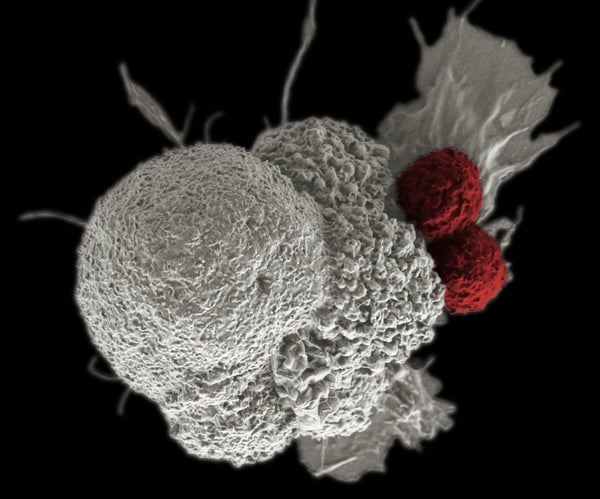
On June 21, an advisory committee at the US National Institutes of Health (NIH) approved a proposal to use CRISPR–Cas9 to help augment cancer therapies that rely on enlisting a patient’s T cells, a type of immune cell.
“Cell therapies [for cancer] are so promising but the majority of people who get these therapies have a disease that relapses,” says study leader Edward Stadtmauer, a physician at the University of Pennsylvania in Philadelphia. Gene editing could improve such treatments and eliminate some of their vulnerabilities to cancer and the body’s immune system, he says.
On supporting science journalism
If you're enjoying this article, consider supporting our award-winning journalism by subscribing. By purchasing a subscription you are helping to ensure the future of impactful stories about the discoveries and ideas shaping our world today.
This first trial is small and designed to test whether CRISPR is safe for use in people, rather than whether it cures cancer or not. It will be funded by a US$250-million immunotherapy foundation formed in April by former Facebook president Sean Parker. The trial itself does not yet have a budget. The University of Pennsylvania will manufacture the edited cells, and will recruit and treat patients alongside centres in California and Texas.
The researchers will remove T cells from 18 patients with melanoma, sarcoma or myeloma, and perform three CRISPR edits on them. One edit will insert a gene for a protein engineered to detect cancer cells and instruct the T cells to target them, and a second edit removes a natural T-cell protein that could interfere with this process. The third is defensive: it will remove the gene for a protein that identifies the T cells as immune cells and prevent the cancer cells from disabling them. The researchers will then infuse the edited cells back into the patient.
On the move
“Last year’s excitement over CRISPR was in anticipation of this,” says Dean Anthony Lee, an immunologist at MD Anderson Cancer Center in Houston, Texas, and a member of the NIH’s Recombinant DNA Research Advisory Committee (RAC), which reviewed the proposal. CRISPR, he says, makes genome engineering easy enough that such trials can move forward quickly.
The RAC reviews all proposals for human trials involving modified DNA that are conducted in the United States. Stadtmauer’s team will now have to convince US regulators and review boards at their own institutions to allow the trial. Immunologist Carl June at the University of Pennsylvania, who is a science adviser on the project, says that it could begin by the end of the year.
Other trials may not be far behind. Editas Biotechnologies in Cambridge, Massachusetts, for instance, has said that it wants to use CRISPR in a clinical trial for a rare form of blindness as soon as 2017. However, RAC members say that they have not yet been approached about reviewing the trial.
Other techniques
CRISPR has courted most attention because of its ease of use, however the T-cell trial will not be the first test of the efficacy of using gene editing to fight diseases. In 2014, June led a trial using a different gene-editing system called zinc-finger nuclease.
His group took blood from 12 people with HIV and removed the gene that encodes a protein on T cells that is targeted by the virus. They hoped that this would prevent infection of the cells. The results were encouraging, and the technique is now being used in clinical trials for several other applications.
And last week, researchers at Great Ormond Street Hospital for Children in London began a safety study with 10 children using a similar technique called TALENS. Instead of using a patient’s own cells, the system uses T cells from a donor that have been edited to remove genes that would cause the patient’s body to reject them. The gene editing then directs the T cells to attack the cancer and protects the cells from other immunotherapy drugs.
Although CRISPR is easier to use than the other techniques, and better at editing multiple genes at once, June says that the main challenge will be overcoming CRISPR's propensity for ‘off-target’ edits. These are instances in which the system cuts or mutates unintended parts of the genome. And despite precautions, the immune system could still attack the edited cells.
Once bitten, twice shy
During the RAC meeting, one of the committee’s greatest concerns was a potential conflict of interest. Among other financial involvements, June has ties to the pharmaceutical company Novartis, holds patents on T-cell technologies, and could stand to benefit from the success of this trial. June declined to give details on the exact nature of his conflicts of interest, but says that his university is taking steps to manage it, such as preventing him from being involved in selecting patients.
Several RAC reviewers suggested that the University of Pennsylvania not be allowed to recruit patients at all and to leave it to other institutions: this language did not make it into their final approval.
However, the RAC members say they are being extra careful with this study. “Penn has a very extensive conflict and has a history,” says Laurie Zoloth, a bioethicist at Northwestern University in Evanston, Illinois. Looming over the discussion is the name Jesse Gelsinger, who died at age 18 while participating in an early gene-therapy trial conducted by researchers at the University of Pennsylvania in 1999.
A subsequent investigation found numerous problems with the study, including unreported animal data on the therapy’s ill effects and the fact that the investigators had a financial stake in the study’s outcome.
The incident is generally considered to have set gene therapy back by decades. “Any first use in humans we have to be extraordinarily careful,” Zoloth says. So a lot is riding on this trial.
But Mildred Cho, a bioethicist at Stanford University in California and an RAC member, says that safety work in animals for a new therapy will take researchers only so far. “Often we have to take the leap of faith.”
This article is reproduced with permission and was first published on June 22, 2016.