
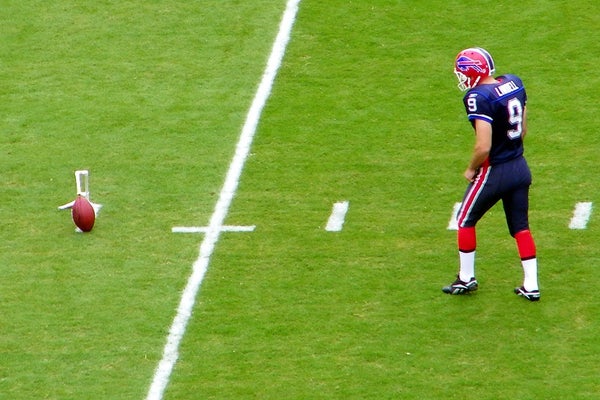
In this episode of NBC Learn's "The Science of NFL Football," you see how Newton's second law of motion is in effect when a placekicker boots the ball. The more force he can apply to the ball, the farther it will go.
You may have noticed in the video that kicker Morten Andersen approached the ball from the side, as all National Football League kickers do today. But that was not always the case. When the league began in 1920, and up through the early 1960s, every placekicker attempting a field goal or extra point would approach the ball straight on and kick it with his toes.
The tide began to turn when Pete Gogolak, who grew up playing soccer in Hungary, appeared on the gridiron at Cornell University. He set up by taking two steps back behind the ball holder, then three steps to the side. The center snapped the ball, the holder propped it on the turf, and Gogolak swung his leg through it from the side, launching it between the uprights.
On supporting science journalism
If you're enjoying this article, consider supporting our award-winning journalism by subscribing. By purchasing a subscription you are helping to ensure the future of impactful stories about the discoveries and ideas shaping our world today.
The pro football world initially thought Gogolak, who was drafted in 1964 by the Buffalo Bills and then played for the New York Giants, was a bit of a circus act. But by the mid-1970s more placekickers were using soccer style than a toe kick. By the late 1980s, toe-ballers were extinct, because soccer kickers were generally making more of their attempts. The field-goal completion rate across the league in the early 1960s was typically less than 60 percent; today it is around 80 percent. And most of the longest field goals ever made have been kicked soccer style.
Why the greater accuracy and distance? In addition to some field changes, two simple physics concepts: surface area and angular momentum, respectively.
When a toe-baller kicks, only the cross-section of the front tip of his shoe contacts the ball. In soccer style , the whole instep of the shoe (the arched portion, along the inside of the laces) makes contact. The greater surface area of contact gives the kicker more control over the ball's flight path. Put another way, a toe-baller has to strike the ball almost perfectly head-on to put it on a successful path, because the contact point is so small. In a soccer kick, the greater contact area provides more margin for error.
Soccer style also imparts more force from the human to the pigskin, sending it farther. For a toe-baller, all the force is generated by the kicking leg, which swings in line under the hip like a pendulum. With soccer style, approaching the ball from the side allows the kicker's hip to rotate, which creates more foot velocity. "The angled approach allows for greater use of hip momentum, which creates more rotational momentum—more angular momentum—in the foot," says William Barfield, a specialist in biomechanics and orthopedic science at the College of Charleston and the Medical University of South Carolina. More angular momentum creates greater foot speed, which delivers more force to the ball.
Rotational momentum helps other athletes as well. Imagine standing at home plate with your body rigid, trying to swing a bat at a baseball with just your arms. Now imagine being able to twist your body as your arms swing; that's much more natural, and you can hit the ball harder.
The same is true for golf. Imagine trying to hit a golf ball off a tee when your body is stiff, so you can only use your arms. Now imagine being able to rotate your torso as you swing. Again, more natural and more effective.
Professional baseball players agree that rotation increases bat speed, and pro golfers agree that rotation creates more club speed, resulting in harder baseball hits and longer tee shots. Similarly
, in football hip rotation increases the angular momentum—foot speed—which imparts more force into the ball. —Mark Fischetti
Postgame: Fun Facts about Pro Kicking
Smaller kickers. Back in the days of toe-ballers, kickers tended to be bigger. Because a straight-on kick could only generate a limited amount of foot speed, the key to hitting longer field goals was to have bigger leg muscles. Placekickers today are generally smaller because they can rely on the soccer-style hip rotation to create foot speed.
Higher salaries. In 1964 the Buffalo Bills, a team in the young American Football League, signed Pete Gogolak, the first pro soccer-style kicker. He proved so valuable that in 1966 the New York Giants, a team in the longstanding National Football League, "poached" him from the Bills, by offering more money. At the time, team owners generally did not sign players from the "other" league, an arrangement that reportedly lessened competition for players and helped prevent salaries from escalating. Poaching increased noticeably after the Gogolak deal and salaries rose, which allegedly helped convince AFL and NFL owners to merge into one league before competition for players became too expensive.