
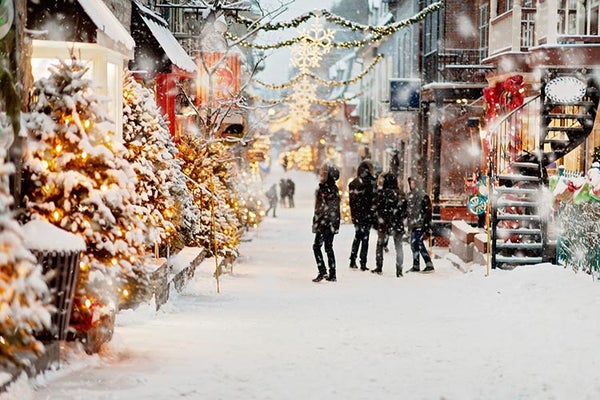
The weather outside is frightful, because it is not beginning to look a lot like Christmas. In fact, only a smattering of Americans has a shot at waking up to a fresh dusting on Friday. Temperatures leading up to and forecast for December 25 run about 10 to 30 degrees Fahrenheit above normal in the U.S. Northeast, Southeast and parts of the Midwest. In fact, this Christmas Eve is expected to register as the warmest on record in many cities along the Eastern Seaboard. That balmy air eliminates the possibility for new snow in those regions. And out West, snowfall so far is absent to low unless you're in the mountains. Blame global warming? Blame El Niño? Actually, the primary factor is likely a climatic phenomenon centered over the North Atlantic Ocean that is keeping cold Arctic air in check.
Let's say that a landscape recently graced with snow will do, even if it fell earlier in December. Still, little snow lays on U.S. ground at lower elevations beyond Alaska and some patches in the Dakotas and Minnesota. Buffalo, notorious for its early season snowstorms and accumulation, just received its first snow of the year this week. And only parts of Alaska, Montana, Idaho, Utah, Nevada, Wyoming and Colorado show even a bit of snow in the forecast for either Christmas Eve or the afternoon of December 25. Precipitation has been down over much of the West this month until recently, and the ratio of rain to snow has been higher than usual. Ample snow and other water crystals have graced theSierras, but subsequent rain has melted some of the white stuff to disappointing depths. And Weather Underground meteorologist and blogger Bob Henson calls the snowpack in New England so far "pathetic."
Behind this snow and rain drought is a climate phenomenon called the North Atlantic Oscillation, currently stuck in a "positive" condition over the Atlantic Ocean, eastern U.S. and Europe. It indicates a high differential in average northern and southern Atlantic Ocean air pressures. This strong phenomenon compacts the real estate of the polar vortex—that air mass that brought relatively frigid temperatures to the Eastern Seaboard in recent winters. Absent polar air spilling into the lower 48 states, an unimpeded spring-like, jet stream carries in tropical air from the opposite direction, Henson says. That air mass could even bring miserable thunderstorms to the Northeast on Christmas Eve.
On supporting science journalism
If you're enjoying this article, consider supporting our award-winning journalism by subscribing. By purchasing a subscription you are helping to ensure the future of impactful stories about the discoveries and ideas shaping our world today.
The North Atlantic Oscillation condition and the resulting strong jet stream also might for now be holding back the storms that the current "super" El Niño typically would provoke in drought-stricken central and southern California and the southern U.S. The El Niño climate phenomenon, which repeats in a maddening irregularity of every two to seven years, tends to bring milder, drier weather to the northern U.S. and stormier, cooler weather to the southern and southwestern U.S. Contrary to some reports, however, the current warm weather in the Midwest and eastern U.S. is mainly unrelated to the El Niño, except in the most northern part of the country, says Tony Barnston, chief forecaster at the International Research Institute for Climate and Society at Columbia University.
Rather, our absurd weather derives from "a mainly unpredictable pattern of low pressure over Greenland and Iceland, and high pressure spanning from the midwestern U.S., through the eastern U.S., across the Atlantic and to western Europe," Barnston says. That pattern causes above-normal temperatures in those regions, allowing the jet stream to push farther north than usual. In the western U.S., he adds, the jet stream has held near average or dipped a little farther south than usual, causing temperatures slightly below average.
El Niño typically results in below normal winter temperatures along the southern tier states, and above average temperatures in the northernmost tier, such as northern New England, the northern Midwest and northern Rockies and Pacific Northwest. It is not unusual for this pattern to take shape no sooner than the very end of December, lasting into March. Often, the pattern also includes above-average precipitation in the southern tier and below-normal precipitation in some pockets in the north, roughly corresponding to warmer than average temperatures. "So far this year, the pattern has yielded above-average temperatures in a much larger area of the eastern U.S. than can be attributed to El Niño alone," Barnston says, "and that’s where the North Atlantic Oscillation comes in."
Global warming serves as a backdrop—scientists expect that 2015 will mark the warmest year on record globally. Arctic ice is melting faster than elsewhere on Earth, throwing off various climate phenomena, but its role in the strange December weather will remain unknown until models are run in early 2016.
One of the most bizarre features of December's weather is unseasonably mild temperature persisting throughout the month, Henson says. "Usually the last 10 days of December are colder than the first 20 days of the month," he says, "but in this case we are even warming up in the final days, which is counter to what nearly always happens." Forecasters expect many U.S. cities, including New York, Philadelphia, Boston, Washington, D.C., and Miami, to break records for the warmest Decembers.
Even more notable than the mild Midwest and East Coast weather this week is the high moisture-content in the air, as indicated by dew point temperatures rising up to 60 degrees F, Henson says. "In Maine, the dew point temperature is hardly ever above 60 degrees in December," he says. "Only a couple of spots have managed that so far this month, but dew point temperature may top 60 degrees in a couple of points in the next couple of days. If the temperature drops to dew point, then you have 100 percent humidity. It's going to feel perceptibly humid even in Boston and NY, and definitely in Washington, D.C."
White Christmas addicts might think they could fly their learjet up to Nova Scotia, but even the forecast for the Canadian province calls for rain and temperatures in the fifties. Pack a slicker. Temperatures in Montreal and Ottawa could break Christmas Eve records, so don't count on fresh snowfall in those cities either.
One still can bank on many locations in Alaska for snow on the ground, but even there, at several sites monitored by atmospheric scientist Gilberto Fochesatto of the University of Alaska, Fairbanks, accumulation measures at one-third of normal. For fresh powder on extant snow, speculators might wish to spend their Christmas anchored down in Anchorage, Alaska. There's gorgeous snow in the nearby Chugach Mountains, a little worn-out snow on the ground, and the forecast calls for a handful of fresh snow in the afternoon. Merry, merry, everyone.