
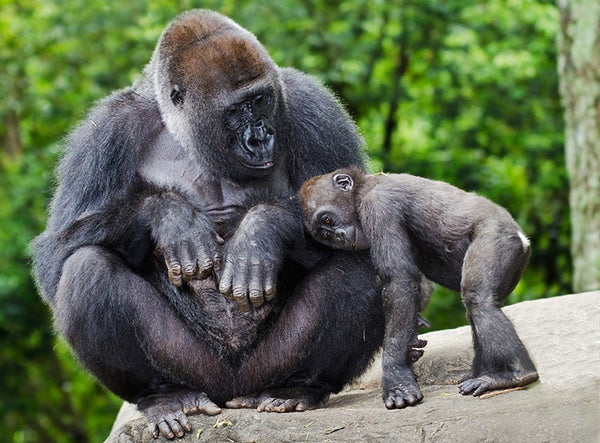
Fossils of what may be primitive relatives of gorillas suggest that the human and gorilla lineages split up to 10 million years ago, millions of years later than what has been recently suggested, researchers say. The finding could help resolve a controversy over the continent where the ape and human lineages first evolved, the scientists added.
Although the fossil record of human evolution is still patchy, it is better understood than that of great apes such as chimpanzees and gorillas. Since few great ape fossils have been found in Africa so far, "some scientists have forcefully suggested that the ancestors of African apes and humans must have emerged in Eurasia," said study senior author Gen Suwa, a paleoanthropologist at the University of Tokyo.
To shed light on the evolution of the ape and human lineages, Suwa and his colleagues investigated the Afar rift of Ethiopia. Previous research at the Afar rift unearthed fossils of some of the earliest known hominins — that is, humans and related species dating back to the split from the ape lineages. [Top 10 Mysteries of the First Humans]
On supporting science journalism
If you're enjoying this article, consider supporting our award-winning journalism by subscribing. By purchasing a subscription you are helping to ensure the future of impactful stories about the discoveries and ideas shaping our world today.
The research team focused on the Chorora Formation, the oldest known sediments from the Afar rift. (The formation gets its name from Chorora, a village in the area.)
In 2007, Suwa and his colleagues discovered nine gorilla-size teeth from the Chorora Formation that belonged to an extinct ape they named Chororapithecus abyssinicus. "Chororapithecus" means "ape from Chorora," while "abyssinicus" refers to Abyssinia, the former name of Ethiopia.
The teeth of Chororapithecus appeared specialized for eating stems and leaves, and resembled those of modern gorillas, which suggests that, "Chororapithecus probably represents an ancestral branch of the gorilla lineage," Suwa told Live Science. As such, heand his colleagues wanted to pin down how old Chororapithecus was, in order to better pinpoint when the human and gorilla lineages may have first diverged.
By analyzing volcanic rocks and once-magnetized particles of sediment above and below fossils from the Chorora Formation, the researchers have new evidence that Chororapithecus was probably about 8 million years old.
The age and location of these fossils strengthen the view that the human and the modern ape lines originated in Africa and not Asia, the researchers said.
"Until now, no mammalian fossils south of the Sahara have been securely dated to 8 million to 9 million years ago," Suwa said. "Any and all fossils from this crucial time period of Africa would help unravel the story of human origins and emergence. These are the first such fossils."
In addition, until recently, "most scientists, especially geneticists, thought that the human-chimp split was as recent as 5 million years ago, and that the human-gorilla split was only about 7 million to 8 million years ago," Suwa said. "This contradicted the fossil record. For example, fossils thought to be on the human side of the split such as Ardipithecus kadabba from Ethiopia and Sahelanthropus from Chad were 6 million years old — or, in the case of the Chad fossil, perhaps 7 million years old."
The new findings suggest that Chororapithecus is 8 million years old, so "the actual gorilla-human split must then have been up to several million years before that," Suwa said. Therefore, the study shows that the human-gorilla split could have happened "at around 10 million years ago and the human-chimp split at around 8 million years ago," he said.
The scientists detailed their findings in the Feb. 11 issue of the journal Nature.
Original article on Live Science.
Copyright 2016 LiveScience, a Purch company. All rights reserved. This material may not be published, broadcast, rewritten or redistributed.