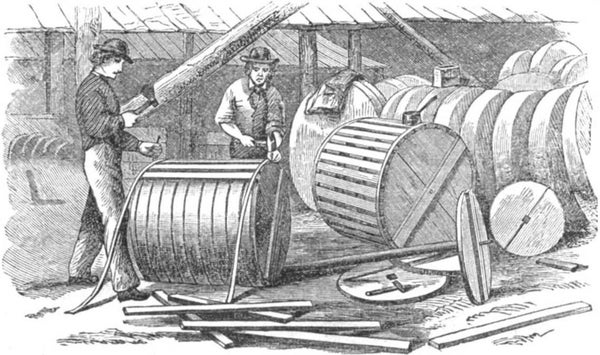
Grindstones for Manufacturing: A very old and useful tool, with a modern distrubution method. Grindstones made in quantity in Ohio are crated for shipping on the Cleveland, Columbus and Cincinnati Railroad.
Image: Scientific American, April 7, 1866
Join Our Community of Science Lovers!
On supporting science journalism
If you're enjoying this article, consider supporting our award-winning journalism by subscribing. By purchasing a subscription you are helping to ensure the future of impactful stories about the discoveries and ideas shaping our world today.
The patent system in the 19th century was a driver of economic expansion (or so it is said). That was problably true for a tiny minority of devices and processes that worked well and saved money. Some devices, such as the grindstone, were old tools, but improved manufacturing and distribution systems enabled them to have a greater impact in the industries of the day. Most of the 15,269 patents granted in 1866, however, were more optimistic than useful. The gizmos they covered may have demonstrated a desire to improve some aspect of the human condition but these inventions seem to lack some aspect of true usefulness or efficiency, or they were simply a more expensive method for getting the same result that could be achieved with existing and cheaper tools.
Take courage, or take heed, from the history of invention from 1845 to today in the Archive of Scientific American at ScientificAmerican.com/magazine/sa
It’s Time to Stand Up for Science
If you enjoyed this article, I’d like to ask for your support. Scientific American has served as an advocate for science and industry for 180 years, and right now may be the most critical moment in that two-century history.
I’ve been a Scientific American subscriber since I was 12 years old, and it helped shape the way I look at the world. SciAm always educates and delights me, and inspires a sense of awe for our vast, beautiful universe. I hope it does that for you, too.
If you subscribe to Scientific American, you help ensure that our coverage is centered on meaningful research and discovery; that we have the resources to report on the decisions that threaten labs across the U.S.; and that we support both budding and working scientists at a time when the value of science itself too often goes unrecognized.