
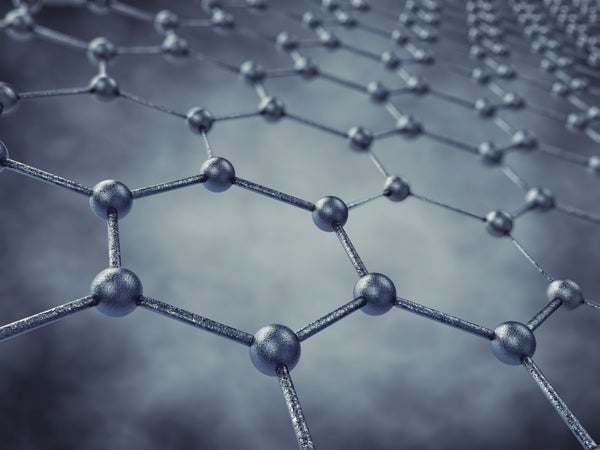
Graphene currently sits atop engineering's list of wonder materials. The single layer of carbon atoms exhibits incredible physical strength and flexibility, as well as unique electrical properties. These characteristics have enabled researchers to use it in everything from phone chargers to water filters. But along one dimension, it disappoints: graphene is not a natural semiconductor. Although engineers are forging ahead to find ways to manipulate it so that it works in transistors—devices that modify electric currents to power gadgets—they are also now turning to a promising alternative with a similar structure: a single layer of black phosphorus atoms, called phosphorene.
Under high pressure, phosphorus becomes black phosphorus, a material with superconductive properties discovered about a century ago. Recently, in 2014, a team of researchers at Purdue University isolated just one layer of black phosphorus atoms. Since then, others in the field have started investigating phosphorene. More than 400 papers with the two-dimensional material's name have been published this year alone.
The excitement has mounted over phosphorene's potential to replace less efficient materials in electronics, says Thomas Szkopek, who specializes in 2-D materials at McGill University. Black phosphorus is a “bona fide semiconductor,” he says, meaning its conductivity can be switched on and off. Because of this property, engineers can modify how much energy flows through phosphorene across many orders of magnitude. Such control minimizes the amount of current that leaks out, which could bring transistors a step closer to perfect efficiency. Conventional transistors, typically made of silicon, are less efficient than the thermodynamic limit by about a magnitude of a million.
On supporting science journalism
If you're enjoying this article, consider supporting our award-winning journalism by subscribing. By purchasing a subscription you are helping to ensure the future of impactful stories about the discoveries and ideas shaping our world today.
Although materials scientists have high hopes for phosphorene, it does have other qualities that compromise its future use in transistors [see table above]. If researchers cannot work around them, the material may have other uses. Because it is less brittle than silicon, it could appear in flexible electronics. And because phosphorus emits light, phosphorene is also a candidate for lasers or LEDs. Or its best application could be in a device no one has invented yet. “There is an explosion of interest around the globe in new 2-D materials like phosphorene that give us access to unique blends of properties,” Szkopek says. Similar structures await their turn in the spotlight—germanene, silicene and stanene all stand on deck.
