
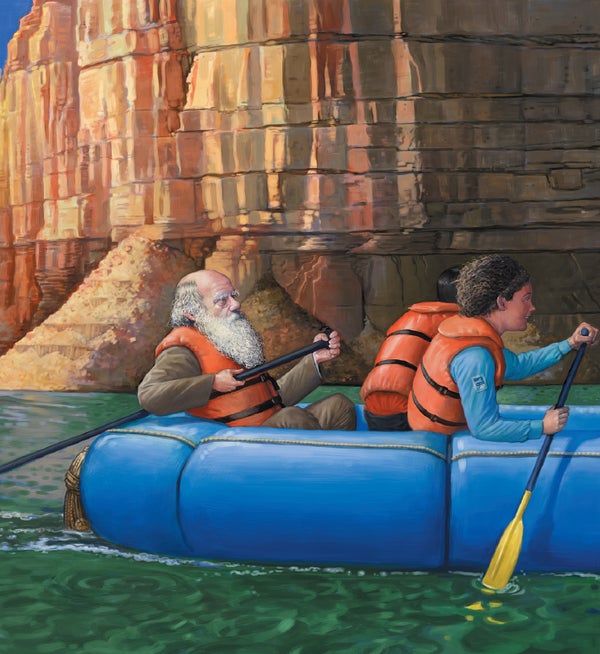
I'm afraid of a lot of things, but two things really terrify me: heights and turbulent water. So naturally I signed up for a whitewater rafting trip in early July down the Colorado River in the Grand Canyon—including hikes in side canyons featuring some don't-look-down moments. I screwed up (keep reading) my courage because this trip was the annual canyon excursion organized by the National Center for Science Education.
Since 1981 the Oakland, Calif.–based NCSE has defended evolution education in public schools against constant threats from those who seek to remove it from biology curricula or to “balance” it with the addition of oxymoronic “scientific creationism” or its mutated progeny such as “intelligent design.”
“So what does rafting down the Grand Canyon have to do with science education?” asked NCSE executive director Ann Reid, as we sat on driftwood at the Fern Glen campsite along the river on the penultimate day of our weeklong journey.
On supporting science journalism
If you're enjoying this article, consider supporting our award-winning journalism by subscribing. By purchasing a subscription you are helping to ensure the future of impactful stories about the discoveries and ideas shaping our world today.
“Well, for NCSE it's one of the most powerful places on the earth to show the differences between religious thinking and scientific thinking,” Reid observed. “The very small minority of Christians who believe the earth is 6,000 years old,” she adds, see the Grand Canyon as “the best evidence they have of Noah's flood.”
Creationists run multiple raft trips down the Colorado every year, during which patrons hear their take, including the notion that the inundation occurred some 4,400 years ago—and rapidly deposited the sediments of the canyon's walls.
“Of course, scientists of many different subdisciplines have figured out that the canyon is much older than that,” Reid said of the perhaps still surprisingly geologically recent date of just five million to six million years ago. “There are the rocks, there's the biology, there's the hydrology—it's just a fantastic place to learn how scientists explain the world around us.”
I'll talk more about some of the geologic history easily observable, even up close and at eye level, in the next issue. But now I want to tell you about living for a week in the Grand Canyon.
Our group of 25 traveled on what some disparagingly call “baloney boats,” rafts some 35 feet long hugged on either side by huge inflated pontoons. Those would be the baloneys. If the crew of the Pequod had been on baloney boats, Ishmael might have wound up recounting a fairly mundane incident.
We nonetheless were told to hit the deck and hold tight to lashings when entering the most violent rapids. Because while the boat will float, a loose passenger could easily be thrown into the maelstrom, which is quite the bother and could result in all kinds of paperwork.
Late each afternoon we'd pull over and make camp. The key issue faced by the professional guides at that point was where to set up the two sanitation facilities. Urine goes directly into the fast-moving river, but solid waste gets collected all week and transported out. The metal collection devices are called groovers, allegedly because people out in the field would use empty steel ammo boxes for this purpose. Only they didn't have the luxury that we enjoyed: a seat. So the tops of the boxes' thin sides would leave a pair of temporary posterior indentations, aka butt grooves.
We performed our ablutions and laundry care in the river, which prompted one late-night visitation by the imaginary spirit of my great-grandmother, who berated me: “You bathe in river, wash clothes in river? We leave old country so you NOT have to go to river for bathing, clothes cleaning.” When she found out that I actually paid to go on the trip, she became even more imaginarily livid: “Idiot.” I'm just glad she didn't see my underwear hanging in a tree to dry overnight.
I came prepared for the searing heat, the burning sun, the frigid water. But what I couldn't have known was that my touch-screen Kindle would be useless at night. Because my headlamp (indispensable if you need the groover in the dark) attracted flying insects, which landed on the screen. And turned the page, changed the type size and might have purchased the complete works of Jean-Henri Fabre if we had any Internet connectivity. Fortunately, the remaining option was to turn the light off and look up from the river into a sea of stars.