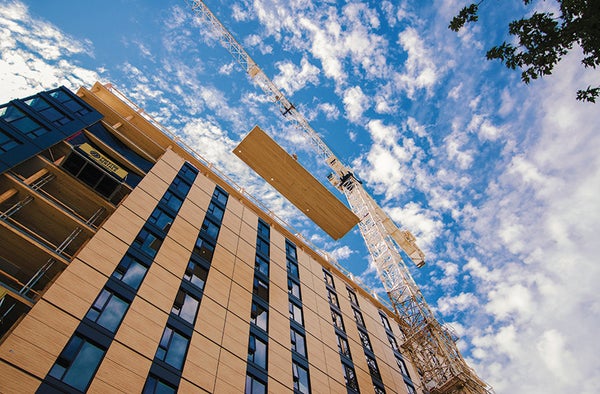
High Rises Made of Wood?

Tall timber buildings could produce fewer emissions and sequester carbon dioxide

Brock Commons, Vancouver

Courtesy of Acton Ostry Architects, Inc.

Join Our Community of Science Lovers!

A wood skyscraper might sound like a bad idea—and potentially a giant tinderbox. But architects around the world are steadily building more timber high-rises, partly with the aim of curbing carbon pollution.

Lofty wood buildings are popping up in major cities from London to Melbourne. Many more are in the works—soon Portland, Ore., will be getting its own—and they continue to break height records for modern lumber construction. The world's tallest such building completed, a 53-meter Vancouver high-rise called Brock Commons, officially opens in September.


On supporting science journalism

If you're enjoying this article, consider supporting our award-winning journalism by subscribing. By purchasing a subscription you are helping to ensure the future of impactful stories about the discoveries and ideas shaping our world today.


Wood is strong, lightweight and resilient to earthquakes, says Russell Acton, a principal architect at Acton Ostry Architects, which designed Brock Commons. And the thick pieces of wood used in such buildings are in fact surprisingly fire-resistant—when burned, they form an outer layer of char that can protect the material underneath. Timber has environmental benefits as well: it is a sustainable resource—as long as forests are properly managed—and appears to emit less carbon dioxide over the course of its production (from living tree to finished building) than traditional materials such as steel and concrete. In addition, trees naturally sequester carbon and thus help to keep greenhouse gases out of the air.

Fittingly, wood is helping cities “go green.”

Annie Sneed is a science journalist who has written for the New York Times, Wired, Public Radio International and Fast Company.

More by Annie Sneed
Scientific American Magazine Vol 317 Issue 3This article was published with the title “Wood Is the New Steel” in Scientific American Magazine Vol. 317 No. 3 (), p. 19
doi:10.1038/scientificamerican0917-19

It’s Time to Stand Up for Science

If you enjoyed this article, I’d like to ask for your support. Scientific American has served as an advocate for science and industry for 180 years, and right now may be the most critical moment in that two-century history.

I’ve been a Scientific American subscriber since I was 12 years old, and it helped shape the way I look at the world. SciAm always educates and delights me, and inspires a sense of awe for our vast, beautiful universe. I hope it does that for you, too.

If you subscribe to Scientific American, you help ensure that our coverage is centered on meaningful research and discovery; that we have the resources to report on the decisions that threaten labs across the U.S.; and that we support both budding and working scientists at a time when the value of science itself too often goes unrecognized.

In return, you get essential news, captivating podcasts, brilliant infographics, can't-miss newsletters, must-watch videos, challenging games, and the science world's best writing and reporting. You can even gift someone a subscription.

There has never been a more important time for us to stand up and show why science matters. I hope you’ll support us in that mission.

Thank you,

David M. Ewalt, Editor in Chief, Scientific American

Subscribe