
Hints of a mysterious new particle at the world's largest particle accelerator just got a little stronger. The excess of photons produced by particle collisions at the Large Hadron Collider (LHC) has kept physicists abuzz since it was discovered three months ago: it is now slightly more statistically significant but still falls well short of the certainty needed to claim a discovery.
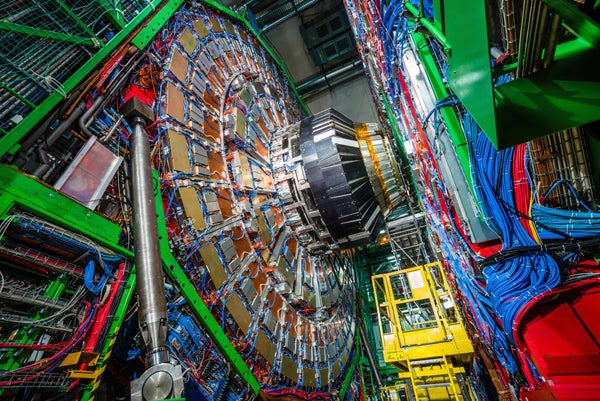
In December, physicists announced that they had seen an excess of pairs of γ-ray photons with a combined energy of around 750 gigaelectronvolts. The data came from ATLAS and CMS, the two largest detectors at the 27-kilometre LHC, which is at CERN, the European particle physics laboratory near Geneva, Switzerland.
That excess of photons seen by the CMS experiment has now become slightly more significant, owing to a fresh analysis reported on March 17 at a conference in La Thuile, Italy. But to the disappointment of many, the significance seen by ATLAS actually went down a bit, as a result of a more conservative interpretation of the data.
On supporting science journalism
If you're enjoying this article, consider supporting our award-winning journalism by subscribing. By purchasing a subscription you are helping to ensure the future of impactful stories about the discoveries and ideas shaping our world today.
The data used in the latest CMS analysis is 23% larger as it includes collisions from early in the LHC’s 2015 run, when the detector’s magnet was switched off due to a problem in its cooling system. The magnetic field affects detector electronics, so data taken without the field needed careful and separate calibration. “The good news is, we now we have almost as much data as ATLAS,” says James Olsen, CMS physics coordinator and a physicist at Princeton University in New Jersey.
Bumps in the road
In addition, the CMS team has re-calibrated the full data set—something the researchers do at the end of each run to account for the way that radiation affects their measurements.
With the additional data and the tweaked calibration, the statistical significance of the CMS bump has now gone up from 1.2 to 1.6 sigma, Pasquale Musella, a physicist at the Swiss Federal Institute of Technology (ETH) in Zurich, told the La Thuile conference.
Marco Delmastro, a physicist at the French National Centre for Scientific Research (CNRS) in nearby Annecy-le-Vieux, presented the ATLAS results, on the same day. “The fact that their excess has gone up is a hopeful sign,” says Delmastro of the CMS results. “But caution is necessary. Statistics is a harsh mistress,” says Delmastro, paraphrasing the title of a science-fiction novel by Robert Heinlein.
This falls well short of physicists’ threshold for a discovery—considered to be 5 sigma, or a chance of around three in 10 million that the signal is a statistical fluke. Moreover, although the calculation takes into account the 'look elsewhere' effect—which allows for the fact that scouring a wide range of data boosts the probability of finding deviations from the expected—it does not consider that photons are just one of many end products that LHC physicists test, warns Marumi Kado, the physics coordinator of ATLAS. Yet conducting many searches increases the odds that at least one such ‘channel’ will contain some statistical fluctuations.
Empty search
Further hints about the excess could emerge as soon as next week from more talks at the La Thuile meeting, in the results of searches for bumps that could appear as the particle decays into something other than two photons. So far, such searches, including one presented earlier this week at CERN, have found nothing, but physicists say that the 2015 data sets may be too small to show bumps in those other modes of decay.
If the excess is a genuine sign of a particle, it would most probably be a boson—a type typically associated with one of the fundamental forces—that no one had predicted. Physicists at the LHC and elsewhere say that such a discovery would be the most important in particle physics since at least 1975, when the unexpected tau lepton was discovered. By contrast the Higgs boson,discovered in 2012, was predicted by the standard model of particle physics. “It would be the first detected in a collider experiment beyond the standard model,“ Olsen says
“If it’s truly a new signal, it’s incredibly interesting,” says Kado, who is an experimental physicist at the Linear Accelerator Laboratory at the University of Paris-Sud. "It would open up so many possibilities, so many questions. Studying it would be wonderful,” he says.
But statistical bumps often go away after more data are collected, so Kado and others still urge caution. “Our job is to doubt—to always check for possible problems”, he says.
Theoretical frenzy
Meanwhile, theoretical physicists have been in a frenzy. “In the Theory Division, it’s all we talk about,” says CERN theorist Gian Francesco Giudice. “Theorists are more emotional,” he says. “Experimentalists are by nature more cautious, especially in their official statements.”
Since the December announcements, theoretical physicists have posted 285 papers to the arXiv online repository purporting to explain the excess, but no consensus has yet emerged on what such a particle could be. Especially interesting is that the particle would probably not be a "lone wolf”, Giudice says, but one of many related particles yet to be discovered. “It’s reasonable to think that it’s just an animal that strayed away from its pack, but that there is a pack somewhere to be found.”
Following a winter shutdown for maintenance, within the next few weeks the LHC's beams will be colliding particles again, with new high-energy particle collisions beginning in April. Physicists say that by June, or August at the latest, the two experiments should have enough data to either make a statistical fluctuation go away—if that’s what the excess is, or to confirm a new discovery.
This article is reproduced with permission and was first published on March 17, 2016.