
Rick Emmer is the lead keeper of The RainForest at Cleveland Metroparks Zoo and an avid observer of amphibians. He provides the following answer.
Frogs are amazing animals. Despite their fragile appearance and inoffensive ways, they have countless strategies to deal with the most severe climates this planet has to offer. They can be found at the Arctic Circle, in deserts, in tropical rain forests and practically everywhere in between. Some of their survival strategies are nothing short of ingenious. Various frog species use two strategies to deal with environmental extremes: hibernation and estivation.
Hibernation is a common response to the cold winter of temperate climates. After an animal finds or makes a living space (hibernaculum) that protects it from winter weather and predators, the animal's metabolism slows dramatically, so it can "sleep away" the winter by utilizing its body's energy stores. When spring weather arrives, the animal "wakes up" and leaves its hibernaculum to get on with the business of feeding and breeding.
On supporting science journalism
If you're enjoying this article, consider supporting our award-winning journalism by subscribing. By purchasing a subscription you are helping to ensure the future of impactful stories about the discoveries and ideas shaping our world today.
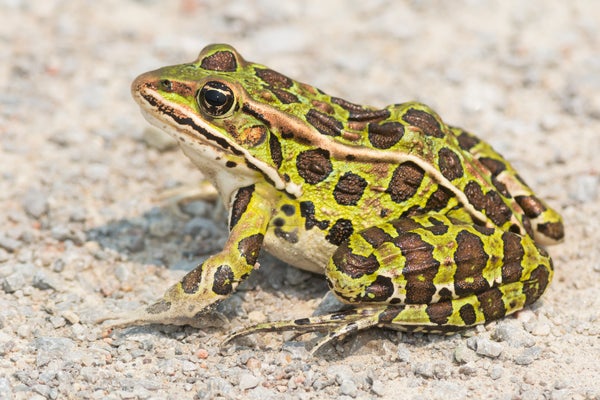
Aquatic frogs such as the leopard frog(Rana pipiens) and American bullfrog (Rana catesbeiana) typically hibernate underwater. A common misconception is that they spend the winter the way aquatic turtles do, dug into the mud at the bottom of a pond or stream. In fact, hibernating frogs would suffocate if they dug into the mud for an extended period of time. A hibernating turtle's metabolism slows down so drastically that it can get by on the mud's meager oxygen supply. Hibernating aquatic frogs, however, must be near oxygen-rich water and spend a good portion of the winter just lying on top of the mud or only partially buried. They may even slowly swim around from time to time.
Terrestrial frogs normally hibernate on land. American toads (Bufo americanus) and other frogs that are good diggers burrow deep into the soil, safely below the frost line. Some frogs, such as the wood frog (Rana sylvatica) and the spring peeper (Hyla crucifer), are not adept at digging and instead seek out deep cracks and crevices in logs or rocks, or just dig down as far as they can in the leaf litter. These hibernacula are not as well protected from frigid weather and may freeze, along with their inhabitants.
And yet the frogs do not die. Why? Antifreeze! True enough, ice crystals form in such places as the body cavity and bladder and under the skin, but a high concentration of glucose in the frog's vital organs prevents freezing. A partially frozen frog will stop breathing, and its heart will stop beating. It will appear quite dead. But when the hibernaculum warms up above freezing, the frog's frozen portions will thaw, and its heart and lungs resume activity--there really is such a thing as the living dead!
Estivation is similar to hibernation. It is a dormant state an animal assumes in response to adverse environmental conditions, in this case, the prolonged dry season of certain tropical regions. Several species of frog are known to estivate. Two of the better-known species are the ornate horned frog (Ceratophrys ornata) from South America and the African bullfrog (Pyxicephalus adspersus).
When the dry season starts, these frogs burrow into the soil and become dormant. During the extended dry season, which can last several months, these frogs perform a neat trick: they shed several intact layers of skin, forming a virtually waterproof cocoon that envelopes the entire body, leaving only the nostrils exposed, which allows them to breathe. These herpetological mummies remain in their cocoons for the duration of the dry season. When the rains return, the frogs free themselves of their shrouds and make their way up through the moist soil to the surface.