
Ian Hiler, Assistant Director of the Husbandry Department and Animal Exhibit Designer at the Aquarium of the Americas in New Orleans, has tackled this series of questions. Here is his reply.
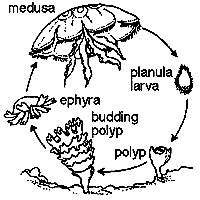
Image: South Carolina Department of Natural Resources
Jellyfish Life Cycle |
Jellyfish reproduction involves several different stages. In the adult, or medusa, stage of a jellyfish, they can reproduce sexually by releasing sperm and eggs into the water, forming a planula. In this larval stage of jellyfish life, the planula hooks on to the bottom of a smooth rock or other structure and grows into another stage of jellyfish life, the polyp--which resembles a miniature sea anemone. During this stage, which can last for several months or years, asexual reproduction occurs. The polyps clone themselves and bud, or strobilate, into another stage of jellyfish life, called ephyra. It is this form that grows into the adult medusa jellyfish.
On supporting science journalism
If you're enjoying this article, consider supporting our award-winning journalism by subscribing. By purchasing a subscription you are helping to ensure the future of impactful stories about the discoveries and ideas shaping our world today.
The jellyfish sting actually comes from tiny nematocysts, or stinging cells, on the jellyfish body. When triggered, these cells eject poison-tipped barbs that help the jellyfish catch food in the ocean. The nematocysts can still release their sting even after the jellyfish is dead. In most jellyfish, these stinging cells are so small that they can't penetrate human skin. Unfortunately, some are large enough to give a good sting if touched or stepped on by unsuspecting feet!
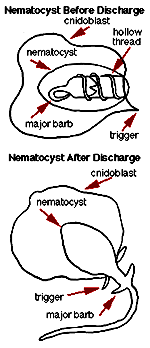
Image: South Carolina Department of Natural Resources
STINGING CELLS, or nematocysts, utilize a coiled fiber to inject a poisoned barb into prey
when triggered. |
The sting is usually no more harmful than an insect bite, but reaction to the toxin can vary greatly. Stings from the box jellyfish or Portuguese man-of-war can result in severe pain and, in some rare cases, even death. If you are stung, splash the area with water; don't rub; you could actually make it worse by triggering more stinging cells. Pouring something acidic on the wound will help take the sting out; vinegar, some soft drinks (like Pepsi or Coke), red wine or even urine will work. Swelling and lingering pain may reflect an allergic reaction and warrant a visit to a physician.
Jellyfish come in a variety of shapes, sizes and colors. Although most of us believe that all jellyfish are clear blobs in the water or washed up on the beach, that is far from true. Reds, browns, yellows, mauve and even several shades of blue are common in many of the large jellyfish. The sea nettle, for example, often has an orange or light brown coloring, Octopus jellyfish have an blue/gray tint, and the Lion's Mane jellyfish has a golden tint to it--just like its namesake! Many other jellyfish are clear, making it easy to see their four stomachs at work.
The water in which they live can give jellyfish coloring, as can their own unique type of farming. Some jellyfish (like the upside-down jellyfish, Cassiopeia xamachana) are vegetarians that grow their own food and carry it with them. These jellyfish raise algae inside their belly, giving them a food source that they take along as they float through the oceans. The algae can range in color, giving the jellyfish a variety of shades.
Others still are influenced in color by their diet. For instance, moon jellies, when feeding on a lot of larval crustaceans that are high in certain pigments, are usually pink to purple in color. And here at the Aquarium of the Americas, we often use brine shrimp as jellyfish food. After the jellyfish eat, the orange-colored brine shrimp can be clearly seen inside the jellyfishes' four stomachs.
