
How to Hunt for Gravitational Waves [Slide Show]
Various experiments seek different versions of this highly sought-after phenomenon
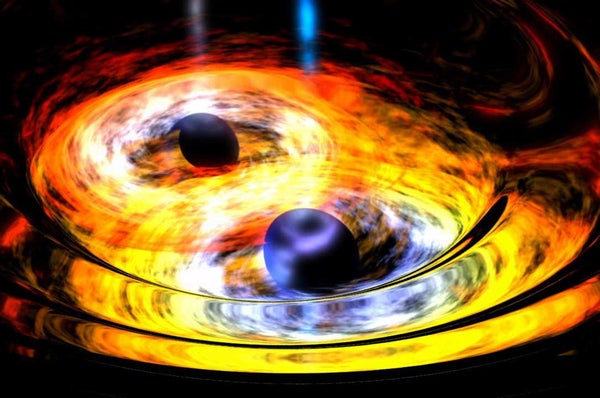
Researchers hunt for three main categories of gravitational waves. Massive bodies moving or merging, such as two black holes or two neutron stars orbiting each other until they collide, as well as the explosion of a supernova, cause ripples strong enough to be measurable on Earth. There are also much older waves thought to have originated in the young universe. Lower frequency, harder-to-detect signals from black holes at the centers of galaxies could be discerned in space. Another way of discovering these waves is via the incredibly precise bursts of radio emission from spinning stars called pulsars. Finally, some researchers have their sights set on the original burst of primordial gravitational waves. These waves would create a unique pattern in the cosmic microwave background of ancient light that pervades the universe.
NASA
Join Our Community of Science Lovers!
Subscribe to Support Independent Journalism
Great science journalism requires human expertise, time, effort and creativity. And it costs money. That’s why I and the journalists here at Scientific American hope you’ll join our community.
When you subscribe, you are supporting staff and freelance journalists who are passionate about telling science stories that are true, important and compelling. Our editors and reporters are often experts in their fields, which means they understand the nuances of big discoveries and can untangle the breakthroughs from the hype. With a subscription, you are also supporting rigorous fact-checking to ensure the words we publish are precise and accurate. And you’re supporting original illustrations, graphics and photos that bring you closer to an advanced laboratory, an ice sheet in Antarctica or a space mission in orbit. You’re helping us craft other types of high-quality journalism as well: Our newsletters are carefully written, edited and curated by staffers you have or will come to know and love. Our Science Quickly podcast is based on original reporting, collaboration with editors and scientists and exacting production.
Subscriptions keep this engine running so we can continue to deliver thoughtful, rigorous and independent science journalism to you. In an era of viral misinformation, this work is crucial. If you value what we do, I hope you’ll consider joining us as a subscriber